


 Cart
Cart
 sales@molnova.com


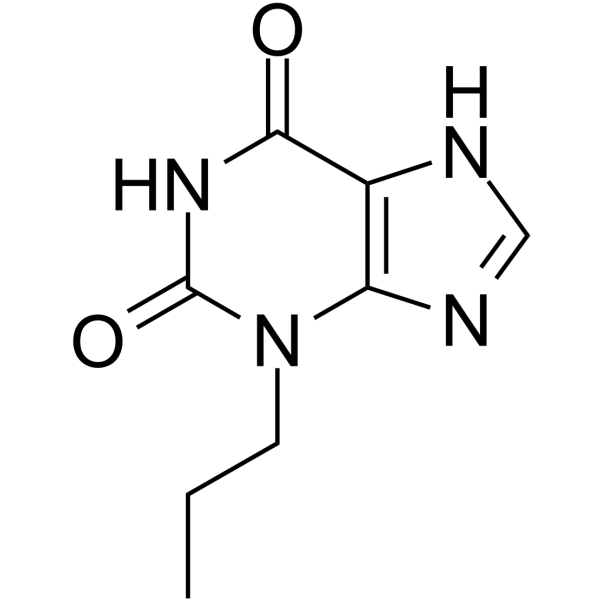
Enprofylline
CAS No. 41078-02-8
Enprofylline( 3-Propylxanthine | 3-n-Propylxanthine | Enprofyllinum | Enprofilina | 3-propylxanthine | enprofylline )
Catalog No. M27397 CAS No. 41078-02-8
Enprofylline, a bronchodilator, acts primarily as a competitive nonselective phosphodiesterase inhibitor.
Purity : >98% (HPLC)
 COA
Datasheet
HNMR
HPLC
MSDS
Handing Instructions
COA
Datasheet
HNMR
HPLC
MSDS
Handing Instructions
| Size | Price / USD | Stock | Quantity |
| 1 mL x 10 mM in DMSO | 54 | In Stock |


|
| 2MG | 35 | In Stock |
|
| 5MG | 56 | In Stock |
|
| 10MG | 81 | In Stock |
|
| 25MG | 144 | In Stock |
|
| 50MG | 221 | In Stock |
|
| 100MG | 328 | In Stock |
|
| 200MG | 456 | In Stock |
|
| 500MG | Get Quote | In Stock |
|
| 1G | Get Quote | In Stock |
|
Biological Information
-
Product NameEnprofylline
-
NoteResearch use only, not for human use.
-
Brief DescriptionEnprofylline, a bronchodilator, acts primarily as a competitive nonselective phosphodiesterase inhibitor.
-
DescriptionEnprofylline, a bronchodilator, acts primarily as a competitive nonselective phosphodiesterase inhibitor. Enprofylline is used in asthma, chronic obstructive pulmonary disease, and in the management of sickle cell disease, diabetic neuropathy, and cerebrovascular insufficiency.
-
In VitroEnprofylline (300 μM) completely blocks the release of IL-8 by N-ethylcarboxamidoadenosine (NECA). Enprofylline (10 μM) inhibits NECA (10 μM) induced proliferation in a concentration-dependent manner. Cell Proliferation Assay Cell Line:Human retinal endothelial cells (HRECs) Concentration:10 μM Incubation Time:24, 48, 72 hours Result:NECA (10 μM) induced a time-dependent increase in HREC proliferation as measured by cell counts, achieving approximately 80% of the density of cells exposed to normal growth medium for 3 days. Enprofylline (10 μM) completely blocked the proliferative effect of NECA when added concurrently with the analogue.
-
In VivoEnprofylline increases heart rate (HR). Injection of Enprofylline (7.5 and 30 mg/kg) increases HR in male WT mouse from 529±23 to 590±20 and 562±20 after the low and high dose, respectively. A high dose of Enprofylline (30 mg/kg) also decreases temperature compared with saline injection in female (but not in males) WT mice, but a low dose (7.5 mg/kg) has little effect on mouse temperature. Animal Model:A1RKO mice (were cross-bred to C57BL/6 mice for six generations) and A2ARKO mice (were backcrossed to C57BL/6 mice for more than 10 generations)Dosage:30 mg/kg Administration:Intraperitoneally injected (bolus) at 2-h intervals Result:Increased HR in male WT mouse from 529±23 to 590±20 and 562±20 after the low (7.5 mg/kg) and high dose (30 mg/kg), respectively.
-
Synonyms3-Propylxanthine | 3-n-Propylxanthine | Enprofyllinum | Enprofilina | 3-propylxanthine | enprofylline
-
PathwayOthers
-
TargetOther Targets
-
RecptorCaspase
-
Research Area——
-
Indication——
Chemical Information
-
CAS Number41078-02-8
-
Formula Weight194.19
-
Molecular FormulaC8H10N4O2
-
Purity>98% (HPLC)
-
SolubilityIn Vitro:?DMSO : 62.5 mg/mL (321.85 mM)
-
SMILESCCCN1C2=C(C(=O)NC1=O)NC=N2
-
Chemical Name——
Shipping & Storage Information
-
Storage(-20℃)
-
ShippingWith Ice Pack
-
Stability≥ 2 years
Reference
1.Paunel-G?rgülü A, et al. Stimulation of Fas signaling down-regulates activity of neutrophils from major trauma patients with SIRS. Immunobiology. 2011;216(3):334-342.
molnova catalog



related products
-
β-Amyloid(1-16), mou...
β-Amyloid(1-16), mouse, rat
-
Azalein
Azalein
-
Bradykinin
Bradykinin is an inflammatory mediator. It is a peptide that causes blood vessels to dilate (enlarge) via the release of prostacyclin, nitric oxide, and Endothelium-Derived Hyperpolarizing Factor. Bradykinin is a physiologically and pharmacologically active peptide of the kinin group of proteins, consisting of nine amino acids.
