


 Cart
Cart
 sales@molnova.com


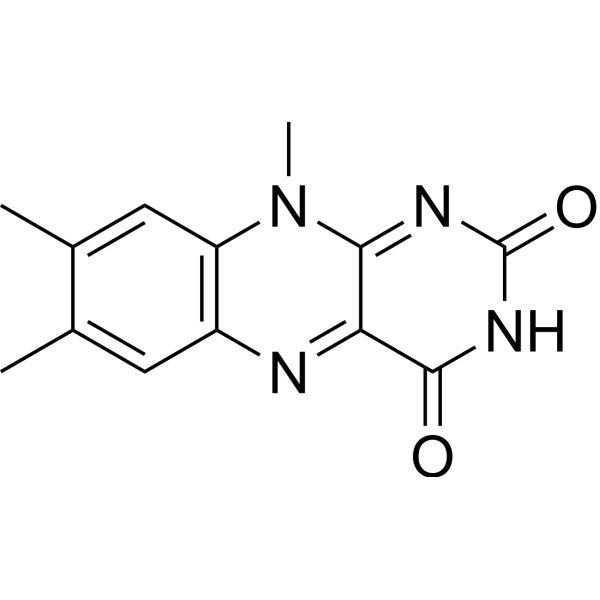
Lumiflavine
CAS No. 1088-56-8
Lumiflavine( Lumiflavin | Lumilactoflavin | Lumiflavine )
Catalog No. M27351 CAS No. 1088-56-8
Lumiflavine inhibits riboflavin uptake. It is produced by the photolysis of vitamin B2.
Purity : >98% (HPLC)
 COA
Datasheet
HNMR
HPLC
MSDS
Handing Instructions
COA
Datasheet
HNMR
HPLC
MSDS
Handing Instructions
| Size | Price / USD | Stock | Quantity |
| 5MG | 34 | In Stock |


|
| 10MG | 53 | In Stock |
|
| 100MG | Get Quote | In Stock |
|
| 200MG | Get Quote | In Stock |
|
| 500MG | Get Quote | In Stock |
|
| 1G | Get Quote | In Stock |
|
Biological Information
-
Product NameLumiflavine
-
NoteResearch use only, not for human use.
-
Brief DescriptionLumiflavine inhibits riboflavin uptake. It is produced by the photolysis of vitamin B2.
-
DescriptionLumiflavine inhibits riboflavin uptake. It is produced by the photolysis of vitamin B2.
-
In Vitro——
-
In Vivo——
-
SynonymsLumiflavin | Lumilactoflavin | Lumiflavine
-
PathwayOthers
-
TargetOther Targets
-
Recptor——
-
Research Area——
-
Indication——
Chemical Information
-
CAS Number1088-56-8
-
Formula Weight256.265
-
Molecular FormulaC13H12N4O2
-
Purity>98% (HPLC)
-
SolubilityIn Vitro:?0.1 M NaOH : 25 mg/mL (97.56 )
-
SMILESCc1cc2nc3c(nc(=O)[nH]c3=O)n(C)c2cc1C
-
Chemical Name——
Shipping & Storage Information
-
Storage(-20℃)
-
ShippingWith Ice Pack
-
Stability≥ 2 years
Reference
1.Uchiumi A, Takatsu A, Teraki Y. Sensitive detection of trace aluminium in biological tissues by confocal laser scanning microscopy after staining with lumogallion. Analyst. 1998 Apr;123(4):759-62.
molnova catalog



related products
-
NVP-DKY709
NVP-DKY709 is a potent IKZF2 inhibitor for the treatment of cancers.
-
(25R)-Spirosta-1,4-d...
(25R)-Spirosta-1,4-diene-3,12-dione
-
Guaiacol
Guaiacol is a precursor to various flavorants, such as eugenol and vanillin. Its derivatives are used medicinally as an expectorant, antiseptic, and local anesthetic.
