


 Cart
Cart
 sales@molnova.com


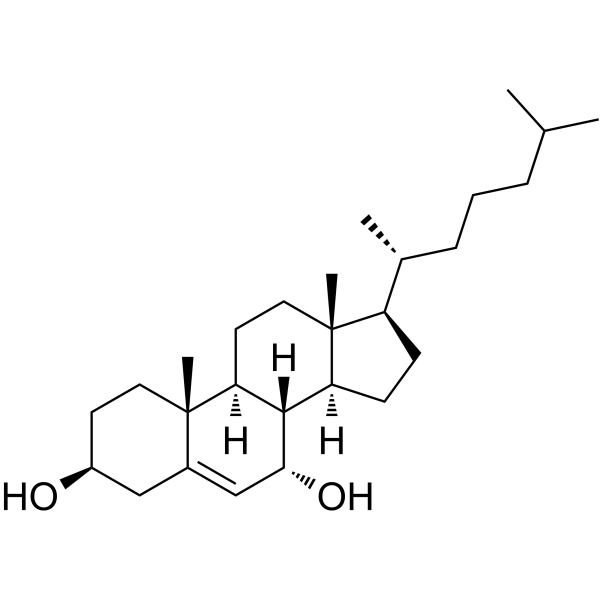
7α-Hydroxycholesterol
CAS No. 566-26-7
7α-Hydroxycholesterol( —— )
Catalog No. M27061 CAS No. 566-26-7
7α-Hydroxycholesterol is a cholesterol oxide formed by both enzymatic and non-enzymatic oxidation.
Purity : >98% (HPLC)
 COA
Datasheet
HNMR
HPLC
MSDS
Handing Instructions
COA
Datasheet
HNMR
HPLC
MSDS
Handing Instructions
| Size | Price / USD | Stock | Quantity |
| 5MG | 92 | In Stock |


|
| 10MG | 163 | In Stock |
|
| 100MG | Get Quote | In Stock |
|
| 200MG | Get Quote | In Stock |
|
| 500MG | Get Quote | In Stock |
|
| 1G | Get Quote | In Stock |
|
Biological Information
-
Product Name7α-Hydroxycholesterol
-
NoteResearch use only, not for human use.
-
Brief Description7α-Hydroxycholesterol is a cholesterol oxide formed by both enzymatic and non-enzymatic oxidation.
-
Description7α-Hydroxycholesterol is a cholesterol oxide formed by both enzymatic and non-enzymatic oxidation. It can be used as a biomarker for lipid peroxidation.
-
In Vitro——
-
In Vivo——
-
Synonyms——
-
PathwayOthers
-
TargetOther Targets
-
RecptorRIPK1
-
Research Area——
-
Indication——
Chemical Information
-
CAS Number566-26-7
-
Formula Weight402.663
-
Molecular FormulaC27H46O2
-
Purity>98% (HPLC)
-
SolubilityIn Vitro:?DMSO : 50 mg/mL (124.18 mM)
-
SMILES[H][C@@]1(CC[C@@]2([H])[C@]3([H])[C@H](O)C=C4C[C@@H](O)CC[C@]4(C)[C@@]3([H])CC[C@]12C)[C@H](C)CCCC(C)C
-
Chemical Name——
Shipping & Storage Information
-
Storage(-20℃)
-
ShippingWith Ice Pack
-
Stability≥ 2 years
Reference
1.Anthony A. ESTRADA, et al. Compounds, compositions and methods. WO2017136727A2.
molnova catalog



related products
-
Vitamin K1
A family of phylloquinones that contains a ring of 2-methyl-1,4-naphthoquinone and an isoprenoid side chain.
-
Sophorabioside
Sophorabioside is a natural product from Sophora japonica.
-
Prepro VIP (81-122),...
Prepro VIP (81-122), human is a prepro-vasoactive intestinal polypeptide (VIP) derived peptide, corresponding to residues 81-122.
