


 Cart
Cart
 sales@molnova.com


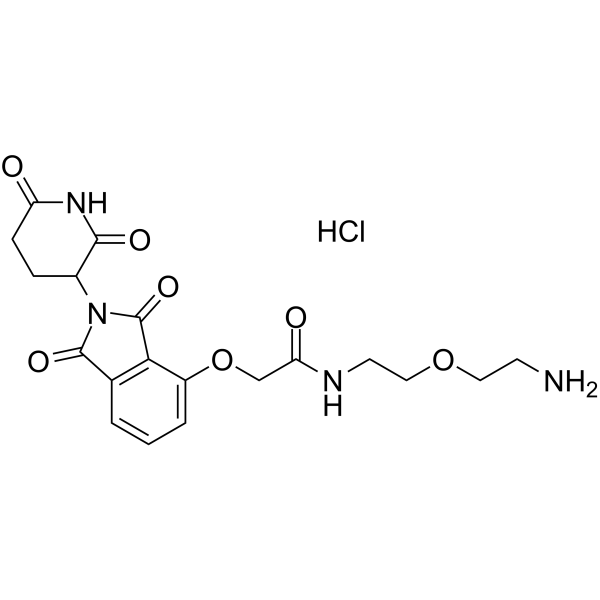
Thalidomide-O-amido-PEG-C2-NH2 hydrochloride
CAS No. 2204226-02-6
Thalidomide-O-amido-PEG-C2-NH2 hydrochloride( —— )
Catalog No. M27020 CAS No. 2204226-02-6
Thalidomide-O-amido-PEG-C2-NH2 hydrochloride, a synthesized E3 ligase ligand-linker conjugate that incorporates the Thalidomide based cereblon ligand and a linker, can be used in the synthesis of PROTACs.
Purity : >98% (HPLC)
 COA
Datasheet
HNMR
HPLC
MSDS
Handing Instructions
COA
Datasheet
HNMR
HPLC
MSDS
Handing Instructions
| Size | Price / USD | Stock | Quantity |
| 1 mL x 10 mM in DMSO | 36 | In Stock |


|
| 5MG | 29 | In Stock |
|
| 10MG | 42 | In Stock |
|
| 25MG | 69 | In Stock |
|
| 50MG | 100 | In Stock |
|
| 100MG | Get Quote | In Stock |
|
| 200MG | Get Quote | In Stock |
|
| 500MG | Get Quote | In Stock |
|
| 1G | Get Quote | In Stock |
|
Biological Information
-
Product NameThalidomide-O-amido-PEG-C2-NH2 hydrochloride
-
NoteResearch use only, not for human use.
-
Brief DescriptionThalidomide-O-amido-PEG-C2-NH2 hydrochloride, a synthesized E3 ligase ligand-linker conjugate that incorporates the Thalidomide based cereblon ligand and a linker, can be used in the synthesis of PROTACs.
-
DescriptionThalidomide-O-amido-PEG-C2-NH2 hydrochloride, a synthesized E3 ligase ligand-linker conjugate that incorporates the Thalidomide based cereblon ligand and a linker, can be used in the synthesis of PROTACs.(In Vitro):PROTACs contain two different ligands connected by a linker; one is a ligand for an E3 ubiquitin ligase and the other is for the target protein. PROTACs exploit the intracellular ubiquitin-proteasome system to selectively degrade target proteins.
-
In VitroPROTACs contain two different ligands connected by a linker; one is a ligand for an E3 ubiquitin ligase and the other is for the target protein. PROTACs exploit the intracellular ubiquitin-proteasome system to selectively degrade target proteins.
-
In Vivo——
-
Synonyms——
-
PathwayOthers
-
TargetOther Targets
-
RecptorMitochondrial Metabolism
-
Research Area——
-
Indication——
Chemical Information
-
CAS Number2204226-02-6
-
Formula Weight454.86
-
Molecular FormulaC19H23ClN4O7
-
Purity>98% (HPLC)
-
SolubilityIn Vitro:?DMSO : 125 mg/mL (274.81 mM)
-
SMILESCl.NCCOCCNC(=O)COc1cccc2C(=O)N(C3CCC(=O)NC3=O)C(=O)c12
-
Chemical Name——
Shipping & Storage Information
-
Storage(-20℃)
-
ShippingWith Ice Pack
-
Stability≥ 2 years
Reference
1.Wang Y, et al. A new point mutation in the iron-sulfur subunit of succinate dehydrogenase confers resistance to boscalid in Sclerotinia sclerotiorum. Mol Plant Pathol. 2015 Sep;16(7):653-61.
molnova catalog



related products
-
Cefoxitin sodium
Cefoxitin sodium is a cephamycin antibiotic, often grouped with the second generation cephalosporins, acts by interfering with cell wall synthesis.
-
C5a Anaphylatoxin (h...
C5a Anaphylatoxin (human)
-
H-Pro-Leu-Ser-Arg-Th...
[Ala9,10, Lys11,12] Glycogen Synthase (1-12) is a selective substrate for phosphorylation by protein kinase C (PKC). [Ala9,10, Lys11,12] Glycogen Synthase (1-12) can be used to determine the activity of protein kinase C.
