


 Cart
Cart
 sales@molnova.com


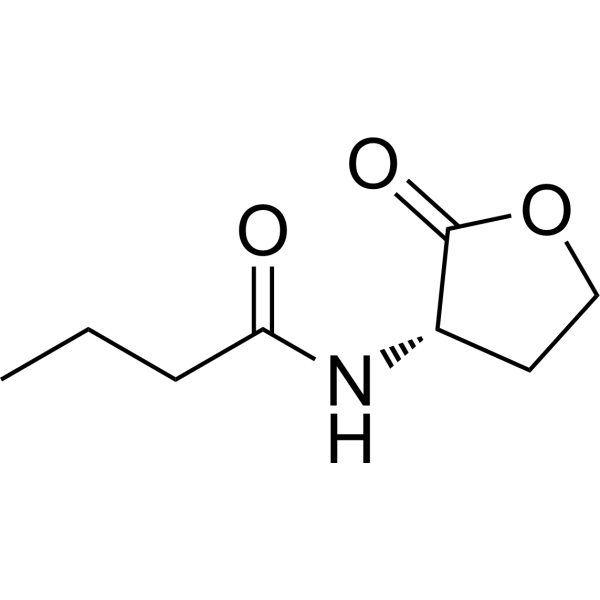
N-Butanoyl-L-homoserine lactone
CAS No. 67605-85-0
N-Butanoyl-L-homoserine lactone( C4-HSL | N-Butyryl-L-homoserine lactone )
Catalog No. M26988 CAS No. 67605-85-0
N-Butanoyl-L-homoserine lactone is a cleavable ADC linker used in the synthesis of antibody-drug conjugates (ADCs).
Purity : >98% (HPLC)
 COA
Datasheet
HNMR
HPLC
MSDS
Handing Instructions
COA
Datasheet
HNMR
HPLC
MSDS
Handing Instructions
| Size | Price / USD | Stock | Quantity |
| 1 mL x 10 mM in DMSO | 37 | In Stock |


|
| 25MG | 28 | In Stock |
|
| 100MG | Get Quote | In Stock |
|
| 200MG | Get Quote | In Stock |
|
| 500MG | Get Quote | In Stock |
|
| 1G | Get Quote | In Stock |
|
Biological Information
-
Product NameN-Butanoyl-L-homoserine lactone
-
NoteResearch use only, not for human use.
-
Brief DescriptionN-Butanoyl-L-homoserine lactone is a cleavable ADC linker used in the synthesis of antibody-drug conjugates (ADCs).
-
DescriptionN-Butanoyl-L-homoserine lactone is a cleavable ADC linker used in the synthesis of antibody-drug conjugates (ADCs). N-Butanoyl-L-homoserine lactone has antibacterial activity and is used in antibacterial biofilm.
-
In Vitro——
-
In Vivo——
-
SynonymsC4-HSL | N-Butyryl-L-homoserine lactone
-
PathwayGPCR/G Protein
-
TargetAntibacterial
-
Recptorperipheral benzodiazepine receptor (PBR)
-
Research Area——
-
Indication——
Chemical Information
-
CAS Number67605-85-0
-
Formula Weight171.196
-
Molecular FormulaC8H13NO3
-
Purity>98% (HPLC)
-
SolubilityIn Vitro:?DMSO : 100 mg/mL (584.15 mM)
-
SMILESCCCC(=O)N[C@H]1CCOC1=O
-
Chemical Name——
Shipping & Storage Information
-
Storage(-20℃)
-
ShippingWith Ice Pack
-
Stability≥ 2 years
Reference
1.Michelle L James, et al. Development of ligands for the peripheral benzodiazepine receptor. Curr Med Chem. 2006;13(17):1991-2001.
molnova catalog



related products
-
Antibacterial agent ...
Antibacterial Agent 125 exhibits potent antimicrobial activity against clinically relevant Gram-positive pathogens, displaying Minimum Inhibitory Concentration (MIC) 50 values ranging from 0.25 to 8 μM. It is suitable for researching antimicrobial resistance.
-
Proflavine
Proflavine (3,6-Diaminoacridine) is a disinfectant bacteriostatic against many gram-positive bacteria and is a topical antiseptic used mainly in wound dressings.
-
Timcodar
timcodar is a non-FKBP12 binding macrolide derivative that is an efflux pump inhibitor with antimicrobial activity, inhibition of lipid accumulation, inhibition of Mycobacterium tuberculosis, and can be used in the study of obesity.
