


 Cart
Cart
 sales@molnova.com


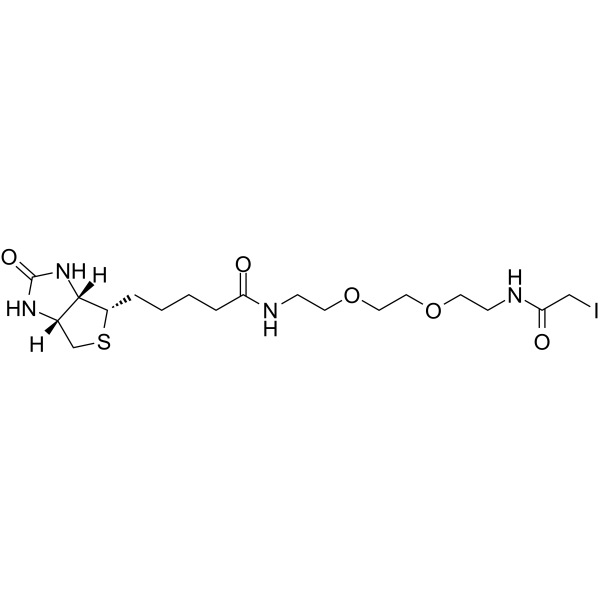
Biotin-PEG2-C2-iodoacetamide
CAS No. 292843-75-5
Biotin-PEG2-C2-iodoacetamide( Biotin-PEG2-C2-iodoacetamide | Biotin-PEG2-iodoacetamide )
Catalog No. M26903 CAS No. 292843-75-5
Biotin-PEG2-C2-iodoacetamide is a PEG-based PROTAC linker that can be used in the synthesis of PROTACs.
Purity : >98% (HPLC)
 COA
Datasheet
HNMR
HPLC
MSDS
Handing Instructions
COA
Datasheet
HNMR
HPLC
MSDS
Handing Instructions
| Size | Price / USD | Stock | Quantity |
| 5MG | 36 | In Stock |


|
| 10MG | 51 | In Stock |
|
| 25MG | 86 | In Stock |
|
| 50MG | 138 | In Stock |
|
| 100MG | 221 | In Stock |
|
| 200MG | Get Quote | In Stock |
|
| 500MG | Get Quote | In Stock |
|
| 1G | Get Quote | In Stock |
|
Biological Information
-
Product NameBiotin-PEG2-C2-iodoacetamide
-
NoteResearch use only, not for human use.
-
Brief DescriptionBiotin-PEG2-C2-iodoacetamide is a PEG-based PROTAC linker that can be used in the synthesis of PROTACs.
-
DescriptionBiotin-PEG2-C2-iodoacetamide is a PEG-based PROTAC linker that can be used in the synthesis of PROTACs.(In Vitro):PROTACs contain two different ligands connected by a linker; one is a ligand for an E3 ubiquitin ligase and the other is for the target protein. PROTACs exploit the intracellular ubiquitin-proteasome system to selectively degrade target proteins.
-
In VitroPROTACs contain two different ligands connected by a linker; one is a ligand for an E3 ubiquitin ligase and the other is for the target protein. PROTACs exploit the intracellular ubiquitin-proteasome system to selectively degrade target proteins.
-
In Vivo——
-
SynonymsBiotin-PEG2-C2-iodoacetamide | Biotin-PEG2-iodoacetamide
-
PathwayOthers
-
TargetOther Targets
-
RecptorSARS-CoV| SARS-CoV 3CLpro
-
Research Area——
-
Indication——
Chemical Information
-
CAS Number292843-75-5
-
Formula Weight542.43
-
Molecular FormulaC18H31IN4O5S
-
Purity>98% (HPLC)
-
Solubility——
-
SMILES[H][C@]12CS[C@@H](CCCCC(=O)NCCOCCOCCNC(=O)CI)[C@@]1([H])NC(=O)N2
-
Chemical Name——
Shipping & Storage Information
-
Storage(-20℃)
-
ShippingWith Ice Pack
-
Stability≥ 2 years
Reference
1.Ghosh AK, et, al. Design, synthesis and antiviral efficacy of a series of potent chloropyridyl ester-derived SARS-CoV 3CLpro inhibitors. Bioorg Med Chem Lett. 2008 Oct 15;18(20):5684-8.
molnova catalog



related products
-
SRT3109
SRT3109 is a CXCR2 ligand used in the treatment of chemokine mediated diseases and conditions.
-
Cyanidin3-xylosyl-(c...
Cyanidin3-xylosyl-(coumaroyl-glucosyl)-galactoside
-
2-Pyrazinecarboxamid...
2-Pyrazinecarboxamide, 3-amino-N-(aminoiminomethyl)-5-(dimethylamino)-6-(2-phenylethynyl)-
