


 Cart
Cart
 sales@molnova.com


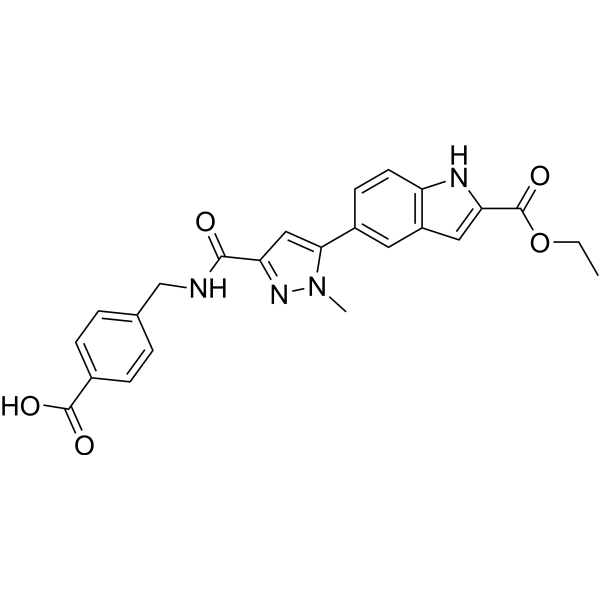
MMP13-IN-3
CAS No. 1222173-37-6
MMP13-IN-3( —— )
Catalog No. M26760 CAS No. 1222173-37-6
MMP13-IN-3 is >1000 selective over other MMPs. MMP13-IN-3 is an effective, selective, and orally active MMP-13 inhibitor (IC50=1 nM) for the potential treatment of osteoarthritis.
Purity : >98% (HPLC)
 COA
Datasheet
HNMR
HPLC
MSDS
Handing Instructions
COA
Datasheet
HNMR
HPLC
MSDS
Handing Instructions
| Size | Price / USD | Stock | Quantity |
| 1 mL x 10 mM in DMSO | 240 | In Stock |


|
| 5MG | 217 | In Stock |
|
| 10MG | 353 | In Stock |
|
| 25MG | 620 | In Stock |
|
| 50MG | 830 | In Stock |
|
| 100MG | 1144 | In Stock |
|
| 200MG | Get Quote | In Stock |
|
| 500MG | Get Quote | In Stock |
|
| 1G | Get Quote | In Stock |
|
Biological Information
-
Product NameMMP13-IN-3
-
NoteResearch use only, not for human use.
-
Brief DescriptionMMP13-IN-3 is >1000 selective over other MMPs. MMP13-IN-3 is an effective, selective, and orally active MMP-13 inhibitor (IC50=1 nM) for the potential treatment of osteoarthritis.
-
DescriptionMMP13-IN-3 is >1000 selective over other MMPs. MMP13-IN-3 is an effective, selective, and orally active MMP-13 inhibitor (IC50=1 nM) for the potential treatment of osteoarthritis.(In Vitro):MMP13-IN-3 inhibits MMP-2, MMP-9, MMP-10 and MMP-14 with IC50s of 18, 8.9, 16 and 8.3 μM, respectively. MMP13-IN-3 is effective in a full-length MMP-13 collagen degradation assay (11 nM) and is able to inhibit the degradation of bovine nasal cartilage (IC50: 31 nM) .(In Vivo):MMP13-IN-3 has short terminal elimination half-life (t1/2=0.47 h for rat (1 mg/kg, i.v.) and rat (10 mg/kg, orally), respectively). MMP13-IN-3 reaches micromolar plasma levels (AUC=1109±64 nM h/mL) when dosed orally at 10 mg/kg or i.v. 1 mg/kg. It displays modest clearance (CL=34 mL/min/kg), and shows acceptable bioavailability (39%). The Vss is quite low at 0.26 mL/mi/kg rat pharmacokinetic profile .
-
In VitroBI-4394 (Compound 15) is potent in a full-length MMP-13 collagen degradation assay (11 nM) and is able to inhibit degradation of bovine nasal cartilage with an IC50 of 31 nM. BI-4394 inhibits MMP-2, MMP-9, MMP-10 and MMP-14 with IC50s of 18, 8.9, 16 and 8.3 μM, respectively.
-
In VivoWhen dosed orally at 10 mg/kg or i.v. 1 mg/kg, BI-4394 (Compound 15) reaches micromolar plasma levels (AUC=1109±64 nM h/mL), displays modest clearance (CL=34 mL/min/kg), and shows acceptable bioavailability (39%). The Vss is quite low at 0.26 mL/mi/kg rat pharmacokinetic profile. BI-4394 has short terminal elimination half-life (t1/2=0.47 h for rat (1 mg/kg, i.v.) and rat (10 mg/kg, orally), respectively). Animal Model:Srapgue Dally Rats Dosage:10 mg/kg (oral gavage); 1 mg/kg (i.v.)Administration:Dosed orally (10 mg/kg); i.v. (1 mg/kg)(Pharmacokinetic Analysis)Result:T1/2=0.47 h for rat (1 mg/kg, i.v.) and rat (10 mg/kg, orally) , respectively.
-
Synonyms——
-
PathwayMetabolic Enzyme/Protease
-
TargetMMP
-
RecptorDNA/RNA Synthesis| Nucleoside Antimetabolite/Analog
-
Research Area——
-
Indication——
Chemical Information
-
CAS Number1222173-37-6
-
Formula Weight446.463
-
Molecular FormulaC24H22N4O5
-
Purity>98% (HPLC)
-
SolubilityIn Vitro:?DMSO : 100 mg/mL (223.98 mM)
-
SMILESCCOC(=O)c1cc2cc(ccc2[nH]1)-c1cc(nn1C)C(=O)NCc1ccc(cc1)C(O)=O
-
Chemical Name——
Shipping & Storage Information
-
Storage(-20℃)
-
ShippingWith Ice Pack
-
Stability≥ 2 years
Reference
1.Kapoor I, et al. Nucleoside Diphosphate Kinase Escalates A-to-C Mutations in MutT-Deficient Strains of Escherichia coli. J Bacteriol. 2019;202(1):e00567-19. Published 2019 Dec 6.
molnova catalog



related products
-
PF-00356231 hydrochl...
PF-00356231 hydrochloride is an inhibitor of matrix metalloproteinase MMP-12 with IC50 of 1.4 μM.
-
T-26c
T-26c is highly potent and selective matrix metalloproteinase-13 (MMP-13) inhibitor (IC50: 6.75 pM).
-
SB-3CT
SB-3CT is an effective and selective gelatinase inhibitor with Ki of 13.9 nM and 600 nM for MMP-2 and MMP-9, respectively.
