


 Cart
Cart
 sales@molnova.com


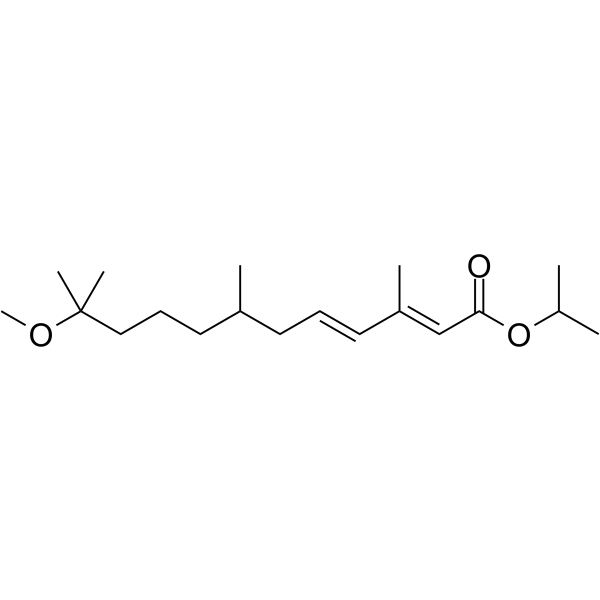
Methoprene
CAS No. 40596-69-8
Methoprene( ZR-515 )
Catalog No. M26753 CAS No. 40596-69-8
Methoprene is a juvenile hormone (JH) mimic and a biological pesticide.
Purity : >98% (HPLC)
 COA
Datasheet
HNMR
HPLC
MSDS
Handing Instructions
COA
Datasheet
HNMR
HPLC
MSDS
Handing Instructions
| Size | Price / USD | Stock | Quantity |
| 1 mL x 10 mM in DMSO | 48 | In Stock |


|
| 10MG | 29 | In Stock |
|
| 25MG | 45 | In Stock |
|
| 50MG | 63 | In Stock |
|
| 100MG | 79 | In Stock |
|
| 200MG | Get Quote | In Stock |
|
| 500MG | Get Quote | In Stock |
|
| 1G | Get Quote | In Stock |
|
Biological Information
-
Product NameMethoprene
-
NoteResearch use only, not for human use.
-
Brief DescriptionMethoprene is a juvenile hormone (JH) mimic and a biological pesticide.
-
DescriptionMethoprene is a juvenile hormone (JH) mimic and a biological pesticide. Methoprene acts as an insect growth regulator interfering with the lifecycles of insects and preventing insects from reaching maturity or reproducing.(In Vivo):The time of first brood deposition is affected by methoprene, with a clear concentration-dependent response and a NOEC of 32 nM. Methoprene reduces fecundity according to a 2-segmented line, with thresholds of 24 and < or =0.18 nM. Methoprene reduces the growth rate of daphnids with evidence of only a single concentration-response line, having a threshold of 12.6 nM. Molt frequency is reduced by methoprene in a concentration-dependent manner, with a response curve corresponding to a 2-segmented line and thresholds at 4.2 and 0.21 nM.
-
In VitroMethoprene reduces the growth rate of daphnids with evidence of only a single concentration-response line, having a threshold of 12.6 nM. Molt frequency is reduced by methoprene in a concentration-dependent manner, with a response curve corresponding to a 2-segmented line and thresholds at 4.2 and 0.21 nM. An endpoint related to reproductive maturation, the time of first brood deposition, is also affected by methoprene, with a clear concentration-dependent response and a NOEC of 32 nM. Methoprene reduces fecundity according to a 2-segmented line, with thresholds of 24 and < or =0.18 nM. Methoprene elicits significant toxicity to endocrine-related processes in the 5-50 nM concentration range.
-
In Vivo——
-
SynonymsZR-515
-
PathwayOthers
-
TargetOther Targets
-
RecptorE3 Ligase Ligand-Linker Conjugate
-
Research Area——
-
Indication——
Chemical Information
-
CAS Number40596-69-8
-
Formula Weight310.478
-
Molecular FormulaC19H34O3
-
Purity>98% (HPLC)
-
SolubilityIn Vitro:?Ethanol : 100 mg/mL (322.09 m)
-
SMILESCOC(C)(C)CCCC(C)C\C=C\C(\C)=C\C(=O)OC(C)C
-
Chemical Name——
Shipping & Storage Information
-
Storage(-20℃)
-
ShippingWith Ice Pack
-
Stability≥ 2 years
Reference
1.An S, et al. Small-molecule PROTACs: An emerging and promising approach for the development of targeted therapy drugs. EBioMedicine. 2018 Oct;36:553-562
molnova catalog



related products
-
P-Cymene
P-cymene is a monoterpene that is?toluene?substituted by an isopropyl group at position 4. It has a role as a plant metabolite a volatile oil component and a human urinary metabolite. It is a member of toluenes and a monoterpene.
-
Monascorubrin
Monascorubrin is purified from the mycelium of Monascus purpureus. Monascorubrin has significant antibiotic activities against Bacillus subtilis and Candida pseudotropicalis.
-
Lappaconitine
Lappaconitine, isolated from Aconitum sinomontanum Nakai, was characterized as analgesic principle.
