


 Cart
Cart
 sales@molnova.com


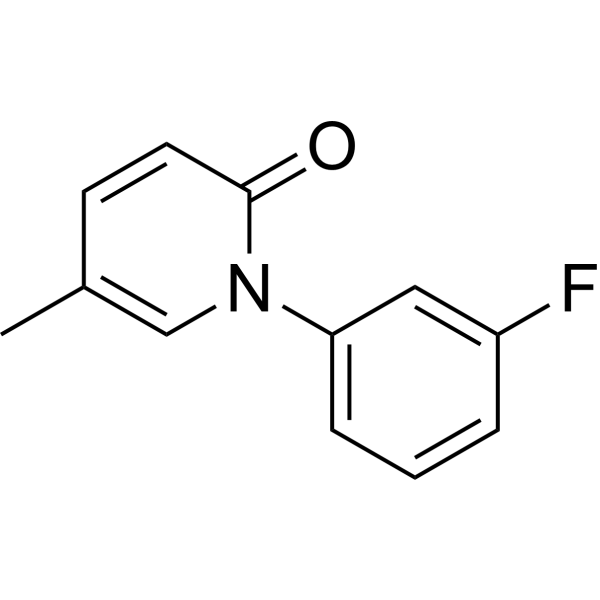
Fluorofenidone
CAS No. 848353-85-5
Fluorofenidone( AKF-PD )
Catalog No. M26688 CAS No. 848353-85-5
Fluorofenidone attenuates the progression of renal interstitial fibrosis partly by suppressing NADPH oxidase and extracellular matrix (ECM) deposition via the PI3K/Akt signalling pathway.
Purity : >98% (HPLC)
 COA
Datasheet
HNMR
HPLC
MSDS
Handing Instructions
COA
Datasheet
HNMR
HPLC
MSDS
Handing Instructions
| Size | Price / USD | Stock | Quantity |
| 1 mL x 10 mM in DMSO | 49 | In Stock |


|
| 2MG | 29 | In Stock |
|
| 5MG | 45 | In Stock |
|
| 10MG | 73 | In Stock |
|
| 25MG | 150 | In Stock |
|
| 50MG | 267 | In Stock |
|
| 100MG | 384 | In Stock |
|
| 200MG | 541 | In Stock |
|
| 500MG | Get Quote | In Stock |
|
| 1G | Get Quote | In Stock |
|
Biological Information
-
Product NameFluorofenidone
-
NoteResearch use only, not for human use.
-
Brief DescriptionFluorofenidone attenuates the progression of renal interstitial fibrosis partly by suppressing NADPH oxidase and extracellular matrix (ECM) deposition via the PI3K/Akt signalling pathway.
-
DescriptionFluorofenidone attenuates the progression of renal interstitial fibrosis partly by suppressing NADPH oxidase and extracellular matrix (ECM) deposition via the PI3K/Akt signalling pathway. Fluorofenidone is an analogue of AMR69. Which displays equivalent lower toxicity, antifibrotic activity, and longer half-life.
-
In Vitro——
-
In Vivo——
-
SynonymsAKF-PD
-
PathwayOthers
-
TargetOther Targets
-
Recptor——
-
Research Area——
-
Indication——
Chemical Information
-
CAS Number848353-85-5
-
Formula Weight203.216
-
Molecular FormulaC12H10FNO
-
Purity>98% (HPLC)
-
SolubilityIn Vitro:?DMSO : 140 mg/mL (688.94 mM)
-
SMILESCc1ccc(=O)n(c1)-c1cccc(F)c1
-
Chemical Name——
Shipping & Storage Information
-
Storage(-20℃)
-
ShippingWith Ice Pack
-
Stability≥ 2 years
Reference
1.Shi J, et al. Sacubitril Is Selectively Activated by Carboxylesterase 1 (CES1) in the Liver and the Activation Is Affected by CES1 Genetic Variation. Drug Metab Dispos. 2016 Apr;44(4):554-9.
molnova catalog



related products
-
Diisopropyl xanthoge...
Diisopropyl xanthogen disulfide can be used to synthesize a proligand for metal complexes related to the molybdenum cofactor.
-
Chromocarbe
Chromocarb is a vascular protective agent used in the treatment of venous disorders and microvascular affections.
-
Amino-PEG9-alcohol
Amino-PEG9-alcohol is a PEG-based PROTAC linker that can be used in the synthesis of PROTACs.
