


 Cart
Cart
 sales@molnova.com


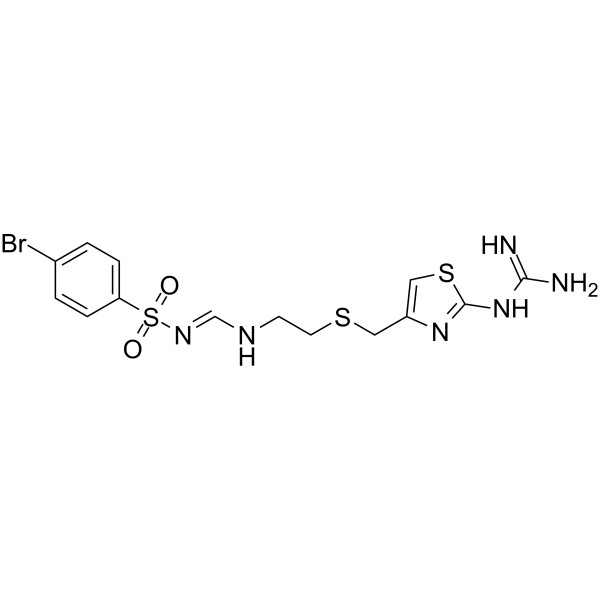
Ebrotidine
CAS No. 100981-43-9
Ebrotidine( FI3542 )
Catalog No. M26675 CAS No. 100981-43-9
Ebrotidine is a competitive H2-receptor antagonist with Ki of 127.5 nM. Ebrotidine has a potent antisecretory activity and evidenced gastroprotection.
Purity : >98% (HPLC)
 COA
Datasheet
HNMR
HPLC
MSDS
Handing Instructions
COA
Datasheet
HNMR
HPLC
MSDS
Handing Instructions
| Size | Price / USD | Stock | Quantity |
| 1 mL x 10 mM in DMSO | 62 | In Stock |


|
| 2MG | 35 | In Stock |
|
| 5MG | 56 | In Stock |
|
| 10MG | 92 | In Stock |
|
| 100MG | Get Quote | In Stock |
|
| 200MG | Get Quote | In Stock |
|
| 500MG | Get Quote | In Stock |
|
| 1G | Get Quote | In Stock |
|
Biological Information
-
Product NameEbrotidine
-
NoteResearch use only, not for human use.
-
Brief DescriptionEbrotidine is a competitive H2-receptor antagonist with Ki of 127.5 nM. Ebrotidine has a potent antisecretory activity and evidenced gastroprotection.
-
DescriptionEbrotidine is a competitive H2-receptor antagonist with Ki of 127.5 nM. Ebrotidine has a potent antisecretory activity and evidenced gastroprotection.(In Vitro):Ebrotidine displaced 3H-thiotidine specific binding to histamine H2-receptors, showing a higher affinity than ranitidine (Ki = 190.0 nM) and cimetidine (Ki = 246.1 nM) .(In Vivo):Ebrotidine inhibited histamine- (ED50: 0.21 mg/kg) and pentagastrin- (ED50: 0.44 mg/kg) stimulated acid secretion in a dose-dependent manner in rats . Ebrotidine at doses of 50mg and higher/kg body weight effectively prevented mucosal injury, and that the maximal protective effect was achieved by 1h. Ebrotidine evoked 30% increase in mucus gel dimension, and showed 20% increase in phospholipids, and the content of sulfo- (18%) and sialomucins (21%) . The mean number of gastric erosions seen at endoscopy after treatment with Ebrotidine plus ASA (2.0 +/- 0.3) was obviously lower than that after placebo plus ASA (3.7 +/- 0.2). This reduction in lesion core by Ebrotidine was accompanied by a significant increase in gastric blood flow (by 15% in corpus and 26% in antrum), by a rise in transmucosal potential difference (by 12%), and by a decrease of mucosal microbleeding.
-
In Vitro——
-
In Vivo——
-
SynonymsFI3542
-
PathwayGPCR/G Protein
-
TargetHistamine Receptor
-
RecptorHuman Endogenous Metabolite| Nucleoside Antimetabolite/Analog
-
Research Area——
-
Indication——
Chemical Information
-
CAS Number100981-43-9
-
Formula Weight477.41
-
Molecular FormulaC14H17BrN6O2S3
-
Purity>98% (HPLC)
-
SolubilityIn Vitro:?DMSO : 100 mg/mL (209.46 mM)
-
SMILESNC(=N)Nc1nc(CSCCN\C=N\S(=O)(=O)c2ccc(Br)cc2)cs1
-
Chemical Name——
Shipping & Storage Information
-
Storage(-20℃)
-
ShippingWith Ice Pack
-
Stability≥ 2 years
Reference
1.1-Methylinosine-Human Metabolome Database.
molnova catalog



related products
-
Toreforant
Toreforant (JNJ-38518168) is a potent, selective histamine H4 receptor (H4R) antagonist with Ki of 8.4 nM.
-
Impromidine hydrochl...
Impromidine hydrochloride is a very potent and specific histamine H2 receptor agonist for conducting cardiovascular studies.
-
Hydroxyzine free bas...
Hydroxyzine is an antagonist of histamine H1-receptor. Hydroxyzine is an antihistaminic with sedative properties used in the control of anxiety and emesis.
