


 Cart
Cart
 sales@molnova.com


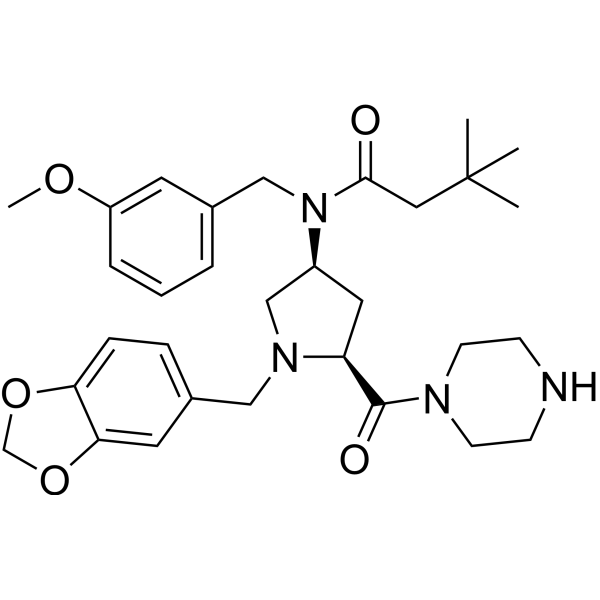
CUR61414
CAS No. 334998-36-6
CUR61414( —— )
Catalog No. M26658 CAS No. 334998-36-6
CUR61414 is an inhibitor of cell permeable Hedgehog signaling pathway (IC50: 100-200 nM) and selectively binds to smoothened (Smo) (Ki: 44 nM).
Purity : >98% (HPLC)
 COA
Datasheet
HNMR
HPLC
MSDS
Handing Instructions
COA
Datasheet
HNMR
HPLC
MSDS
Handing Instructions
| Size | Price / USD | Stock | Quantity |
| 1 mL x 10 mM in DMSO | 119 | In Stock |


|
| 2MG | 65 | In Stock |
|
| 5MG | 106 | In Stock |
|
| 10MG | 172 | In Stock |
|
| 25MG | 345 | In Stock |
|
| 50MG | 508 | In Stock |
|
| 100MG | 763 | In Stock |
|
| 200MG | 1004 | In Stock |
|
| 500MG | Get Quote | In Stock |
|
| 1G | Get Quote | In Stock |
|
Biological Information
-
Product NameCUR61414
-
NoteResearch use only, not for human use.
-
Brief DescriptionCUR61414 is an inhibitor of cell permeable Hedgehog signaling pathway (IC50: 100-200 nM) and selectively binds to smoothened (Smo) (Ki: 44 nM).
-
DescriptionCUR61414 is an inhibitor of cell permeable Hedgehog signaling pathway (IC50: 100-200 nM) and selectively binds to smoothened (Smo) (Ki: 44 nM). CUR-61414 can induce apoptosis in cancer cells without affecting neighboring non-tumor cells.(In Vitro):CUR61414 arrests the proliferation of basal cells within the BCC-like lesions and induces cell apoptosis and complete regression of the lesions, without affecting neighboring non-tumor cells.(In Vivo):CUR61414 regresses these lesions in the mice exposed to UV light irradiation and produces many microscopic BCC-like basaloid lesions throughout their skin.
-
In VitroCUR61414 is able to arrest proliferation of basal cells within the BCC-like lesions and induce cells to undergo apoptosis resulting in complete regression of the lesions, without affecting neighboring skin cells.
-
In VivoCUR61414 cause regression of these lesions in the mice, which are exposed to UV light irradiation for 6-9 months, producing many microscopic BCC-like basaloid lesions throughout their skin. Moreover,a significant increase in apoptotic nuclei can be seen in basaloid nests after CUR61414 treatment and no overt toxicity is observed in the skin surrounding the lesions.
-
Synonyms——
-
PathwayOthers
-
TargetOther Targets
-
Recptor——
-
Research Area——
-
Indication——
Chemical Information
-
CAS Number334998-36-6
-
Formula Weight550.7
-
Molecular FormulaC31H42N4O5
-
Purity>98% (HPLC)
-
SolubilityIn Vitro:?DMSO : 100 mg/mL (181.59 mM)
-
SMILESCOc1cccc(CN([C@H]2C[C@H](N(Cc3ccc4OCOc4c3)C2)C(=O)N2CCNCC2)C(=O)CC(C)(C)C)c1
-
Chemical Name——
Shipping & Storage Information
-
Storage(-20℃)
-
ShippingWith Ice Pack
-
Stability≥ 2 years
Reference
1.Uesawa M, Muroi K, Ozawa K. Plasmapheresis-refractory transplantation-associated thrombotic microangiopathy successfully treated with pravastatin and limaprost alfadex. Ther Apher Dial. 2013 Aug;17(4):462-3.
molnova catalog



related products
-
Trichodesmine
Trichodesmine, a dehydropyrrolizidine alkaloid, exhibits hepatotoxic, pneumotoxic, and neurotoxic effects in vivo.
-
N-(3-Phenylpropionyl...
N-(3-Phenylpropionyl)glycine is an acyl glycine. Acyl glycines are normally minor metabolites of fatty acids. However the excretion of certain acyl glycines is increased in several inborn errors of metabolism.
-
(D-Ala2)-Dynorphin A...
(D-Ala2)-Dynorphin A (1-9)
