


 Cart
Cart
 sales@molnova.com


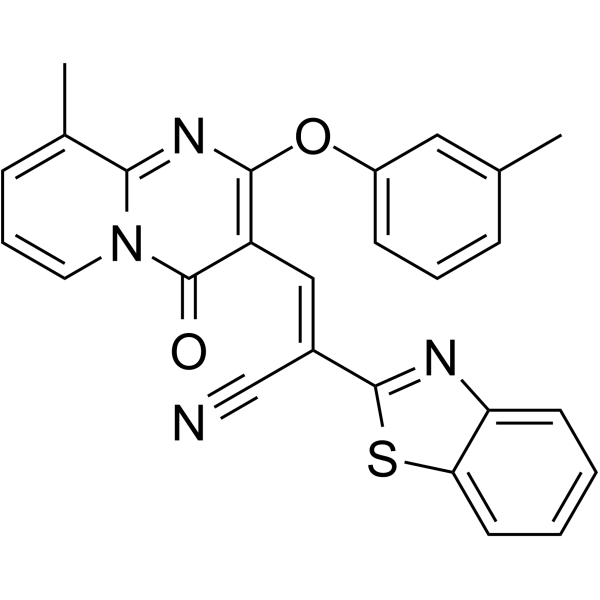
CCG-63802
CAS No. 620112-78-9
CCG-63802( —— )
Catalog No. M26640 CAS No. 620112-78-9
CCG-63802 is a reversible small-molecule inhibitor of regulator of G protein signaling (RGS) proteins.
Purity : >98% (HPLC)
 COA
Datasheet
HNMR
HPLC
MSDS
Handing Instructions
COA
Datasheet
HNMR
HPLC
MSDS
Handing Instructions
| Size | Price / USD | Stock | Quantity |
| 2MG | 34 | In Stock |


|
| 5MG | 54 | In Stock |
|
| 10MG | 92 | In Stock |
|
| 25MG | 180 | In Stock |
|
| 100MG | Get Quote | In Stock |
|
| 200MG | Get Quote | In Stock |
|
| 500MG | Get Quote | In Stock |
|
| 1G | Get Quote | In Stock |
|
Biological Information
-
Product NameCCG-63802
-
NoteResearch use only, not for human use.
-
Brief DescriptionCCG-63802 is a reversible small-molecule inhibitor of regulator of G protein signaling (RGS) proteins.
-
DescriptionCCG-63802 is a reversible small-molecule inhibitor of regulator of G protein signaling (RGS) proteins. CCG-63802 inhibits the interaction between RGS4 and Galpha with an IC50 value of 1.4 μM.(In Vitro):CCG-63802 showed selectivity among RGS proteins with a potency order of RGS 4 > 19 = 16 > 8 7. CCG-63802 inhibited the GTPase accelerating protein activity of RGS4.(In Vivo):The attenuating effect of PGZ on airway inflammation, hyperresponsiveness (AHR), and remodeling was partially abrogated by administration of RGS4 inhibitor CCG-63802(0.5 mg/kg). The downregulation of RGS4 by CCG-63802 also significantly increased inflammatory cell accumulation and AHR, and increased levels of IL-4, IL-13, eotaxin, IFN-γ, and IL-17A in BALF, and total and OV-specific IgE in serum. The inhibitory effects of PGZ on the activations of ERK and Akt/mTOR signaling, and MMPs were apparently reversed by CCG-63802 administration.
-
In VitroCCG-63802 (5 μM) inhibits regulators of G-protein signaling (RGS) proteins in the presence of BK (bradykinin) and 8-Br-cGMP (membrane-permeable analogue of cGMP), HEK-293 cells start to depolarize again.
-
In VivoCCG-63802 (0.05 mg/kg; intratracheal administration; once per week; 90 days) reduces RGS4 protein expression, leading to partially abrogate the attenuating effect of PGZ on airway inflammation, hyperresponsiveness (AHR), and remodeling. Animal Model:Forty female BALB/c mice aged 6-8 week oldDosage:0.05 mg/kg Administration:Intratracheal administration; once per week; 90 days Result:CCG 63802 treatment in OVA +PGZ + CCG group significantly reduced RGS4 protein expression compared to OVA + PGZ group (P < 0.05)
-
Synonyms——
-
PathwayOthers
-
TargetOther Targets
-
RecptorMicrotubule/Tubulin
-
Research Area——
-
Indication——
Chemical Information
-
CAS Number620112-78-9
-
Formula Weight450.52
-
Molecular FormulaC26H18N4O2S
-
Purity>98% (HPLC)
-
SolubilityIn Vitro:?DMSO : 1.67 mg/mL (3.71 mM)
-
SMILESCc1cccc(Oc2nc3c(C)cccn3c(=O)c2\C=C(/C#N)c2nc3ccccc3s2)c1
-
Chemical Name——
Shipping & Storage Information
-
Storage(-20℃)
-
ShippingWith Ice Pack
-
Stability≥ 2 years
Reference
1.Gardner ER, et al. Antiangiogenic and antitumor activity of LP-261, a novel oral tubulin binding agent, alone and in combination with bevacizumab. Invest New Drugs. 2012 Feb;30(1):90-7.
molnova catalog



related products
-
Septemloside D
Septemloside D
-
7β-Hydroxyganodereni...
12β-Acetoxy-7β-hydroxy-3,11,15,23-tetraoxo-5a-lanosta-8,20-dien-26-oic acid, a lanostanoid triterpene that can be isolated from Ganoderma lingzhi, exhibits an IC50 of 80.8 μM in MCF-7 cells.
-
HTHQ
HTHQ, a hydroquinone monoalkyl ether, is an effective anti-oxidative agent.
