


 Cart
Cart
 sales@molnova.com


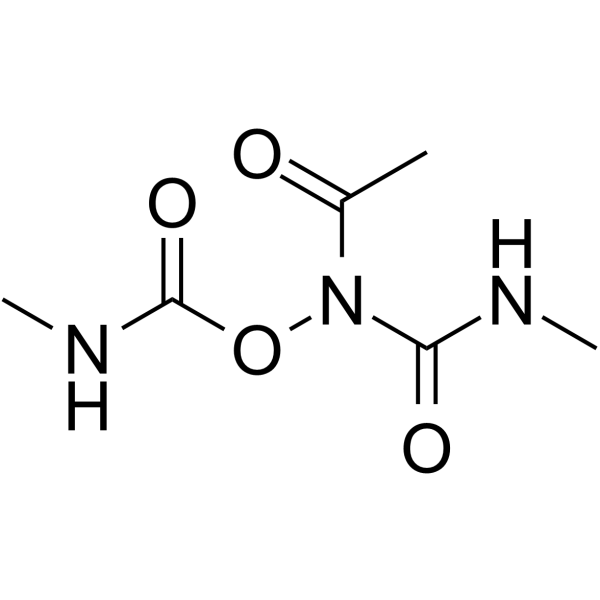
Caracemide
CAS No. 81424-67-1
Caracemide( NSC-253272 )
Catalog No. M26639 CAS No. 81424-67-1
Caracemide inhibits the enzyme ribonucleotide reductase of Escherichia coli. Caracemide can be used in anticancer studies.
Purity : >98% (HPLC)
 COA
Datasheet
HNMR
HPLC
MSDS
Handing Instructions
COA
Datasheet
HNMR
HPLC
MSDS
Handing Instructions
| Size | Price / USD | Stock | Quantity |
| 1 mL x 10 mM in DMSO | 39 | In Stock |


|
| 5MG | 36 | In Stock |
|
| 10MG | 50 | In Stock |
|
| 25MG | 90 | In Stock |
|
| 100MG | Get Quote | In Stock |
|
| 200MG | Get Quote | In Stock |
|
| 500MG | Get Quote | In Stock |
|
| 1G | Get Quote | In Stock |
|
Biological Information
-
Product NameCaracemide
-
NoteResearch use only, not for human use.
-
Brief DescriptionCaracemide inhibits the enzyme ribonucleotide reductase of Escherichia coli. Caracemide can be used in anticancer studies.
-
DescriptionCaracemide inhibits the enzyme ribonucleotide reductase of Escherichia coli. Caracemide can be used in anticancer studies.(In Vitro):Caracemide produces severe central nervous system (CNS) toxicity because of the toxic metabolite, methylisocyanate (MIC). Caracemide inactivates R1 by covalent modification at the substrate-binding site.(In Vivo):After administration of Caracemide (6.6 mg/kg;i.p.), the mercapturic acid derivative AMCC was identified in rats urine.
-
In VitroCaracemide inactivates R1 by covalent modification at the substrate-binding site and has a toxic metabolite, methylisocyanate (MIC), in vivo.
-
In VivoThe mercapturic acid derivative AMCC was identified in urine rats following administration to rats of a single i.p. dose (6.6 mg/kg) of caracemide (NSC-253272). .
-
SynonymsNSC-253272
-
PathwayOthers
-
TargetOther Targets
-
RecptorAnti-infection| Bacterial
-
Research Area——
-
Indication——
Chemical Information
-
CAS Number81424-67-1
-
Formula Weight189.171
-
Molecular FormulaC6H11N3O4
-
Purity>98% (HPLC)
-
SolubilityIn Vitro:?DMSO : 100 mg/mL (528.63 mM)
-
SMILESCNC(=O)ON(C(C)=O)C(=O)NC
-
Chemical Name——
Shipping & Storage Information
-
Storage(-20℃)
-
ShippingWith Ice Pack
-
Stability≥ 2 years
Reference
1.Basanti LalHiran, et al. Oxidation of 3,4,5-trimethoxybenzaldehyde by pyridinium fluorochromate in N,N-dimethyl formamide medium: A kinetic and mechanistic study. Arabian Journal of Chemistry. Volume 9, Supplement 1, September 2016, Pages S440-S445
molnova catalog



related products
-
Micromelin
Micromelin is a coumarin from Micromelum minutum (Forst. f.) Seem (family Rutaceae).
-
LY195448
LY 195448 (4-(3-(2-Hydroxy-2-phenyl)ethylamino-3-methylbutyl)benzamide) is a substance present in human blood and urine that shows antitumor activity in a mouse tumor model and blocks cells in the mid-stage.
-
Apigenin 4-O-β-D-glu...
Apigenin 4′-O-β-D-glucopyranoside is a flavonoid that can be found in caledonian guioa villosa.
