


 Cart
Cart
 sales@molnova.com


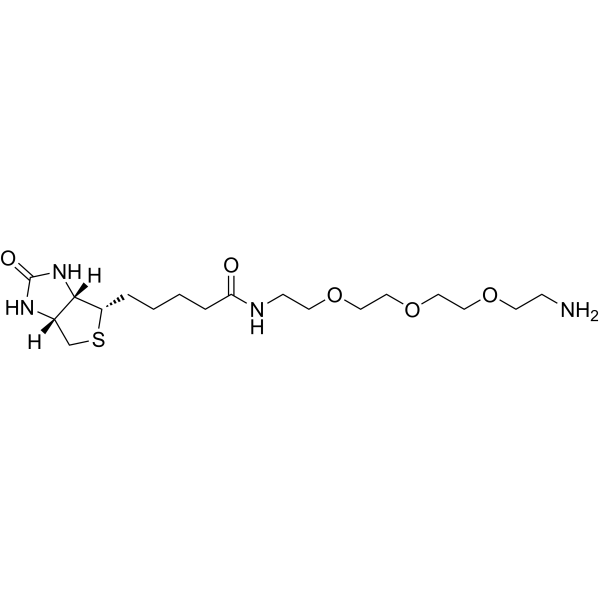
Amine-PEG3-Biotin
CAS No. 359860-27-8
Amine-PEG3-Biotin( —— )
Catalog No. M26604 CAS No. 359860-27-8
Amine-PEG3-Biotin can be used as a signal amplification label.
Purity : >98% (HPLC)
 COA
Datasheet
HNMR
HPLC
MSDS
Handing Instructions
COA
Datasheet
HNMR
HPLC
MSDS
Handing Instructions
| Size | Price / USD | Stock | Quantity |
| 10MG | 29 | In Stock |


|
| 25MG | 41 | In Stock |
|
| 50MG | 54 | In Stock |
|
| 100MG | Get Quote | In Stock |
|
| 200MG | Get Quote | In Stock |
|
| 500MG | Get Quote | In Stock |
|
| 1G | Get Quote | In Stock |
|
Biological Information
-
Product NameAmine-PEG3-Biotin
-
NoteResearch use only, not for human use.
-
Brief DescriptionAmine-PEG3-Biotin can be used as a signal amplification label.
-
DescriptionAmine-PEG3-Biotin can be used as a signal amplification label.
-
In Vitro——
-
In Vivo——
-
Synonyms——
-
PathwayOthers
-
TargetOther Targets
-
RecptormGluR
-
Research Area——
-
Indication——
Chemical Information
-
CAS Number359860-27-8
-
Formula Weight418.55
-
Molecular FormulaC18H34N4O5S
-
Purity>98% (HPLC)
-
SolubilityIn Vitro:?DMSO : 100 mg/mL (238.92 mM)
-
SMILESNCCOCCOCCOCCNC(=O)CCCC[C@@H]1SC[C@@H]2NC(=O)N[C@H]12
-
Chemical Name——
Shipping & Storage Information
-
Storage(-20℃)
-
ShippingWith Ice Pack
-
Stability≥ 2 years
Reference
1.Brabet I, et al. Phenylglycine derivatives discriminate between mGluR1- and mGluR5-mediated responses. Neuropharmacology. 1995 Aug;34(8):895-903.
molnova catalog



related products
-
Pueroside B
Pueroside B may can treat coronary heart disease, it can interact with two or more targets[peroxisome proliferator activated receptor γ (PPAR-γ), angiotensin-converting enzyme (ACE), hydroxymethylglutaryl coenzyme A receptor (HMGR), cyclooxygenase-2 (COX2), and thrombin].
-
4-Methylumbelliferyl...
4-Methylumbelliferyl-β-D-xylopyranoside (4-Methylumbelliferyl-β-D-xyloside) exhibits bursting steady-state kinetics in biological experiments.
-
3-Guanidinopropionic...
3-Guanidinopropionic acid is a creatine analog that alters skeletal muscle energy expenditure.?It reduces cellular ATP creatine and phosphocreatine levels and stimulates AMP-activated protein kinase (AMPK) activating PPARγ coactivator 1α (PGC-1α).
