


 Cart
Cart
 sales@molnova.com


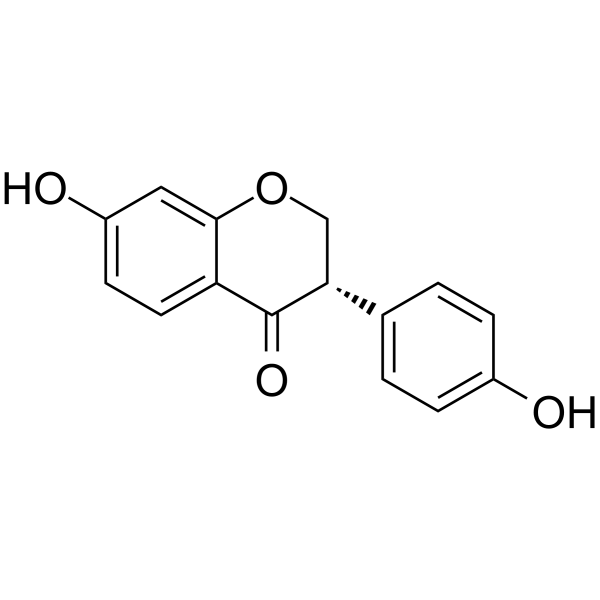
S-Dihydrodaidzein
CAS No. 879559-75-8
S-Dihydrodaidzein( (3S)-7-hydroxy-3-(4-hydroxyphenyl)-2,3-dihydrochromen-4-one )
Catalog No. M26427 CAS No. 879559-75-8
S-Dihydrodaidzein is an enantiomer of dihydrodaidzein which is involved in equol biosynthesis in a lactic acid bacterium, Lactococcus sp. strain.
Purity : >98% (HPLC)
 COA
Datasheet
HNMR
HPLC
MSDS
Handing Instructions
COA
Datasheet
HNMR
HPLC
MSDS
Handing Instructions
| Size | Price / USD | Stock | Quantity |
| 1 mL x 10 mM in DMSO | 181 | In Stock |


|
| 5MG | 92 | In Stock |
|
| 100MG | Get Quote | In Stock |
|
| 200MG | Get Quote | In Stock |
|
| 500MG | Get Quote | In Stock |
|
| 1G | Get Quote | In Stock |
|
Biological Information
-
Product NameS-Dihydrodaidzein
-
NoteResearch use only, not for human use.
-
Brief DescriptionS-Dihydrodaidzein is an enantiomer of dihydrodaidzein which is involved in equol biosynthesis in a lactic acid bacterium, Lactococcus sp. strain.
-
DescriptionS-Dihydrodaidzein is an enantiomer of dihydrodaidzein which is involved in equol biosynthesis in a lactic acid bacterium, Lactococcus sp. strain.
-
In Vitro——
-
In Vivo——
-
Synonyms(3S)-7-hydroxy-3-(4-hydroxyphenyl)-2,3-dihydrochromen-4-one
-
PathwayOthers
-
TargetOther Targets
-
RecptorCereblon
-
Research Area——
-
Indication——
Chemical Information
-
CAS Number879559-75-8
-
Formula Weight256.257
-
Molecular FormulaC15H12O4
-
Purity>98% (HPLC)
-
Solubility——
-
SMILESOc1ccc(cc1)[C@H]1COc2cc(O)ccc2C1=O
-
Chemical Name——
Shipping & Storage Information
-
Storage(-20℃)
-
ShippingWith Ice Pack
-
Stability≥ 2 years
Reference
1.Kim K, et al. Disordered region of cereblon is required for efficient degradation by proteolysis-targeting chimera.Sci Rep. 2019 Dec 23;9(1):19654.
molnova catalog



related products
-
ML-097
ML-097 (CID-2160985) is a pan activator of Ras-related GTPases.
-
4-O-beta-D-Glucopyra...
4'''-O-beta-D-Glucopyranosyltrifloroside
-
[Tyr0] - α - CGRP, h...
[Tyr0] - α - CGRP, human
