


 Cart
Cart
 sales@molnova.com


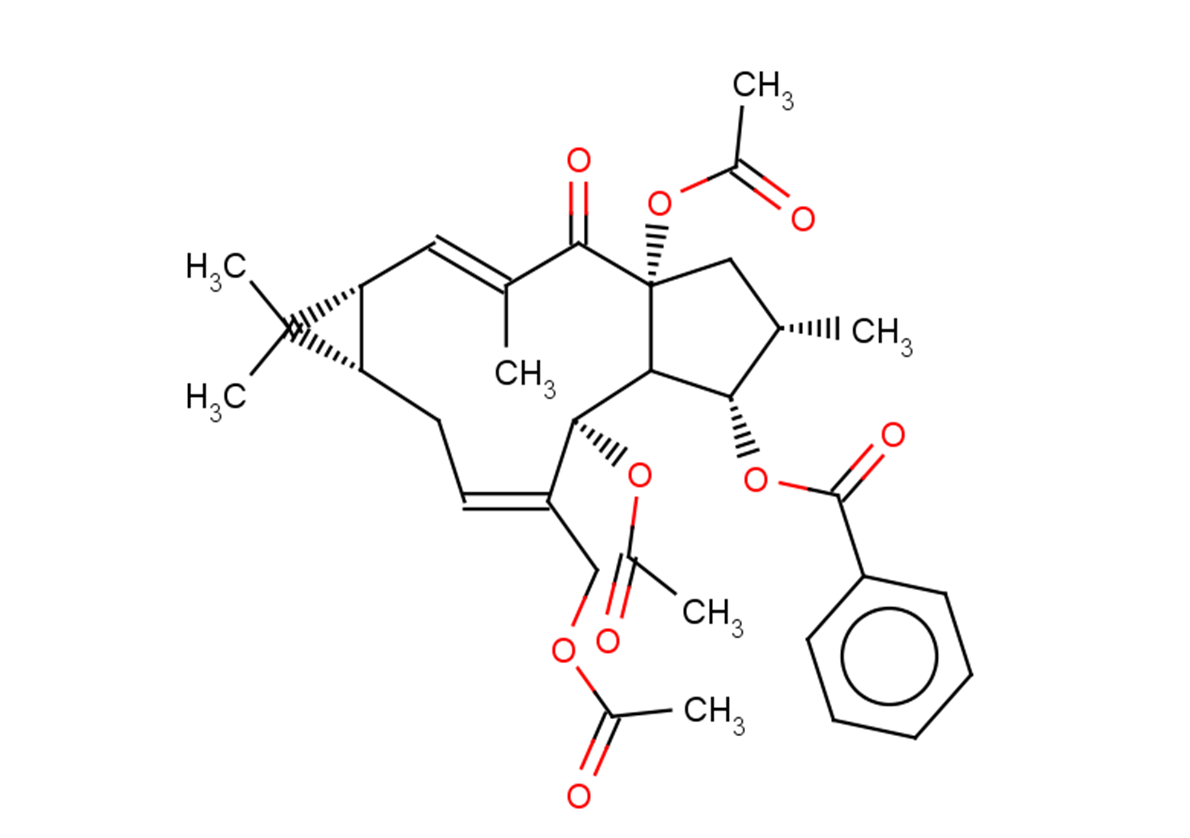
Euphorbia factor L7b
CAS No. 93550-95-9
Euphorbia factor L7b( —— )
Catalog No. M24987 CAS No. 93550-95-9
Euphorbia factor L7b,a natural product obtained from the herbs of Euphorbia pekinensis Rupr.
Purity : >98% (HPLC)
 COA
Datasheet
HNMR
HPLC
MSDS
Handing Instructions
COA
Datasheet
HNMR
HPLC
MSDS
Handing Instructions
| Size | Price / USD | Stock | Quantity |
| 1 mL x 10 mM in DMSO | 186 | In Stock |


|
| 5MG | 148 | In Stock |
|
| 10MG | 217 | In Stock |
|
| 100MG | Get Quote | In Stock |
|
| 200MG | Get Quote | In Stock |
|
| 500MG | Get Quote | In Stock |
|
| 1G | Get Quote | In Stock |
|
Biological Information
-
Product NameEuphorbia factor L7b
-
NoteResearch use only, not for human use.
-
Brief DescriptionEuphorbia factor L7b,a natural product obtained from the herbs of Euphorbia pekinensis Rupr.
-
DescriptionEuphorbia factor L7b,a natural product obtained from the herbs of Euphorbia pekinensis Rupr.
-
In Vitro——
-
In Vivo——
-
Synonyms——
-
PathwayOthers
-
TargetOther Targets
-
RecptorOthers
-
Research Area——
-
Indication——
Chemical Information
-
CAS Number93550-95-9
-
Formula Weight580.67
-
Molecular FormulaC33H40O9
-
Purity>98% (HPLC)
-
Solubility——
-
SMILESC[C@@H](C[C@@]([C@H]1[C@H](/C(/COC(C)=O)=C\C[C@@H]2C(C)(C)[C@@H]2/C=C2\C)OC(C)=O)(C2=O)OC(C)=O)[C@@H]1OC(c1ccccc1)=O
-
Chemical Name——
Shipping & Storage Information
-
Storage(-20℃)
-
ShippingWith Ice Pack
-
Stability≥ 2 years
Reference
1.W.Adolf, et al. Lathyrane type diterpene esters from Euphorbia lathyris. Phytochemistry (Elsevier) (1984), 23(7), 1461-3.
molnova catalog



related products
-
H-Glu-Glu-Lys-Leu-Il...
EEKLIVVAF is a pepitide, can be recognized on HLA-B44 by the anti-melanoma cytolytic T-cell (CTL) clone LB33- CTL-159/5.
-
SIVmac239-1
SIVmac239-1
-
BRM/BRG1 ATP Inhibit...
BRM/BRG1 ATP Inhibitor-1 is an allosteric dual Brahma homolog (BRM)/SWI/SNF related matrix-associated actin-dependent regulator of chromatin subfamily A member 2 (SMARCA2) and BRG1/SMARCA4 ATPase activity inhibitor (IC50s<0.005 μM).
