


 Cart
Cart
 sales@molnova.com


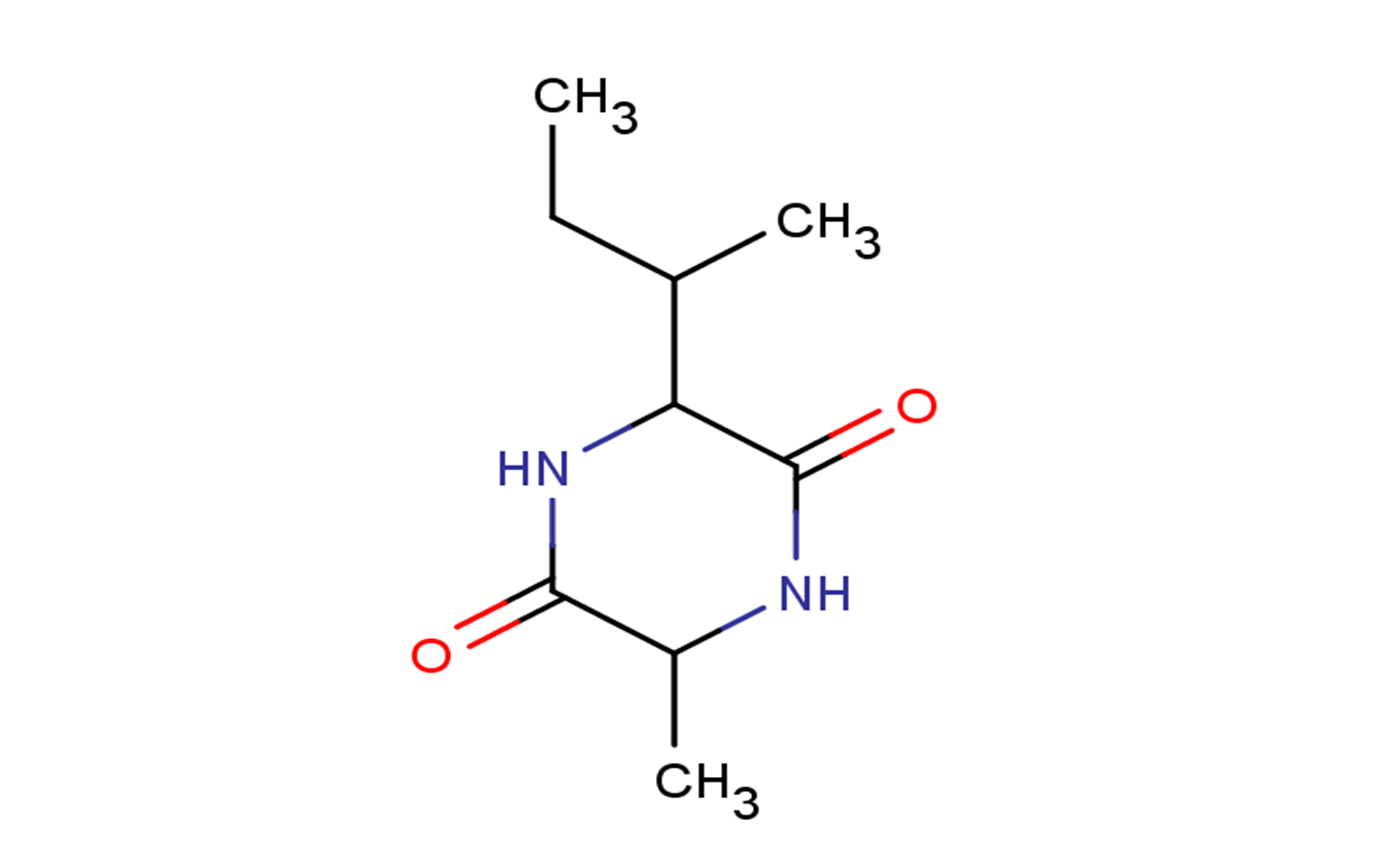
Cyclo(Ile-Ala)
CAS No. 90821-99-1
Cyclo(Ile-Ala)( —— )
Catalog No. M24947 CAS No. 90821-99-1
Cyclo(Ile-Ala) is a natural product.
Purity : >98% (HPLC)
 COA
Datasheet
HNMR
HPLC
MSDS
Handing Instructions
COA
Datasheet
HNMR
HPLC
MSDS
Handing Instructions
| Size | Price / USD | Stock | Quantity |
| 1 mL x 10 mM in DMSO | 42 | In Stock |


|
| 5MG | 38 | In Stock |
|
| 10MG | 65 | In Stock |
|
| 25MG | 107 | In Stock |
|
| 50MG | 154 | In Stock |
|
| 100MG | 228 | In Stock |
|
| 200MG | Get Quote | In Stock |
|
| 500MG | Get Quote | In Stock |
|
| 1G | Get Quote | In Stock |
|
Biological Information
-
Product NameCyclo(Ile-Ala)
-
NoteResearch use only, not for human use.
-
Brief DescriptionCyclo(Ile-Ala) is a natural product.
-
DescriptionCyclo(Ile-Ala) is a natural product.
-
In Vitro——
-
In Vivo——
-
Synonyms——
-
PathwayOthers
-
TargetOther Targets
-
RecptorOthers
-
Research Area——
-
Indication——
Chemical Information
-
CAS Number90821-99-1
-
Formula Weight184.24
-
Molecular FormulaC9H16N2O2
-
Purity>98% (HPLC)
-
SolubilityDMSO:10 mM
-
SMILESCCC(C)C1C(=O)NC(C(=O)N1)C
-
Chemical Name——
Shipping & Storage Information
-
Storage(-20℃)
-
ShippingWith Ice Pack
-
Stability≥ 2 years
Reference
1.Cyclic dipeptides as new cell cycle inhibitors produced by Streptomyces flavoretus 18522 Journal of Shenyang Pharmaceutical University, 2015 (2) :107 -10.
molnova catalog



related products
-
RORγ inverse agonist...
RORγ inverse agonist 1 has anti-inflammatory activity and can be used to treat rheumatism and psoriasis.
-
MRE-269
Ursonic acid belongs to the family of Ursane Triterpenes whose structure is based on the pentacyclic ursane skeleton. It has potential as HIV-1 Protease Inhibitor.
-
Fosaprepitant Benzyl...
Fosaprepitant Benzyl Ester
