


 Cart
Cart
 sales@molnova.com


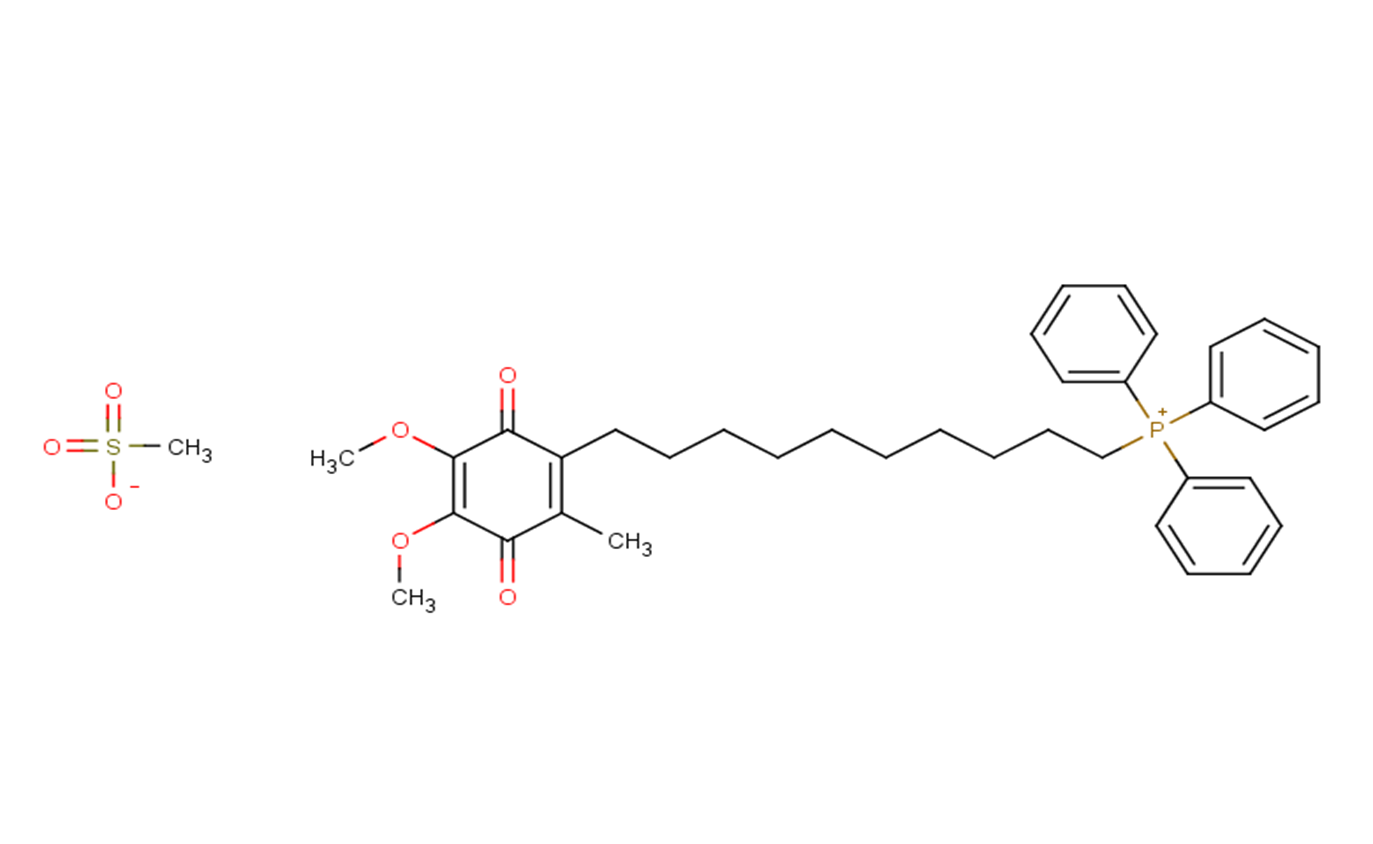
Mitoquinone mesylate
CAS No. 845959-50-4
Mitoquinone mesylate( MitoQ mesylate | MitoQ10 mesylate )
Catalog No. M24836 CAS No. 845959-50-4
Mitoquinone mesylate is a TPP-based, mitochondrially targeted antioxidant to protect against oxidative damage.
Purity : >98% (HPLC)
 COA
Datasheet
HNMR
HPLC
MSDS
Handing Instructions
COA
Datasheet
HNMR
HPLC
MSDS
Handing Instructions
| Size | Price / USD | Stock | Quantity |
| 1 mL x 10 mM in DMSO | 104 | In Stock |


|
| 5MG | 68 | In Stock |
|
| 10MG | 107 | In Stock |
|
| 25MG | 188 | In Stock |
|
| 50MG | 276 | In Stock |
|
| 100MG | 423 | In Stock |
|
| 200MG | Get Quote | In Stock |
|
| 500MG | Get Quote | In Stock |
|
| 1G | Get Quote | In Stock |
|
Biological Information
-
Product NameMitoquinone mesylate
-
NoteResearch use only, not for human use.
-
Brief DescriptionMitoquinone mesylate is a TPP-based, mitochondrially targeted antioxidant to protect against oxidative damage.
-
DescriptionMitoquinone mesylate is a TPP-based, mitochondrially targeted antioxidant to protect against oxidative damage.(In Vitro):Mitoquinone (MitoQ) is a mitochondria-targeted antioxidant.The optimal doses for Mitoquinone (MitoQ) and DecylTPP treatment are selected from dose-response experiments during 4-h cold storage (CS). The potential protective benefits of Mitoquinone treatment against CS injury are tested initially using MitoSOX Red, a mitochondrial-targeted fluorescent dye that measures mitochondrial superoxide generation. Normal rat kidney (NRK) cells exposed to CS result in a ~2-fold increase in fluorescence due to mitochondrial superoxide compared with untreated cells. Mitoquinone offers significant protection against CS-induced mitochondrial superoxide generation; whereas the control compound DecylTPP does not offer any protection. Mitoquinone treatment markedly decreases mitochondrial superoxide generation, whereas kidneys treated with DecylTPP have comparable levels of mitochondrial superoxide to kidneys exposed to CS alone.(In Vivo):Mitoquinone (MitoQ) treatment significantly reduces pancreatic oedema and neutrophil infiltration. MitoQ dose-dependently increases serum amylase with an approximate doubling at the higher dose. MitoQ treatment nearly doubles lung MPO activity induced by Caerulein with a significant increase of serum IL-6 levels also evident at 10 mg/kg (dose 1).
-
In VitroMitoquinone (MitoQ) is a mitochondria-targeted antioxidant.The optimal doses for Mitoquinone (MitoQ) and DecylTPP treatment are selected from dose-response experiments during 4-h cold storage (CS). The potential protective benefits of Mitoquinone treatment against CS injury are tested initially using MitoSOX Red, a mitochondrial-targeted fluorescent dye that measures mitochondrial superoxide generation. Normal rat kidney (NRK) cells exposed to CS result in a ~2-fold increase in fluorescence due to mitochondrial superoxide compared with untreated cells. Mitoquinone offers significant protection against CS-induced mitochondrial superoxide generation; whereas the control compound DecylTPP does not offer any protection. Mitoquinonetreatment markedly decreases mitochondrial superoxide generation, whereas kidneys treated with DecylTPP have comparable levels of mitochondrial superoxide to kidneys exposed to CS alone.
-
In VivoMitoquinone (MitoQ) treatment significantly reduces pancreatic oedema and neutrophil infiltration. MitoQ dose-dependently increases serum amylase with an approximate doubling at the higher dose. MitoQ treatment nearly doubles lung MPO activity induced by Caeruleinwith a significant increase of serum IL-6 levels also evident at 10?mg/kg (dose 1).
-
SynonymsMitoQ mesylate | MitoQ10 mesylate
-
PathwayImmunology/Inflammation
-
TargetROS
-
RecptorReactive Oxygen Species
-
Research Area——
-
Indication——
Chemical Information
-
CAS Number845959-50-4
-
Formula Weight678.81
-
Molecular FormulaC38H47O7PS
-
Purity>98% (HPLC)
-
SolubilityDMSO:50 mg/mL (73.66 mM; Need ultrasonic);H2O:< 0.1 mg/mL (insoluble)
-
SMILES[O-]S(=O)(C)=O.O=C(C(CCCCCCCCCC[P+](C1=CC=CC=C1)(C2=CC=CC=C2)C3=CC=CC=C3)=C4C)C(OC)=C(OC)C4=O
-
Chemical Name——
Shipping & Storage Information
-
Storage(-20℃)
-
ShippingWith Ice Pack
-
Stability≥ 2 years
Reference
1.Mitchell T, et al. The mitochondria-targeted antioxidant mitoquinone protects against cold storage injury of renaltubular cells and rat kidneys. J Pharmacol Exp Ther. 2011 Mar;336(3):682-92.
molnova catalog



related products
-
Lycopene
Extracted from Papaya fruit, marigold flower petals;Store the product in sealed, cool and dry condition.
-
Camalexin
Camalexin is a phytoalexin isolated from Camelina sativa. It has antifungal, antibacterial, antiproliferative, and anticancer activities.
-
Fagomine
Fagomine (D-Fagomine) is a mild glycosidase inhibitor, an analog of 1-deoxynojirimycin (DNJ) with hypoglycemic activity, and Fagomine reduces intracellular reactive oxygen species (ROS) production and malondialdehyde (MDA) levels.
