


 Cart
Cart
 sales@molnova.com


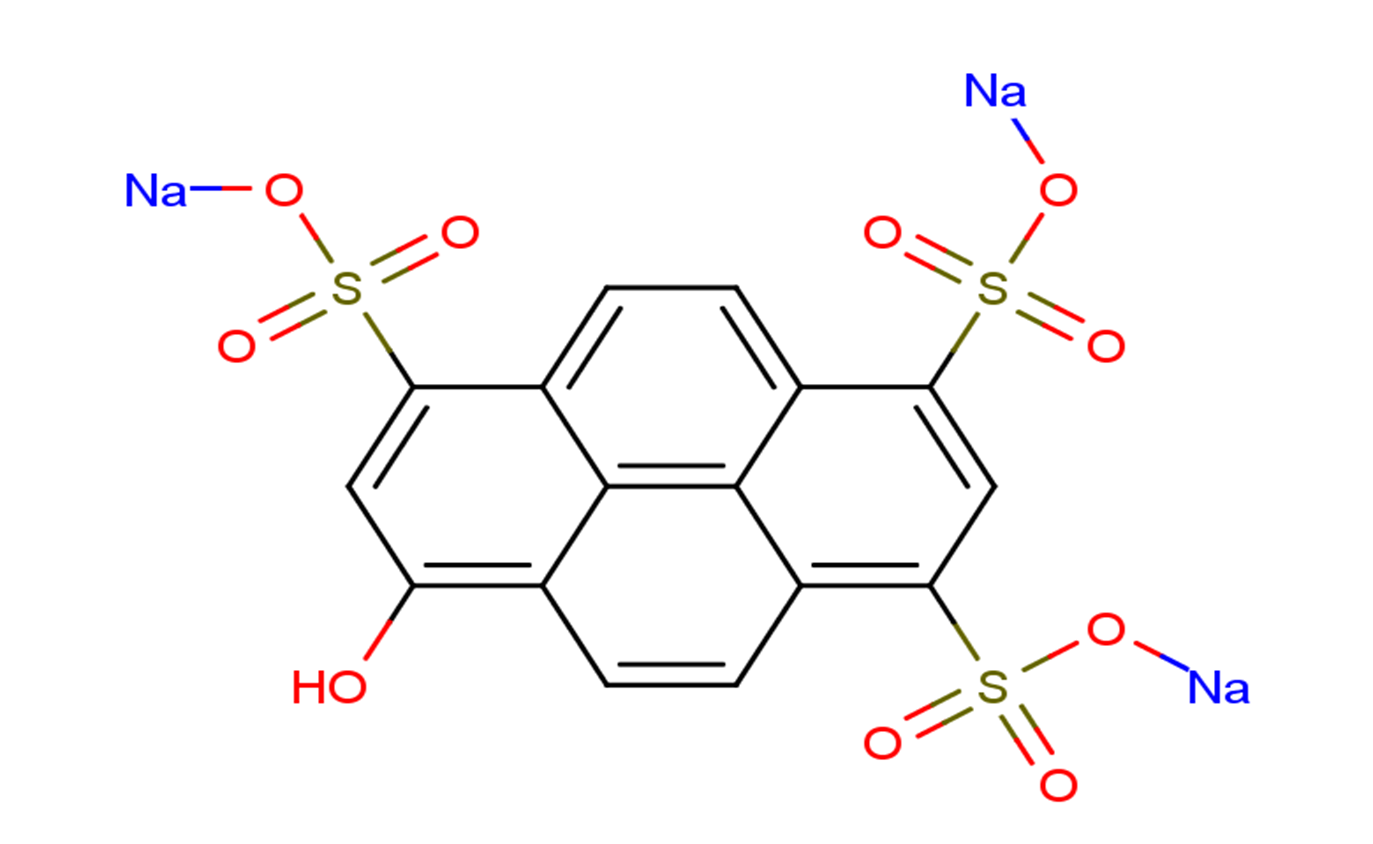
Pyranine
CAS No. 6358-69-6
Pyranine( HPTS | Solvent Green 7 )
Catalog No. M24647 CAS No. 6358-69-6
Pyranine is reported as a new class of fluorescent chemosensor for the Cu+ ion.
Purity : >98% (HPLC)
 COA
Datasheet
HNMR
HPLC
MSDS
Handing Instructions
COA
Datasheet
HNMR
HPLC
MSDS
Handing Instructions
| Size | Price / USD | Stock | Quantity |
| 1 mL x 10 mM in DMSO | 48 | In Stock |


|
| 100MG | Get Quote | In Stock |
|
| 200MG | Get Quote | In Stock |
|
| 500MG | 43 | In Stock |
|
| 1G | 73 | In Stock |
|
Biological Information
-
Product NamePyranine
-
NoteResearch use only, not for human use.
-
Brief DescriptionPyranine is reported as a new class of fluorescent chemosensor for the Cu+ ion.
-
DescriptionPyranine is reported as a new class of fluorescent chemosensor for the Cu+ ion.
-
In VitroPyranine is capable of discriminating ranges of cations from the Cu+ ion, even in competing environment. Pyranine displays a rapid fluorescence response (t1/2=1.66 min) towards the Cu+ ion, and the micromolar detection limit enables the detection of the ion in environmental samples. The observed stoichiometry of complexation between Pyranine and Cu+ is 2:1. The pH-sensitive fluorescent indicator Pyranine is studied to determine its usefulness as probes for the living cornea and anterior chamber. Adequate concentrations are reached in the cornea and anterior chamber after topical administration; measurements can be made by fluorophotometry for many hours. The pH is calculated by measuring the ratio of fluorescent intensity at two excitation wavelengths, I463/I404, a measurement which is dependent on pH but independent of the concentration of the fluorophore and other variables which can alter the intensity. In the rabbit eye, Pyranine in the cornea and anterior chamber is observed to undergo easily measurable changes in fluorescent ratios associated with lid closure and contact lens wear, indicating its sensitivity to mild changes in pH.
-
In Vivo——
-
SynonymsHPTS | Solvent Green 7
-
PathwayOthers
-
TargetOther Targets
-
RecptorOthers
-
Research Area——
-
Indication——
Chemical Information
-
CAS Number6358-69-6
-
Formula Weight524.39
-
Molecular FormulaC16H7Na3O10S3
-
Purity>98% (HPLC)
-
SolubilityH2O:100 mg/mL (190.70 mM; Need ultrasonic);DMSO:25 mg/mL (47.67 mM; Need ultrasonic)
-
SMILESO=S(C1=C(C2=C34)C=CC4=C(O)C=C(S(=O)(O[Na])=O)C3=CC=C2C(S(=O)(O[Na])=O)=C1)(O[Na])=O
-
Chemical Name——
Shipping & Storage Information
-
Storage(-20℃)
-
ShippingWith Ice Pack
-
Stability≥ 2 years
Reference
1.Saha T, et al. In vitro sensing of Cu(+) through a green fluorescence rise of pyranine. Photochem Photobiol Sci. 2014 Oct;13(10):1427-33.
molnova catalog



related products
-
8-[(2,6-dimethylbenz...
8-[(2,6-dimethylbenzyl)amino]-2,3-dimethylimidazo[1,2-a]pyridine-6-carboxylic acid is chemical agent.
-
(β-Asp3)-VIP (human,...
(β-Asp3)-VIP (human, bovine, porcine, rat)
-
HIV-gp120- Fragment ...
HIV gp120 308-331 is HIV antigen fragments, that conjugates with keyhole limpet hemocyanin (KLH) and generates specific anti-HIV antibody.
