


 Cart
Cart
 sales@molnova.com


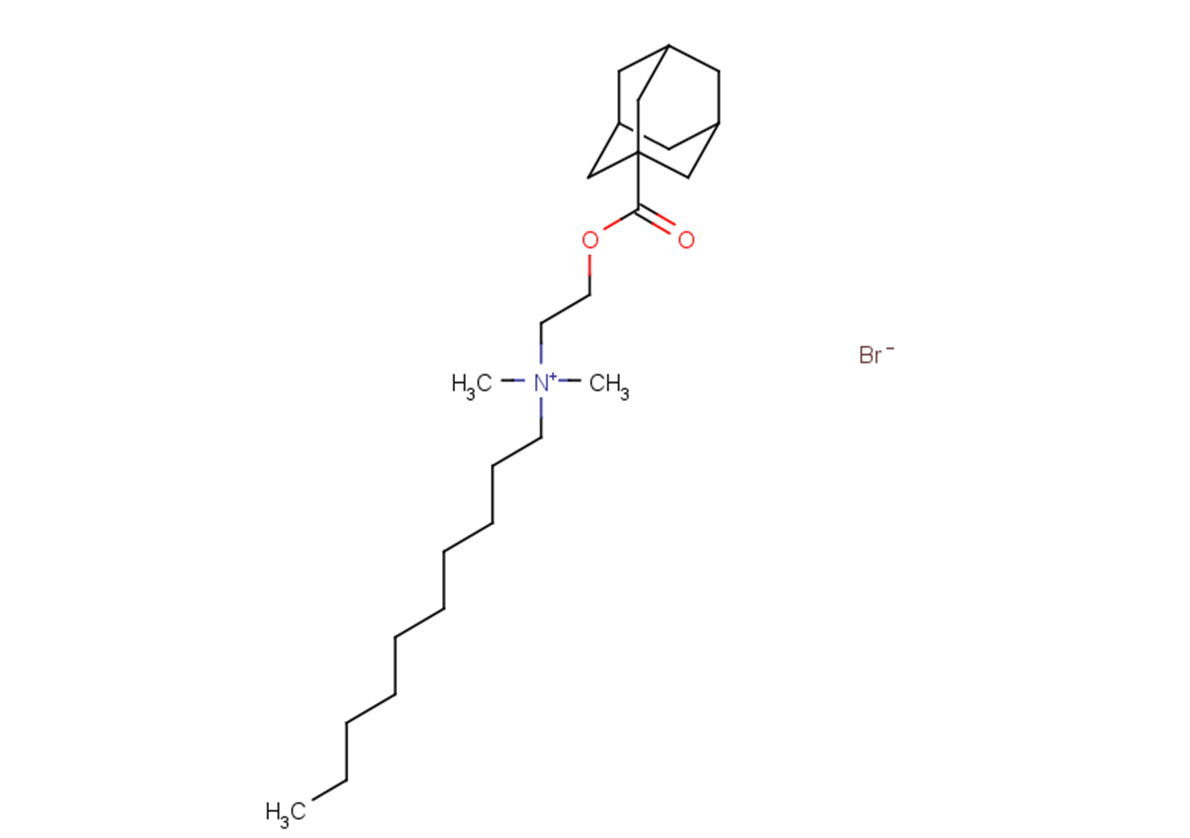
Amantanium bromide
CAS No. 58158-77-3
Amantanium bromide( Amantanil bromidum )
Catalog No. M24573 CAS No. 58158-77-3
Amantanium bromide is a quaternary ammonium compound used as an antiseptic/disinfectant for therapeutic function.
Purity : >98% (HPLC)
 COA
Datasheet
HNMR
HPLC
MSDS
Handing Instructions
COA
Datasheet
HNMR
HPLC
MSDS
Handing Instructions
| Size | Price / USD | Stock | Quantity |
| 1 mL x 10 mM in DMSO | 432 | In Stock |


|
| 5MG | 661 | In Stock |
|
| 10MG | 895 | In Stock |
|
| 25MG | 1321 | In Stock |
|
| 50MG | 1739 | In Stock |
|
| 100MG | 2353 | In Stock |
|
| 200MG | Get Quote | In Stock |
|
| 500MG | Get Quote | In Stock |
|
| 1G | Get Quote | In Stock |
|
Biological Information
-
Product NameAmantanium bromide
-
NoteResearch use only, not for human use.
-
Brief DescriptionAmantanium bromide is a quaternary ammonium compound used as an antiseptic/disinfectant for therapeutic function.
-
DescriptionAmantanium bromide is a quaternary ammonium compound used as an antiseptic/disinfectant for therapeutic function.
-
In Vitro——
-
In Vivo——
-
SynonymsAmantanil bromidum
-
PathwayOthers
-
TargetOther Targets
-
RecptorOthers
-
Research Area——
-
Indication——
Chemical Information
-
CAS Number58158-77-3
-
Formula Weight472.54
-
Molecular FormulaC25H46BrNO2
-
Purity>98% (HPLC)
-
Solubility——
-
SMILESCCCCCCCCCC[N+](C)(C)CCOC(C1(CC(C2)C3)CC3CC2C1)=O.[Br-]
-
Chemical Name——
Shipping & Storage Information
-
Storage(-20℃)
-
ShippingWith Ice Pack
-
Stability≥ 2 years
Reference
1.Richard C. Allen. Chapter 32. To Market, To Market—1984[J]. Annual Reports in Medicinal Chemistry, 1985, 20:315-325.
molnova catalog



related products
-
D(-)-Arabinose
Arabinose is an aldopentose – a monosaccharide containing five carbon atoms, and including an aldehyde (CHO) functional group.
-
4-P-PDOT
4-P-PDOT is a potent, selective and affinity Melatonin receptor (MT2) antagonist.
-
Djenkolic Acid
Djenkolic Acid is a naturally occurring sulfur-containing amino acid extracted from djenkol beans(Archidendron pauciflorum), which is native to Southeast Asia.
