


 Cart
Cart
 sales@molnova.com


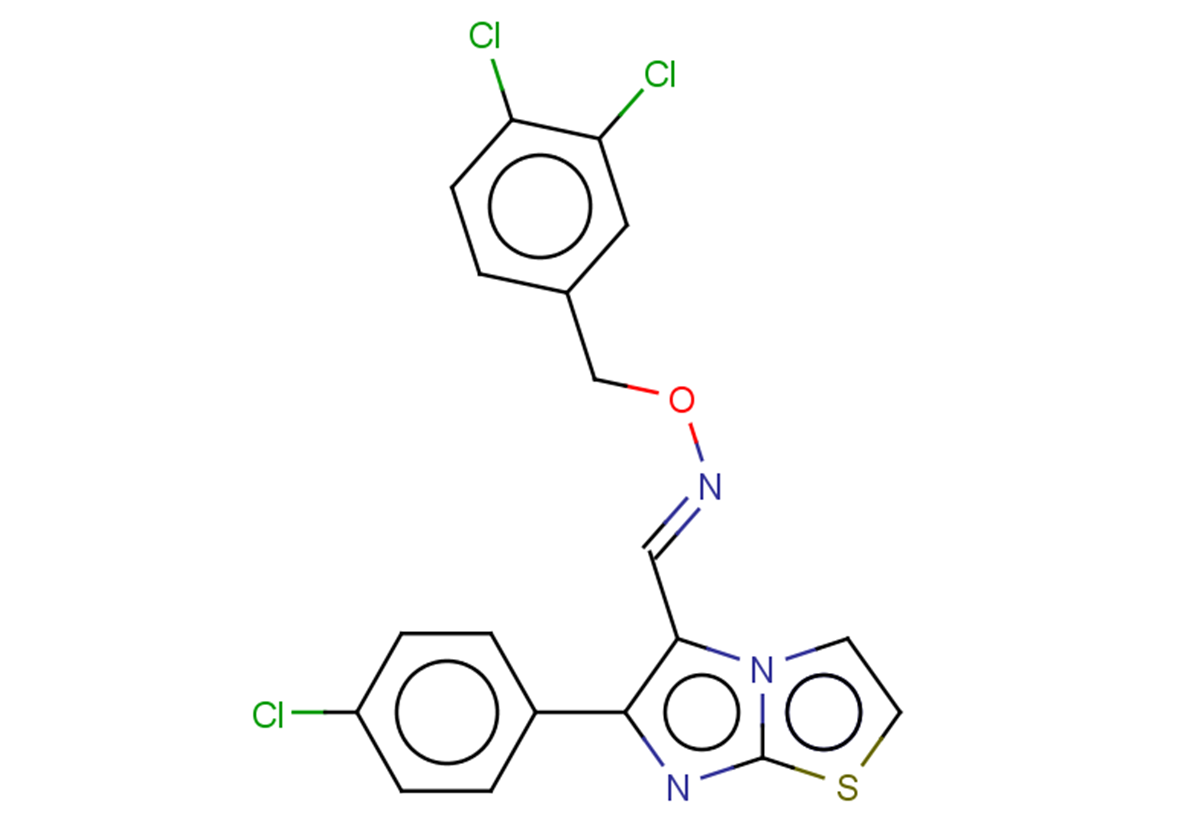
CITCO
CAS No. 338404-52-7
CITCO( —— )
Catalog No. M24287 CAS No. 338404-52-7
CITCO inhibits growth and expansion of brain tumour stem cells (BTSCs) and has an EC50 of 49 nM over pregnane X receptor (PXR), and no activity on other nuclear receptors.
Purity : >98% (HPLC)
 COA
Datasheet
HNMR
HPLC
MSDS
Handing Instructions
COA
Datasheet
HNMR
HPLC
MSDS
Handing Instructions
| Size | Price / USD | Stock | Quantity |
| 1 mL x 10 mM in DMSO | 60 | In Stock |


|
| 5MG | 54 | In Stock |
|
| 10MG | 86 | In Stock |
|
| 25MG | 158 | In Stock |
|
| 50MG | 247 | In Stock |
|
| 100MG | 369 | In Stock |
|
| 200MG | 555 | In Stock |
|
| 500MG | Get Quote | In Stock |
|
| 1G | Get Quote | In Stock |
|
Biological Information
-
Product NameCITCO
-
NoteResearch use only, not for human use.
-
Brief DescriptionCITCO inhibits growth and expansion of brain tumour stem cells (BTSCs) and has an EC50 of 49 nM over pregnane X receptor (PXR), and no activity on other nuclear receptors.
-
DescriptionCITCO inhibits growth and expansion of brain tumour stem cells (BTSCs) and has an EC50 of 49 nM over pregnane X receptor (PXR), and no activity on other nuclear receptors. CITCO is an imidazothiazole derivative and it also is a selective Constitutive androstane receptor (CAR) agonist.
-
In VitroCITCO (1-50 μM; 48?hours) results in a dose-dependent inhibition of viable cell count and proliferation in both T98G and U87MG glioma and BTSCs. CITCO (2.5, 5?μM; 48?hours) induces cell cycle arrest differentially in different BTSCs in culture, but not in normal astrocytes. CITCO (2.5-10?μM; 48?hours) induces apoptosis in BTSCs in culture in dose dependently, but not in normal astrocytes. CITCO (0-25?μM; 48?hours) causes the T98G and U87MG glioma and BTSCs expressing very low levels of CAR protein that increased significantly. Cell Proliferation Assay Cell Line:T98G, U87MG, DB29 and DB33 human glioma cells, astrocytes Concentration:1, 2.5, 5, 10, 25, 50 μM Incubation Time:48?hours Result:Resulted in a dose-dependent inhibition of viable cell count and proliferation.Cell Cycle Analysis Cell Line:The T98G, U87MG, DB29 and DB33 glioma cells Concentration:2.5, 5?μM Incubation Time:48?hours Result:Induced cell cycle arrest differentially in different BTSCs in culture.Apoptosis Analysis Cell Line:The T98G, U87MG, DB29 and DB33 glioma cells Concentration:2.5, 5 or 10?μM Incubation Time:48?hours Result:Increased the levels of Annexin V-positive apoptotic cells in dose dependently. Western Blot Analysis Cell Line:T98G, U87MG, DB29 and DB33 glioma cells Concentration:0 to 25?μM Incubation Time:48?hours Result:The T98G, U87MG glioma and BTSCs expressed very low levels of CAR protein that increased significantly.
-
In VivoCITCO (intraperitoneal; on days 22, 24, 26, 30 and 36) with 25?μg results a significant decrease in tumour growth, which further decreases to an undetectable level after treatment with 100?μg CITCO . Animal Model:Six- to eight-week-old male athymic nude mice Dosage:25 or 100?μg Administration:Intraperitoneal; on days 22, 24, 26, 30 and 36 Result:Decreased tumour growth.
-
Synonyms——
-
PathwayOthers
-
TargetOther Targets
-
RecptorCAR|PXR
-
Research Area——
-
Indication——
Chemical Information
-
CAS Number338404-52-7
-
Formula Weight436.74
-
Molecular FormulaC19H12Cl3N3OS
-
Purity>98% (HPLC)
-
SolubilityDMSO:soluble; H2O:insoluble
-
SMILESClc(cc1)ccc1-c1c(/C=N/OCc(cc2)cc(Cl)c2Cl)n(ccs2)c2n1
-
Chemical Name——
Shipping & Storage Information
-
Storage(-20℃)
-
ShippingWith Ice Pack
-
Stability≥ 2 years
Reference
1.Chakraborty S, et al. Constitutive androstane receptor agonist CITCO inhibits growth and expansion of brain tumour stem cells. Br J Cancer. 2011 Feb 1;104(3):448-59.
molnova catalog



related products
-
rec Acetyl-Eglin c
rec Acetyl-Eglin c
-
MG149
in clinically as an antihypertensive.
-
Kaempferol 3,4-di-O-...
Kaempferol 3,4'-diglucoside, a flavonol compound, has been isolated from the aqueous methanolic extract of Norway spruce buds. Furthermore, this compound has also been identified in the needles of the Norway spruce.
