


 Cart
Cart
 sales@molnova.com


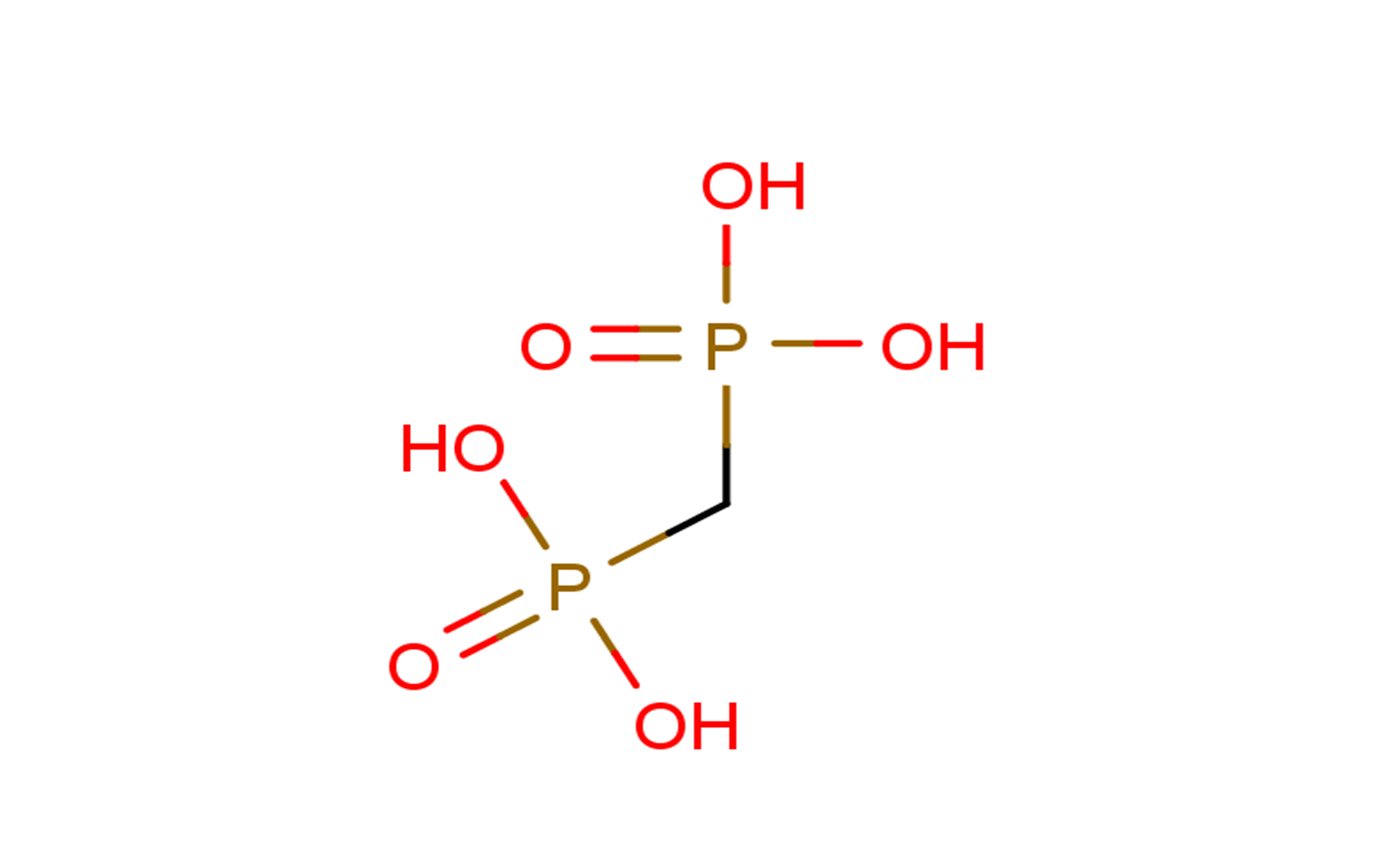
Medronic acid
CAS No. 1984-15-2
Medronic acid( Methylenediphosphonic acid )
Catalog No. M23896 CAS No. 1984-15-2
Medronic acid has affinity for and adheres to the surface of hydroxyapatite crystals in the bone matrix.
Purity : >98% (HPLC)
 COA
Datasheet
HNMR
HPLC
MSDS
Handing Instructions
COA
Datasheet
HNMR
HPLC
MSDS
Handing Instructions
| Size | Price / USD | Stock | Quantity |
| 1 mL x 10 mM in DMSO | 43 | In Stock |


|
| 50MG | 27 | In Stock |
|
| 100MG | Get Quote | In Stock |
|
| 200MG | Get Quote | In Stock |
|
| 500MG | Get Quote | In Stock |
|
| 1G | Get Quote | In Stock |
|
Biological Information
-
Product NameMedronic acid
-
NoteResearch use only, not for human use.
-
Brief DescriptionMedronic acid has affinity for and adheres to the surface of hydroxyapatite crystals in the bone matrix.
-
DescriptionMedronic acid has affinity for and adheres to the surface of hydroxyapatite crystals in the bone matrix. Medronic acid is a methylene-substituted bisphosphonate. Medronic acid accumulates at sites of osteoid mineralization and can be used, complexed with radioisotopes in bone imaging.
-
In Vitro——
-
In Vivo——
-
SynonymsMethylenediphosphonic acid
-
PathwayOthers
-
TargetOther Targets
-
RecptorOthers
-
Research Area——
-
Indication——
Chemical Information
-
CAS Number1984-15-2
-
Formula Weight176
-
Molecular FormulaCH6O6P2
-
Purity>98% (HPLC)
-
SolubilityDMSO:250 mg/mL (1420.45 mM; Need ultrasonic)
-
SMILESO=P(O)(O)CP(O)(O)=O
-
Chemical Name——
Shipping & Storage Information
-
Storage(-20℃)
-
ShippingWith Ice Pack
-
Stability≥ 2 years
Reference
1.Ohta Y, et al. Salt Tolerance Enhancement of Liquid Chromatography-Matrix-Assisted Laser Desorption/Ionization-Mass Spectrometry Using Matrix Additive MethylenediphosphonicAcid. Mass Spectrom (Tokyo). 2014;3(1):A0031.
molnova catalog



related products
-
Norfluoxetine Hydroc...
Norfluoxetine hydrochloride is an active metabolite of fluoxetine. Fluoxetine is an antidepressant drug.
-
GRP (18-27) (human, ...
Neuromedin C porcine (GRP, 18-27, porcine) is a bombesin-like neuropeptide that can be obtained from porcine spinal cord. Neuromedin C porcine exhibits a potent contractile activity on rat uterus in the characteristic manner of bombesin. Neuromedin C porcine has research potential for neurological-related diseases.
-
Rebaudioside E
Rebaudioside E is a natural product.
