


 Cart
Cart
 sales@molnova.com


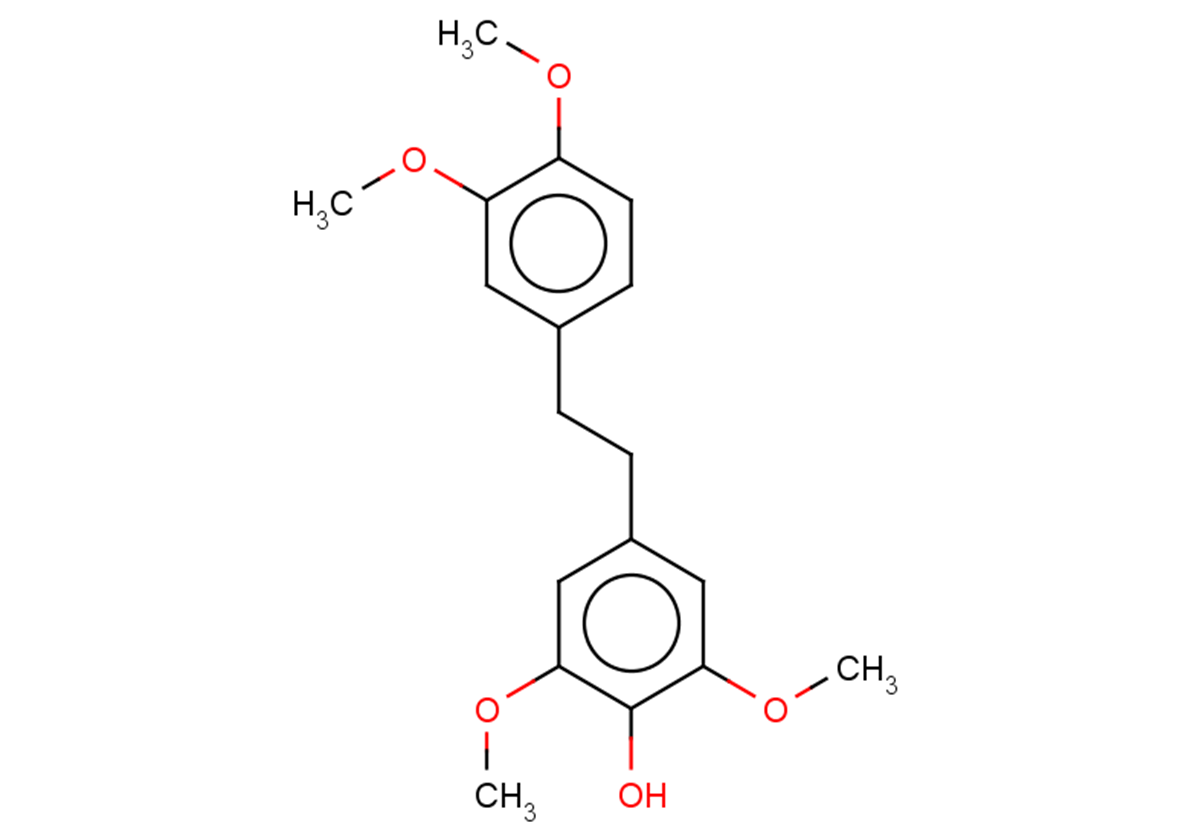
Chrysotoxine
CAS No. 156951-82-5
Chrysotoxine( 4-[2-(3,4-Dimethoxyphenyl)ethyl]-2,6-dimethoxyphenol | Phenol, 4-[2-(3,4-dimethoxyphenyl)ethyl]-2,6-dimethoxy- )
Catalog No. M23681 CAS No. 156951-82-5
Chrysotoxine inhibits 6-hydroxydopamine induced apoptosis in SH-SY5Y cells via NF-κB modulation and mitochondria protection.
Purity : >98% (HPLC)
 COA
Datasheet
HNMR
HPLC
MSDS
Handing Instructions
COA
Datasheet
HNMR
HPLC
MSDS
Handing Instructions
| Size | Price / USD | Stock | Quantity |
| 1 mL x 10 mM in DMSO | 282 | In Stock |


|
| 5MG | 283 | In Stock |
|
| 10MG | 430 | In Stock |
|
| 25MG | 710 | In Stock |
|
| 50MG | 977 | In Stock |
|
| 100MG | Get Quote | In Stock |
|
| 200MG | Get Quote | In Stock |
|
| 500MG | Get Quote | In Stock |
|
| 1G | Get Quote | In Stock |
|
Biological Information
-
Product NameChrysotoxine
-
NoteResearch use only, not for human use.
-
Brief DescriptionChrysotoxine inhibits 6-hydroxydopamine induced apoptosis in SH-SY5Y cells via NF-κB modulation and mitochondria protection.
-
DescriptionChrysotoxine inhibits 6-hydroxydopamine induced apoptosis in SH-SY5Y cells via NF-κB modulation and mitochondria protection.
-
In VitroWestern Blot Analysis Cell Line:460, H23 cells Concentration:0-20 μM Incubation Time:Overnight Result:Significant decreased the p-Src and p-Akt expression in a dose-dependent manner instead of Src and Akt.Significantly reduced the down-stream stem cell transcription factor Sox2 as the decline of p-Src in H460 and H23 cells.Cell Viability Assay Cell Line:460, H23 cells Concentration:0, 1, 5, 10, 20 and 50 μM Incubation Time:24 h Result:Significantly reduced cell viability and increased H460 and H23 cells cell apoptosis at 50 μM with IC50s of 127.34 and 145.47 μM, respectively.Showed no cytotoxic effect on non-tumor cell lines at all tested concentrations.Cell Differentiation Assay Cell Line:460, H23 cells Concentration:5-20 μM Incubation Time:72 h Result:Decreased approximately 30, 60, 90 and 95% of the H460 CSC spheroid size at day 7 with treated 1, 5,10 and 20 μM Chrysotoxine, respectively.Decreased approximately 40, 60, 80 and 92% of the H23 CSC spheroid size at day 7 with treated 1, 5,10 and 20 μM Chrysotoxine, respectively.
-
In Vivo——
-
Synonyms4-[2-(3,4-Dimethoxyphenyl)ethyl]-2,6-dimethoxyphenol | Phenol, 4-[2-(3,4-dimethoxyphenyl)ethyl]-2,6-dimethoxy-
-
PathwayApoptosis
-
TargetNF-κB
-
RecptorNF-κB
-
Research Area——
-
Indication——
Chemical Information
-
CAS Number156951-82-5
-
Formula Weight318.36
-
Molecular FormulaC18H22O5
-
Purity>98% (HPLC)
-
Solubility——
-
SMILESCOc(ccc(CCc(cc1OC)cc(OC)c1O)c1)c1OC
-
Chemical Name——
Shipping & Storage Information
-
Storage(-20℃)
-
ShippingWith Ice Pack
-
Stability≥ 2 years
Reference
1.Bhummaphan N, Pongrakhananon V, Sritularak B, Chanvorachote P. Cancer Stem Cell Suppressing Activity of Chrysotoxine, a bibenzyl from Dendrobium pulchellum. J Pharmacol Exp Ther. 2017 Dec 7. pii: jpet.117.244467. doi: 10.1124/jpet.117.244467.
molnova catalog



related products
-
Andrographolide
Andrographolide(Andrographis) is an irreversible antagonist of NF-κB and prevents in vitro T cell activation.
-
Withaferin A
Withaferin A is a steroid lactone that displays anti-inflammatory, antitumor and antiangiogenic activity, potently inhibits NF-κB activation.
-
AM-0561
AM-0561 (AM0561) is a highly potent inhibitor of NF-κB inducing Kinase (NIK) with Ki of 0.3 nM.
