


 Cart
Cart
 sales@molnova.com


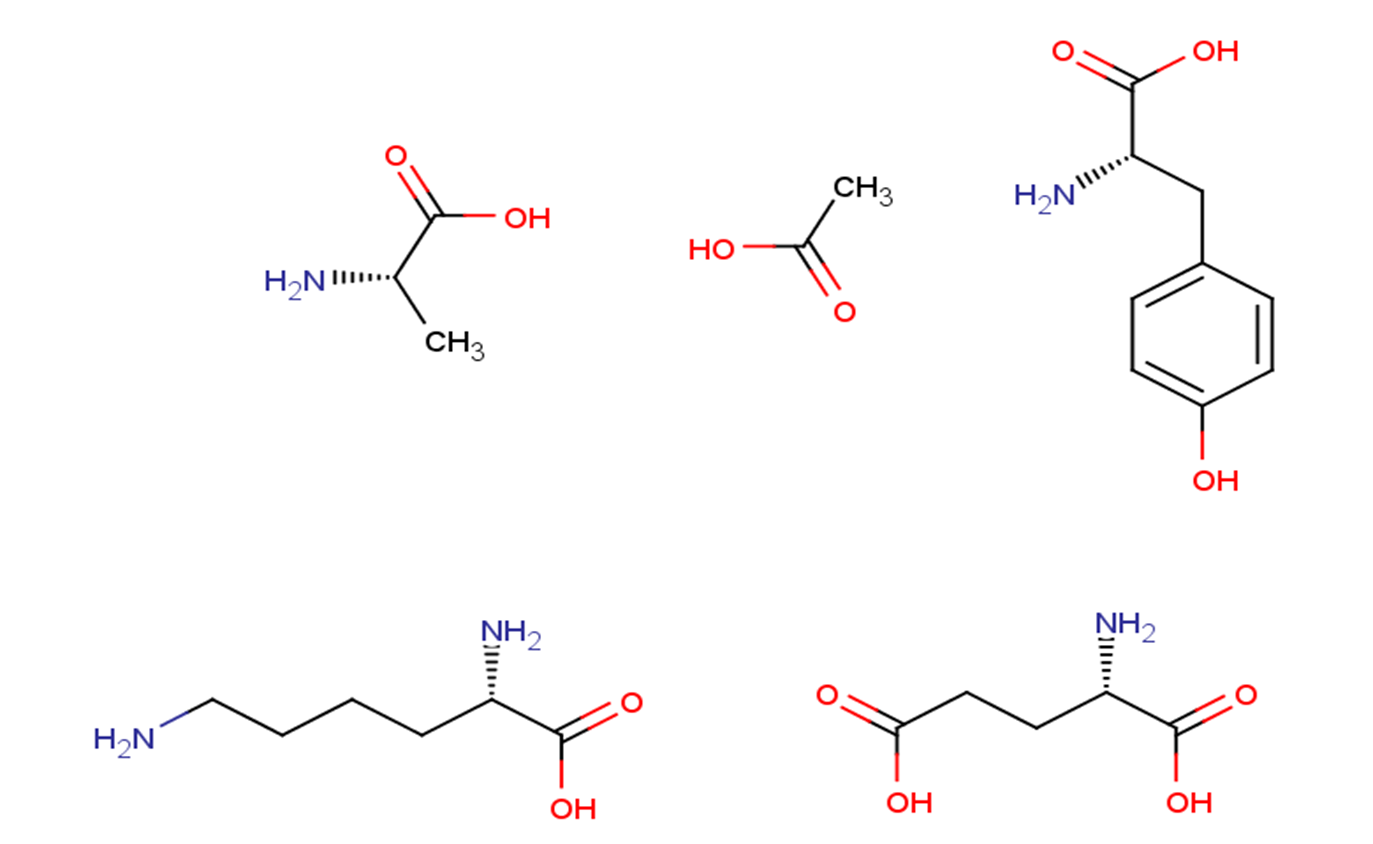
glatiramer Acetate
CAS No. 147245-92-9
glatiramer Acetate( —— )
Catalog No. M23631 CAS No. 147245-92-9
Glatiramer acetate (GA) is a synthetic amino acid copolymer that is approved for treatment of relapsing remitting multiple sclerosis (RRMS) and clinically isolated syndrome (CIS).
Purity : >98% (HPLC)
 COA
Datasheet
HNMR
HPLC
MSDS
Handing Instructions
COA
Datasheet
HNMR
HPLC
MSDS
Handing Instructions
| Size | Price / USD | Stock | Quantity |
| 2MG | 37 | In Stock |


|
| 5MG | 61 | In Stock |
|
| 10MG | 93 | In Stock |
|
| 25MG | 188 | In Stock |
|
| 50MG | 305 | In Stock |
|
| 100MG | 499 | In Stock |
|
| 200MG | Get Quote | In Stock |
|
| 500MG | Get Quote | In Stock |
|
| 1G | Get Quote | In Stock |
|
Biological Information
-
Product Nameglatiramer Acetate
-
NoteResearch use only, not for human use.
-
Brief DescriptionGlatiramer acetate (GA) is a synthetic amino acid copolymer that is approved for treatment of relapsing remitting multiple sclerosis (RRMS) and clinically isolated syndrome (CIS).
-
DescriptionGlatiramer acetate (GA) is a synthetic amino acid copolymer that is approved for treatment of relapsing remitting multiple sclerosis (RRMS) and clinically isolated syndrome (CIS).(In Vitro):Glatiramer acetate (25-100 mg/kg; S.c; 5 days) increase BDNF levels.In huntington’s disease (HD) mouse model, the N171-82Q transgenic mouse line, which exhibits a more rapidly progressing disease course. Glatiramer acetate (1 mg/mouse; s.c.; 5×week) beginning at 8 weeks of age and continuing until 20 weeks of age, which is near the age of death due to the disease. Glatiramer acetate elicited improves performance on several motor function measures. Glatiramer acetate significantly improves the performance of N171-82Q transgenic mice at 15 weeks of age in the rotarod test measured over the course of 4 days.
-
In VitroGlatiramer acetate (25-100 mg/kg; S.c; 5 days) increase BDNF levels.In huntington’s disease (HD) mouse model, the N171-82Q transgenic mouse line, which exhibits a more rapidly progressing disease course. Glatiramer acetate (1 mg/mouse; s.c.; 5×week) beginning at 8 weeks of age and continuing until 20 weeks of age, which is near the age of death due to the disease. Glatiramer acetate elicited improves performance on several motor function measures. Glatiramer acetate significantly improves the performance of N171-82Q transgenic mice at 15 weeks of age in the rotarod test measured over the course of 4 days.
-
In Vivo——
-
Synonyms——
-
PathwayOthers
-
TargetOther Targets
-
RecptorOthers
-
Research Area——
-
Indication——
Chemical Information
-
CAS Number147245-92-9
-
Formula Weight623.65
-
Molecular FormulaC25H45N5O13
-
Purity>98% (HPLC)
-
SolubilityDMSO:Insoluble;Water:10 mM
-
SMILESC[C@@H](C(=O)O)N.CC(=O)O.C1=CC(=CC=C1C[C@@H](C(=O)O)N)O.C(CCN)C[C@@H](C(=O)O)N.C(CC(=O)O)[C@@H](C(=O)O)N
-
Chemical Name——
Shipping & Storage Information
-
Storage(-20℃)
-
ShippingWith Ice Pack
-
Stability≥ 2 years
Reference
1.Prod'homme T, Zamvil SS. The Evolving Mechanisms of Action of Glatiramer Acetate. Cold Spring Harb Perspect Med. 2019 Feb 1;9(2):a029249. doi: 10.1101/cshperspect.a029249.
molnova catalog



related products
-
Guaiacol
Guaiacol is a precursor to various flavorants, such as eugenol and vanillin. Its derivatives are used medicinally as an expectorant, antiseptic, and local anesthetic.
-
Gatipotuzumab
Gatipotuzumab (PankoMab) is a novel humanized monoclonal antibody conjugated to the tumor-associated epitope of mucin 1 (TA-MUC1) with potential anti-tumor activity for the study of recurrent epithelial ovarian cancer.
-
7-Acetylintermedine
7-Acetylintermedine is a hepatotoxic botanical pyrrolizidine alkaloid.
