


 Cart
Cart
 sales@molnova.com


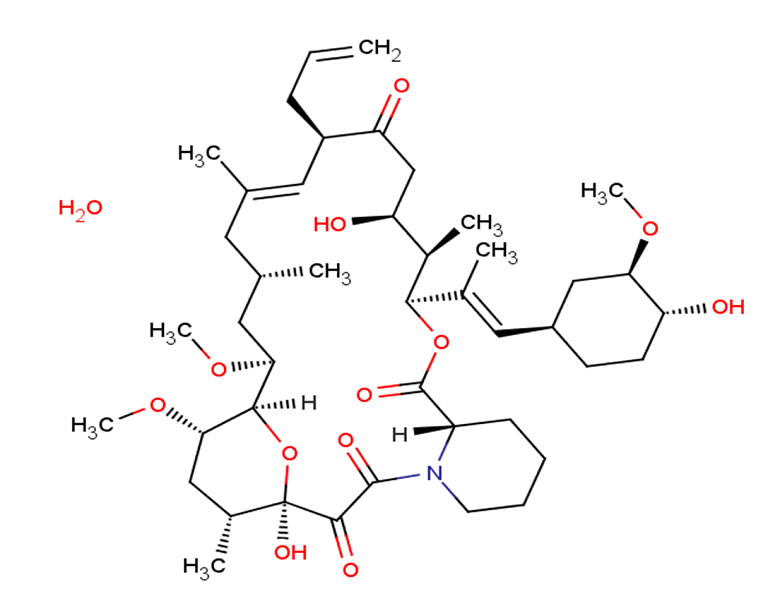
Tacrolimus hydrate
CAS No. 109581-93-3
Tacrolimus hydrate( FR 900506 | FR900506 | LCP-Tacro | Prograf | FK 506 | FK-506 )
Catalog No. M23300 CAS No. 109581-93-3
Tacrolimus hydrate is a macrolide from the culture broth of a strain of Streptomyces tsukubaensis, binds to FK506 binding protein (FKBP) to form a complex.
Purity : >98% (HPLC)
 COA
Datasheet
HNMR
HPLC
MSDS
Handing Instructions
COA
Datasheet
HNMR
HPLC
MSDS
Handing Instructions
| Size | Price / USD | Stock | Quantity |
| 1 mL x 10 mM in DMSO | 46 | In Stock |


|
| 5MG | 37 | In Stock |
|
| 10MG | 52 | In Stock |
|
| 50MG | 67 | In Stock |
|
| 100MG | 98 | In Stock |
|
| 200MG | Get Quote | In Stock |
|
| 500MG | 244 | In Stock |
|
| 1G | Get Quote | In Stock |
|
Biological Information
-
Product NameTacrolimus hydrate
-
NoteResearch use only, not for human use.
-
Brief DescriptionTacrolimus hydrate is a macrolide from the culture broth of a strain of Streptomyces tsukubaensis, binds to FK506 binding protein (FKBP) to form a complex.
-
DescriptionTacrolimus hydrate is a macrolide from the culture broth of a strain of Streptomyces tsukubaensis, binds to FK506 binding protein (FKBP) to form a complex. Tacrolimus inhibits calcineurin phosphatase, which inhibits T-lymphocyte signal transduction and IL-2 transcription. Immunosuppressive properties. It prevents the activation of T-lymphocytes in response to antigenic or mitogenic stimulation in vitro and has strong immunosuppressive activity in vivo.
-
In VitroTacrolimus monohydrate (FK506 monohydrate; Fujimycin monohydrate; FR900506 monohydrate) inhibits calcium-dependent events, such as IL-2 gene transcription, NO synthase activation, cell degranulation, and apoptosis. Tacrolimus also potentiates the actions of glucocorticoids and progesterone by binding to FKBPs contained within the hormone receptor complex, preventing degradation. The agent may enhance expression of the TGFβ-1 gene in a fashion analogous to that demonstrated for CsA. T cell proliferation in response to ligation of the T cell receptor is inhibited by Tacrolimus. Treatment with a low concentration of Tacrolimus (FK506,10 μg/L) does not significantly affect the proliferation of MH3924A cells (P=0.135). Upon treatment with higher concentrations of Tacrolimus (100-1,000 μg/L), the proliferation of MH3924A cells is significantly enhanced (P<0.01). Treatment with AMD3100 at any concentration (10, 50 or 100 μg/L), has no obvious effect on MH3924A cell proliferation (P>0.05). However, when different concentrations of AMD3100 are combined with 100 μg/L Tacrolimus, the in vitro proliferation of MH3924A cells is increased (P<0.01).
-
In VivoThe therapeutic effect of Tacrolimus is investigated on progression and perpetuation of colitis by administering Tacrolimus to Dextran sulfate sodium (DSS)-treated mice from Days 10 to 16 or to 23. At Days 17 and 24, colon length is significantly shortened, and colon weight is significantly higher in DSS-treated control animals than in normal animals. In addition, colon weight per unit length in the control group is more than twice that in the normal group. While both 7 and 14 d treatment with Tacrolimus significantly suppresses increases in colon weight per unit length in DSS-treated animals compared with the control group, this treatment does not actually restore the colon shortening. In addition, this inhibitory effect of Tacrolimus on increases in colon weight per unit length is more pronounced with 14-d than 7-d treatment, as shown by the inhibitory percentages (59% vs. 28%).
-
SynonymsFR 900506 | FR900506 | LCP-Tacro | Prograf | FK 506 | FK-506
-
PathwayMetabolic Enzyme/Protease
-
TargetPhospholipase
-
RecptorFKBP|Phosphatase|Autophagy|BacteriaL|Antibiotic
-
Research Area——
-
Indication——
Chemical Information
-
CAS Number109581-93-3
-
Formula Weight822.05
-
Molecular FormulaC44H71NO13
-
Purity>98% (HPLC)
-
SolubilityDMSO:100 mg/mL (121.65 mM)
-
SMILESO=C([C@@](CCCC1)([H])N1C(C([C@@]2(O)[C@H](C)C[C@H](OC)[C@@](O2)([H])[C@@H](OC)C[C@@H](C)C/C(C)=C/[C@H]3CC=C)=O)=O)O[C@H](/C(C)=C/[C@H]4C[C@@H](OC)[C@H](O)CC4)[C@H](C)[C@@H](O)CC3=O.O
-
Chemical Name——
Shipping & Storage Information
-
Storage(-20℃)
-
ShippingWith Ice Pack
-
Stability≥ 2 years
Reference
1.Dodi PL. Immune-mediated keratoconjunctivitis sicca in dogs: current perspectives on management. Vet Med (Auckl). 2015 Oct 30;6:341-347. doi: 10.2147/VMRR.S66705. eCollection 2015. Review. PubMed PMID: 30101119; PubMed Central PMCID: PMC6067592.
molnova catalog



related products
-
Tris(2,4-di-tert-but...
Tris(2,4-di-tert-butylphenyl)phosphate is a natural compound isolated from Vitex negundo L. with anti-inflammatory activity.
-
Efipladib
Efipladib (PLA 902) is a potent, selective and orally active inhibitor of cPLA2α with IC50 of 20 nM for LTB4 inhibition.
-
5-HT1A modulator 1
5-HT1A modulator 1 displays very high affinities for the 5-HT1A, α1-adrenergic receptor, and D2 receptor.
