


 Cart
Cart
 sales@molnova.com


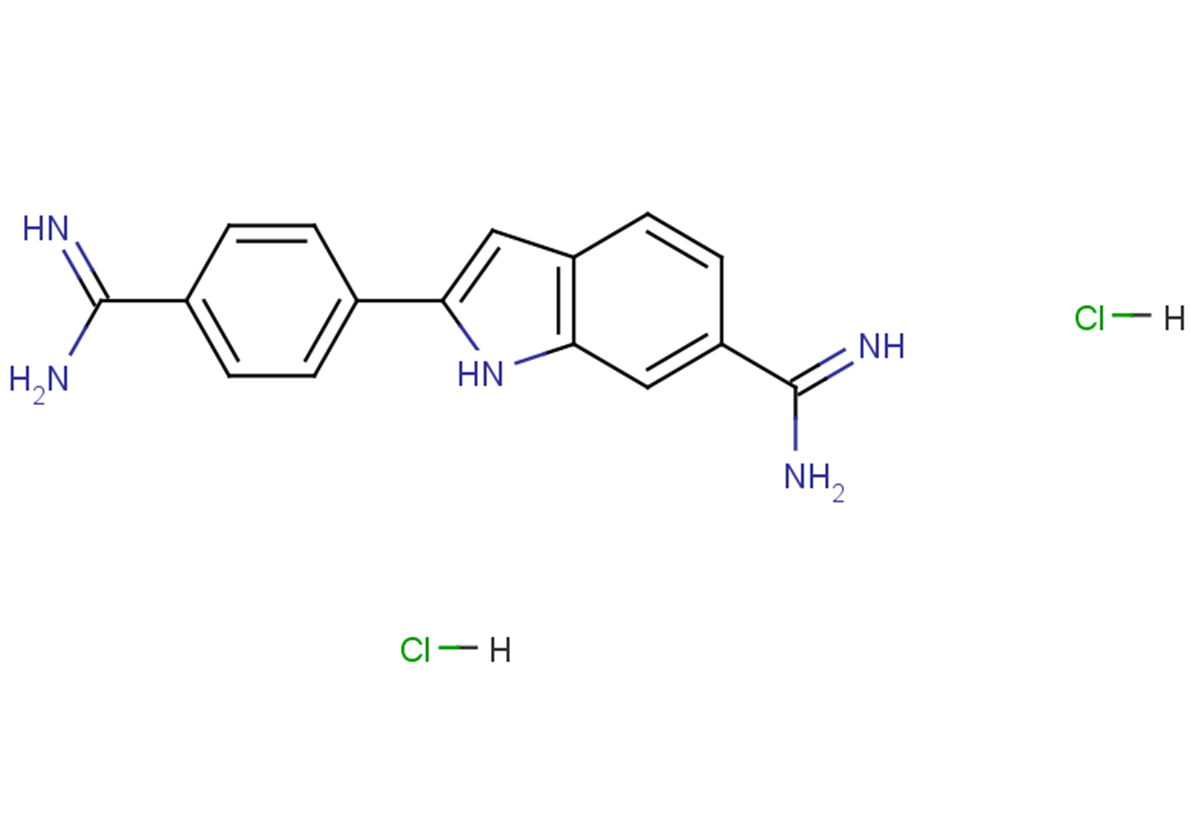
DAPI Dihydrochloride
CAS No. 28718-90-3
DAPI Dihydrochloride( 4',6-diamidino-2-phenylindole )
Catalog No. M22983 CAS No. 28718-90-3
DAPI Dihydrochloride is a cell-permeable fluorescent probe by binding in the minor grove of A-T rich sequences of DNA, used to stain DNA and chromosomes, with a preference for adenine and thymine rich DNA.
Purity : >98% (HPLC)
 COA
Datasheet
HNMR
HPLC
MSDS
Handing Instructions
COA
Datasheet
HNMR
HPLC
MSDS
Handing Instructions
| Size | Price / USD | Stock | Quantity |
| 1 mL x 10 mM in DMSO | 37 | In Stock |


|
| 5MG | 33 | In Stock |
|
| 10MG | 59 | In Stock |
|
| 25MG | 126 | In Stock |
|
| 50MG | 198 | In Stock |
|
| 100MG | 296 | In Stock |
|
| 200MG | 440 | In Stock |
|
| 500MG | Get Quote | In Stock |
|
| 1G | Get Quote | In Stock |
|
Biological Information
-
Product NameDAPI Dihydrochloride
-
NoteResearch use only, not for human use.
-
Brief DescriptionDAPI Dihydrochloride is a cell-permeable fluorescent probe by binding in the minor grove of A-T rich sequences of DNA, used to stain DNA and chromosomes, with a preference for adenine and thymine rich DNA.
-
DescriptionDAPI Dihydrochloride is a cell-permeable fluorescent probe by binding in the minor grove of A-T rich sequences of DNA, used to stain DNA and chromosomes, with a preference for adenine and thymine rich DNA.
-
In Vitro——
-
In Vivo——
-
Synonyms4',6-diamidino-2-phenylindole
-
PathwayOthers
-
TargetOther Targets
-
RecptorOthers
-
Research Area——
-
Indication——
Chemical Information
-
CAS Number28718-90-3
-
Formula Weight350.24
-
Molecular FormulaC16H17Cl2N5
-
Purity>98% (HPLC)
-
SolubilityH2O:8.33 mg/mL (23.78 mM; Need ultrasonic); DMSO:75 mg/mL (214.13 mM; Need ultrasonic)
-
SMILESN=C(C1=CC2=C(C=C1)C=C(C3=CC=C(C(N)=N)C=C3)N2)N.[H]Cl.[H]Cl
-
Chemical Name——
Shipping & Storage Information
-
Storage(-20℃)
-
ShippingWith Ice Pack
-
Stability≥ 2 years
Reference
1.Kapuscinski J, et al. DAPI: a DNA-specific fluorescent probe. Biotech Histochem. 1995 Sep;70(5):220-33.
molnova catalog



related products
-
Pro-xylane
Pro-xylane (Hydroxypropyl tetrahydropyrantriol) is a biologically active C-glycoside in aqueous media, acts as an activator of glycosaminoglycans (GAGs) biosynthesis.
-
GR 82334
Tachykinin NK1 receptor antagonist.
-
Rhodamine 110
Rhodamine 110 is a xanthene dye similar to fluorescein and eosin.
