


 Cart
Cart
 sales@molnova.com


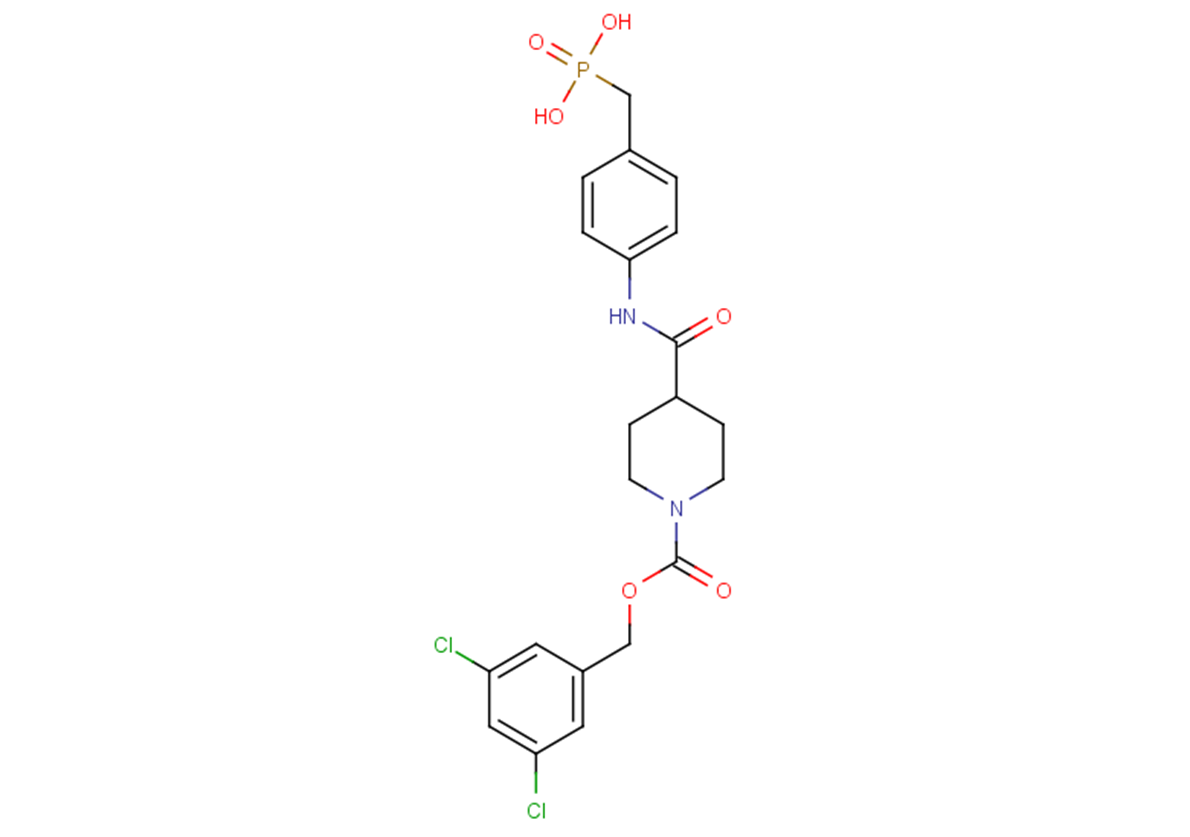
ATX inhibitor 1
CAS No. 2225892-70-4
ATX inhibitor 1( —— )
Catalog No. M22925 CAS No. 2225892-70-4
ATX inhibitor 1 is a potent ATX inhibitor (IC50: 1.23 nM, FS-3 and 2.18 nM, bis-pNPP).
Purity : >98% (HPLC)
 COA
Datasheet
HNMR
HPLC
MSDS
Handing Instructions
COA
Datasheet
HNMR
HPLC
MSDS
Handing Instructions
| Size | Price / USD | Stock | Quantity |
| 1 mL x 10 mM in DMSO | 42 | In Stock |


|
| 5MG | 38 | In Stock |
|
| 10MG | 61 | In Stock |
|
| 25MG | 123 | In Stock |
|
| 50MG | 184 | In Stock |
|
| 100MG | 305 | In Stock |
|
| 200MG | Get Quote | In Stock |
|
| 500MG | Get Quote | In Stock |
|
| 1G | Get Quote | In Stock |
|
Biological Information
-
Product NameATX inhibitor 1
-
NoteResearch use only, not for human use.
-
Brief DescriptionATX inhibitor 1 is a potent ATX inhibitor (IC50: 1.23 nM, FS-3 and 2.18 nM, bis-pNPP).
-
DescriptionATX inhibitor 1 is a potent ATX inhibitor (IC50: 1.23 nM, FS-3 and 2.18 nM, bis-pNPP).
-
In Vitro——
-
In Vivo——
-
Synonyms——
-
PathwayAngiogenesis
-
TargetPDE
-
RecptorATX
-
Research Area——
-
Indication——
Chemical Information
-
CAS Number2225892-70-4
-
Formula Weight501.3
-
Molecular FormulaC21H23Cl2N2O6P
-
Purity>98% (HPLC)
-
SolubilityDMSO:250 mg/mL (498.70 mM; Need ultrasonic)
-
SMILESO=P(O)(O)CC1=CC=C(NC(C2CCN(C(OCC3=CC(Cl)=CC(Cl)=C3)=O)CC2)=O)C=C1
-
Chemical Name——
Shipping & Storage Information
-
Storage(-20℃)
-
ShippingWith Ice Pack
-
Stability≥ 2 years
Reference
1. Balupuri A, et al. Discovery and optimization of ATX inhibitors via modeling, synthesis and biological evaluation. Eur J Med Chem. 2018 Mar 25;148:397-409.
molnova catalog



related products
-
THPP-1
THPP-1 is a potent and orally bioavailable inhibitor of PDE10A(Ki of 1 nM and 1.3 nM for human and rat PDE10A, respectively).
-
cis-Tadalafil
cis-Tadalafil (cis-IC-351) is a potent PDE5 inhibitor with an IC50 value of 0.09 μM that can be used to study arterial hypertension.
-
D 159687
D159687 is a selective?PDE4D?inhibitorhad a procognitive profile as it improved memory in the novel object recognition test but had no antidepressant or anxiolytic benefit.
