


 Cart
Cart
 sales@molnova.com


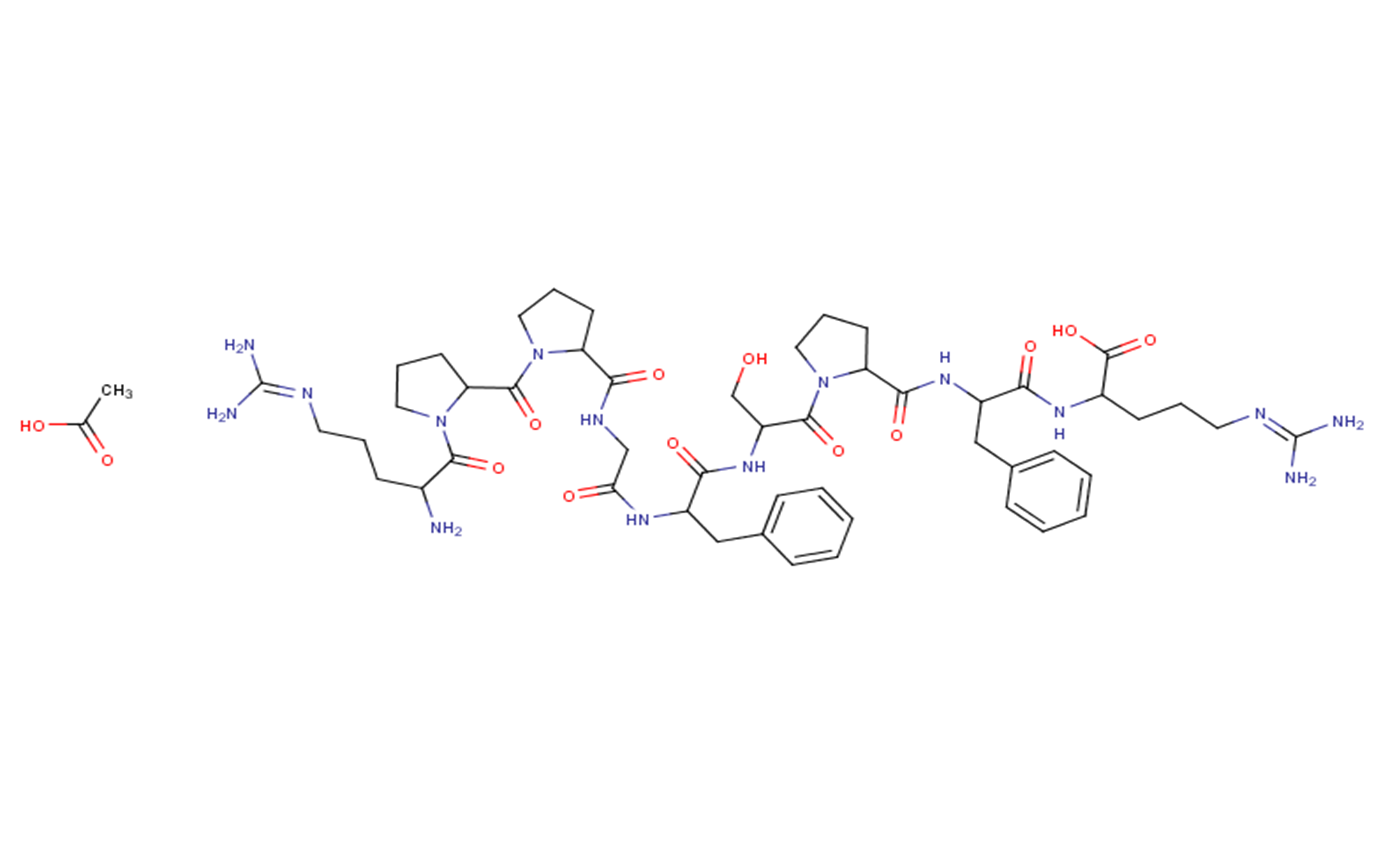
Bradykinin (acetate)
CAS No. 6846-03-3
Bradykinin (acetate)( —— )
Catalog No. M22895 CAS No. 6846-03-3
Bradykinin (acetate) is an active peptide that is generated by the kallikrein-kinin system. It is a inflammatory mediator and also recognized as a neuromediator and regulator of several vascular and renal functions. Enzymatically produced from kallidin in the blood, it is a powerful vasodilator that causes smooth muscle contraction, and may mediate inflammation.
Purity : >98% (HPLC)
 COA
Datasheet
HNMR
HPLC
MSDS
Handing Instructions
COA
Datasheet
HNMR
HPLC
MSDS
Handing Instructions
| Size | Price / USD | Stock | Quantity |
| 5MG | 50 | In Stock |


|
| 10MG | 76 | In Stock |
|
| 25MG | 133 | In Stock |
|
| 50MG | 219 | In Stock |
|
| 100MG | 386 | In Stock |
|
| 200MG | Get Quote | In Stock |
|
| 500MG | Get Quote | In Stock |
|
| 1G | Get Quote | In Stock |
|
Biological Information
-
Product NameBradykinin (acetate)
-
NoteResearch use only, not for human use.
-
Brief DescriptionBradykinin (acetate) is an active peptide that is generated by the kallikrein-kinin system. It is a inflammatory mediator and also recognized as a neuromediator and regulator of several vascular and renal functions. Enzymatically produced from kallidin in the blood, it is a powerful vasodilator that causes smooth muscle contraction, and may mediate inflammation.
-
DescriptionBradykinin (acetate) is an active peptide that is generated by the kallikrein-kinin system. It is a inflammatory mediator and also recognized as a neuromediator and regulator of several vascular and renal functions. Enzymatically produced from kallidin in the blood, it is a powerful vasodilator that causes smooth muscle contraction, and may mediate inflammation. It has a role as a human blood serum metabolite and a vasodilator agent. It is a tautomer of a bradykinin(2+).Exogenous bradykinin markedly inhibited TF expression in mRNA and protein level induced by LPS in a dose-dependent manner. Moreover, the NO synthase antagonist L-NAME and PI3K inhibitor LY294002 dramatically abolished the inhibitory effects of bradykinin on tissue factor expression. PI3K/Akt signaling pathway activation induced by bradykinin administration reduced the activity of GSK-3β and MAPK, and reduced NF-x03BA;B level in the nucleus, thereby inhibiting TF expression.Intraperitoneal injection of C57/BL6 mice with bradykinin also inhibited the thrombus formation induced by ligation of inferior vena cava.
-
In Vitro——
-
In Vivo——
-
Synonyms——
-
PathwayGPCR/G Protein
-
TargetBradykinin Receptor
-
RecptorBradykinin Receptor
-
Research AreaCardiovascular system
-
IndicationPrehypertension|Hypertension
Chemical Information
-
CAS Number6846-03-3
-
Formula Weight1120.26
-
Molecular FormulaC52H77N15O13
-
Purity>98% (HPLC)
-
Solubility——
-
SMILESCC(=O)O.C1CC(N(C1)C(=O)C2CCCN2C(=O)C(CCCN=C(N)N)N)C(=O)NCC(=O)NC(CC3=CC=CC=C3)C(=O)NC(CO)C(=O)N4CCCC4C(=O)NC(CC5=CC=CC=C5)C(=O)NC(CCCN=C(N)N)C(=O)O
-
Chemical Name——
Shipping & Storage Information
-
Storage(-20℃)
-
ShippingWith Ice Pack
-
Stability≥ 2 years
Reference



-
Bradykinin (1-6)
Bradykinin (1-6) is an amino-truncated Bradykinin peptide. Bradykinin (1-6) is a stable metabolite of Bradykinin, cleaved by carboxypeptidase Y (CPY).Bradykinin (1-6) is a fragment of bradykinin. Bradykinin activates pain receptors. It induces smooth muscle contractions and activates Ca2+-dependent nitric oxide synthetase.
-
[Phe8Ψ(CH-NH)-Arg9]-...
Selective bradykinin B2 receptor agonist that is resistant to carboxypeptidase cleavage. 5-fold more potent and exhibits a more prolonged duration of action than bradykinin in vivo.
-
Bradykinin (1-5)
Bradykinin (1-5) is a major stable metabolite of Bradykinin, formed by the proteolytic action of angiotensin-converting enzyme (ACE).The bradykinin (BK) fragment (1-5) (RPPGF) is among the most stable of naturally occurring metabolites. Bradykinin (1-5) may be used as a marker for BK production in vivo.
