


 Cart
Cart
 sales@molnova.com


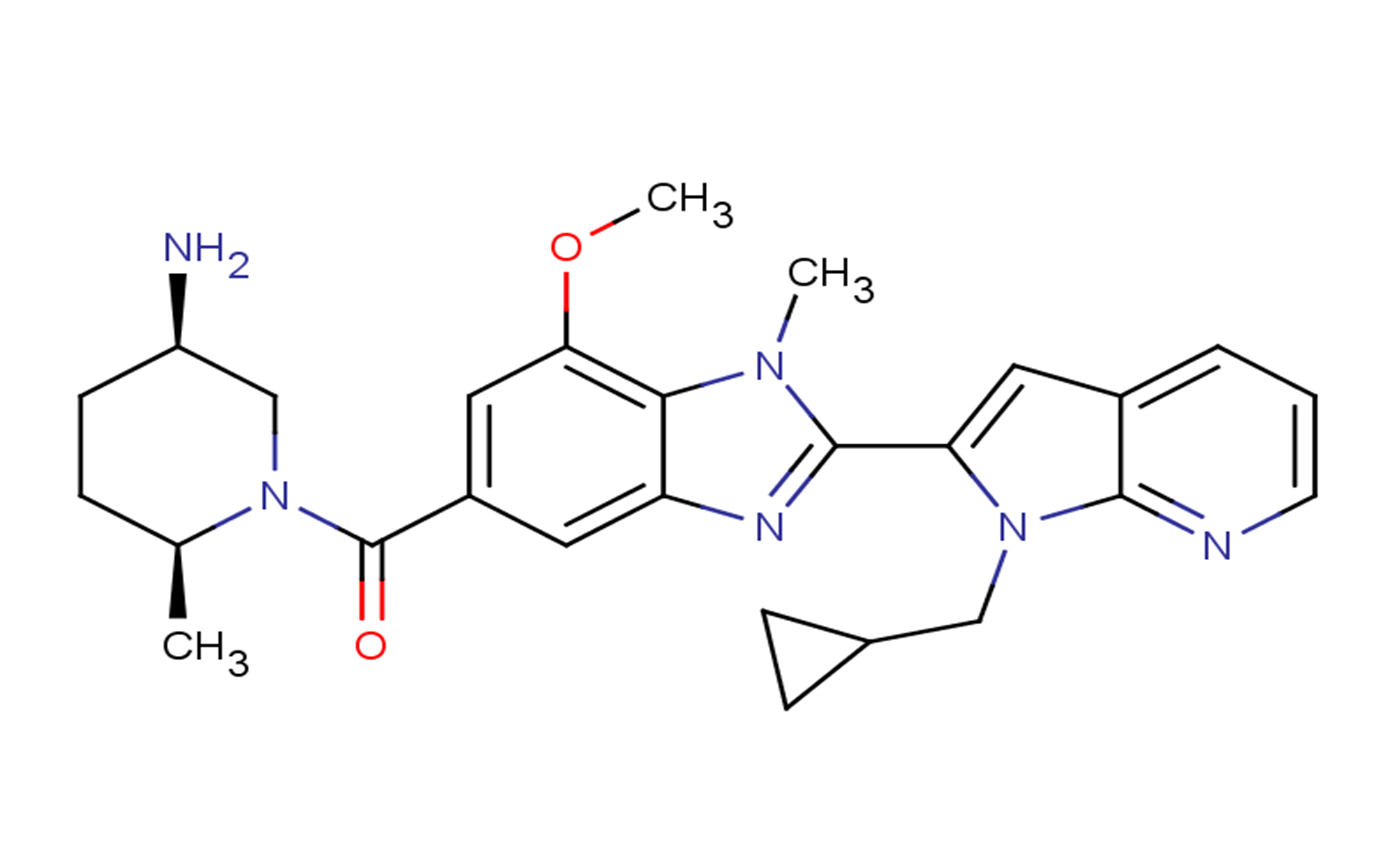
BMS-P5 free base
CAS No. 1550371-22-6
BMS-P5 free base( —— )
Catalog No. M22888 CAS No. 1550371-22-6
BMS-P5 free base is a specific and orally active peptidylarginine deiminase 4 (PAD4) inhibitor. BMS-P5 Blocks Formation of Neutrophil Extracellular Traps and Delays Progression of Multiple Myeloma.
Purity : >98% (HPLC)
 COA
Datasheet
HNMR
HPLC
MSDS
Handing Instructions
COA
Datasheet
HNMR
HPLC
MSDS
Handing Instructions
| Size | Price / USD | Stock | Quantity |
| 1 mL x 10 mM in DMSO | 81 | In Stock |


|
| 5MG | 78 | In Stock |
|
| 10MG | 138 | In Stock |
|
| 25MG | 282 | In Stock |
|
| 50MG | 496 | In Stock |
|
| 100MG | 706 | In Stock |
|
| 200MG | Get Quote | In Stock |
|
| 500MG | Get Quote | In Stock |
|
| 1G | Get Quote | In Stock |
|
Biological Information
-
Product NameBMS-P5 free base
-
NoteResearch use only, not for human use.
-
Brief DescriptionBMS-P5 free base is a specific and orally active peptidylarginine deiminase 4 (PAD4) inhibitor. BMS-P5 Blocks Formation of Neutrophil Extracellular Traps and Delays Progression of Multiple Myeloma.
-
DescriptionBMS-P5 free base is a specific and orally active peptidylarginine deiminase 4 (PAD4) inhibitor. BMS-P5 Blocks Formation of Neutrophil Extracellular Traps and Delays Progression of Multiple Myeloma. Administration of BMS-P5 to multiple myeloma-bearing mice delays appearance of symptoms and disease progression Targeting PAD4 may be beneficial for treatment of multiple myeloma.Administration of BMS-P5 to multiple myeloma-bearing mice delays appearance of symptoms and disease progression.
-
In VitroCell Viability Assay.Cell Line:Neutrophils.Concentration:10 μM and 100 μM.Incubation Time:30 min followed by addition of DP42 or 5TGM1 CM.Result:Prevented MM-induced NET formation.
-
In VivoAnimal Model:Syngeneic mouse model of MM.Dosage:50 mg/kg.Administration:Oral gavage, twice a day beginning on day 3 after tumor cell injection.Result:Significantly delayed development of symptoms and significantly prolonged survival of MM-bearing mice.
-
Synonyms——
-
PathwayOthers
-
TargetOther Targets
-
Recptorpeptidylarginine deiminase 4 (PAD4)
-
Research Area——
-
Indication——
Chemical Information
-
CAS Number1550371-22-6
-
Formula Weight472.58
-
Molecular FormulaC27H32N6O2
-
Purity>98% (HPLC)
-
SolubilityIn Vitro:?DMSO : 250 mg/mL (529.01 mM)
-
SMILESO=C(N1[C@@H](C)CC[C@@H](N)C1)C2=CC(OC)=C3C(N=C(C4=CC5=CC=CN=C5N4CC6CC6)N3C)=C2
-
Chemical Name——
Shipping & Storage Information
-
Storage(-20℃)
-
ShippingWith Ice Pack
-
Stability≥ 2 years
Reference
1.Li M , Lin C , Deng H , et al. A novel peptidylarginine deiminase 4 (PAD4) inhibitor BMS-P5 blocks formation of neutrophil extracellular traps and delays progression of multiple myeloma[J]. Molecular Cancer Therapeutics, 2020, 19(7):molcanther.1020.2019.
molnova catalog



related products
-
Odoriflavene
Odoriflavene has antioxidant activity, and it also shows inhibition effects on the decrease of glutathione level of rat lens induced by UV irradiation.
-
Hirudin (54-65) (des...
Hirudin (54-65) is a fragment of the 65 residue protein of Hirudin with anticoagulant effects.
-
D-(+)-Fucose
D-(+)-Fucose is a hexose deoxy sugar found on N-linked glycans that appears on the cell surface of mammalian and plant cells.
