


 Cart
Cart
 sales@molnova.com


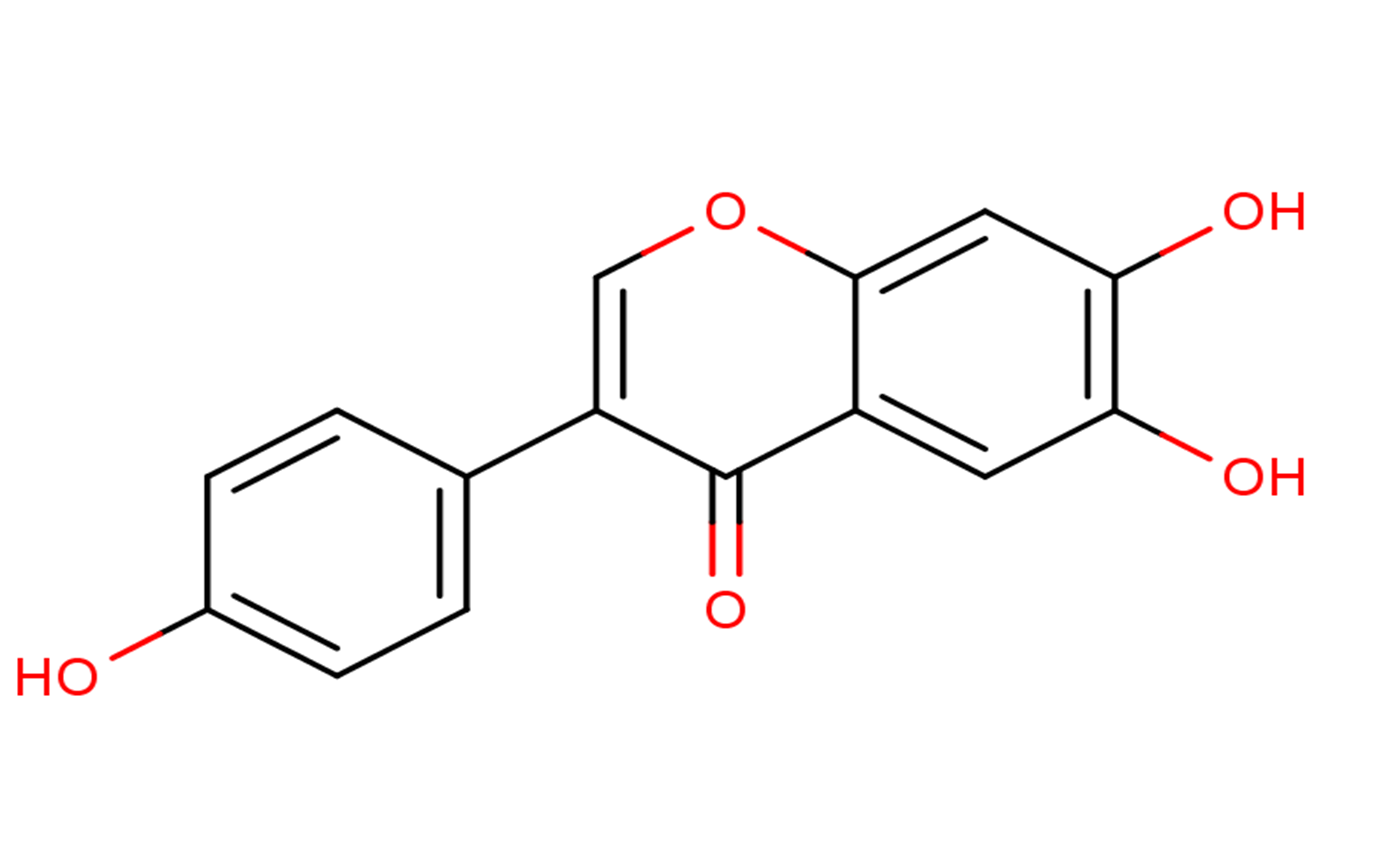
6,7,4'-Trihydroxyisoflavone
CAS No. 17817-31-1
6,7,4'-Trihydroxyisoflavone( —— )
Catalog No. M22805 CAS No. 17817-31-1
6,7,4'-Trihydroxyisoflavone, is a novel inhibitor of PKCα in suppressing solar UV-induced matrix metalloproteinase 1, which has antioxidant, and anti-cancer activities.Molecular studies showed that 6,7,4'-THIF significantly inhibited acetylcholinesterase and thiobarbituric acid reactive substance (TBARS) activities in the hippocampus of scopolamine-induced mice.
Purity : >98% (HPLC)
 COA
Datasheet
HNMR
HPLC
MSDS
Handing Instructions
COA
Datasheet
HNMR
HPLC
MSDS
Handing Instructions
| Size | Price / USD | Stock | Quantity |
| 1 mL x 10 mM in DMSO | 28 | In Stock |


|
| 10MG | 38 | In Stock |
|
| 25MG | 69 | In Stock |
|
| 50MG | 99 | In Stock |
|
| 100MG | 145 | In Stock |
|
| 200MG | 212 | In Stock |
|
| 500MG | Get Quote | In Stock |
|
| 1G | Get Quote | In Stock |
|
Biological Information
-
Product Name6,7,4'-Trihydroxyisoflavone
-
NoteResearch use only, not for human use.
-
Brief Description6,7,4'-Trihydroxyisoflavone, is a novel inhibitor of PKCα in suppressing solar UV-induced matrix metalloproteinase 1, which has antioxidant, and anti-cancer activities.Molecular studies showed that 6,7,4'-THIF significantly inhibited acetylcholinesterase and thiobarbituric acid reactive substance (TBARS) activities in the hippocampus of scopolamine-induced mice.
-
Description6,7,4'-Trihydroxyisoflavone, is a novel inhibitor of PKCα in suppressing solar UV-induced matrix metalloproteinase 1, which has antioxidant, and anti-cancer activities.Molecular studies showed that 6,7,4'-THIF significantly inhibited acetylcholinesterase and thiobarbituric acid reactive substance (TBARS) activities in the hippocampus of scopolamine-induced mice.In addition, immunohistochemistry and Western blot results revealed that 6,7,4'-THIF significantly increased brain-derived neurotrophic factor (BDNF) and phosphor cAMP response element binding (CREB) in the hippocampus of mice. A single administration of 6,7,4'-THIF significantly improved scopolamine-induced cognitive dysfunction in these in vivo tests. Moreover, treatment with 6,7,4'-THIF alone enhanced learning and memory performance in the same behavioral tests. 6,7,4'-THIF improves cognitive dysfunction induced by scopolamine and enhances learning and memory by activation of the cholinergic system and the p-CREB/BDNF signaling pathway in mice.
-
In VitroDesmethylglycitein (4',6,7-Trihydroxyisoflavone)(0-100 μM; 24-72 hours) suppessesanchorage-dependent growth of HCT-116 and DLD1 cells in a dose- and time-dependent manner without cytotoxicity.Desmethylglycitein (4',6,7-Trihydroxyisoflavone)(0-100 μM; 24-72 hours) suppresses CDK1 activity in a dose-dependent manner andinhibits CDK2 activity in HCT-116 cells.Desmethylglycitein (4',6,7-Trihydroxyisoflavone)(0-100 μM; 24-72 hours) induces cell cycle arrest at the S and G2/M phases, the percentage of cells in S phase is higher in the 100 μM 6,7,4′-THIF-treated group, and the same pattern is observed in G2/M phase (29.5% versus 19.1% ) . Cell Viability Assay Cell Line:HCT-116 cells Concentration:0, 12.5, 25, 50 or 100 μM Incubation Time:24, 48 or 72 hours Result:Inhibited anchorage-dependent and -independent growth of HCT-116 cells.Western Blot Analysis Cell Line:HCT-116 and DLD1 cells Concentration:0, 25, 50 or 100 μM Incubation Time:48 hours Result:Inhibited CDK1,CDK2 expression.Cell Cycle Analysis Cell Line:HCT-116 cells Concentration:0, 25, 50 or 100 μM Incubation Time:24, 48 or 72 hours Result:Induces cell cycle arrest of HCT-116 cells at S and G2/M phases.
-
In VivoDesmethylglycitein (4',6,7-Trihydroxyisoflavone) (intraperitoneally injection; 5 or 25 mg/kg; once daily; 20 days) suppresses tumor development in mice and serves as an effective anticancer treatment with the potential to inhibit or delay the tumorigenicity of HCT-116 cells in an in vivo system. Animal Model:Female athymic nude mice subcutaneously injected with HCT-116 cells Dosage:5 or 25 mg/kg Administration:Intraperitoneally injection; 5 or 25 mg/kg; once daily; 20 days Result:Decreased tumor growth, volume and weight of HCT-116 xenografts.
-
Synonyms——
-
PathwayAngiogenesis
-
TargetPKC
-
RecptorCDK1|CDK2|PKC
-
Research Area——
-
Indication——
Chemical Information
-
CAS Number17817-31-1
-
Formula Weight270.2
-
Molecular FormulaC15H10O5
-
Purity>98% (HPLC)
-
SolubilityDMSO:125 mg/mL (462.55 mM; Need ultrasonic)
-
SMILESO=C1C(C2=CC=C(O)C=C2)=COC3=CC(O)=C(O)C=C13
-
Chemical Name——
Shipping & Storage Information
-
Storage(-20℃)
-
ShippingWith Ice Pack
-
Stability≥ 2 years
Reference
1.A metabolite of daidzein, 6,7,4'-trihydroxyisoflavone, suppresses adipogenesis in 3T3-L1 preadipocytes via ATP-competitive inhibition of PI3K.Mol Nutr Food Res. 2013 Aug;57(8):1446-55. doi: 10.1002/mnfr.201200593. Epub 2013 Jun 4.
molnova catalog



related products
-
LY379196
LY379196 is a highly specific PKCβ inhibitor with IC50 of 30-50 nM for PKCβI and PKCβII.
-
Sotrastaurin
A potent, selective, orally available pan-PKC inhibitor with Ki of 0.22-3.2 nM for PKC isotypes.
-
Safingol hydrochlori...
Safingol hydrochloride (L-threo-dihydrosphingosine hydrochloride) is a specific inhibitor of protein kinase C. It induces autophagy in solid tumor cells and cancer cell death by inhibiting the PKC and PI3-kinase pathways.
