


 Cart
Cart
 sales@molnova.com


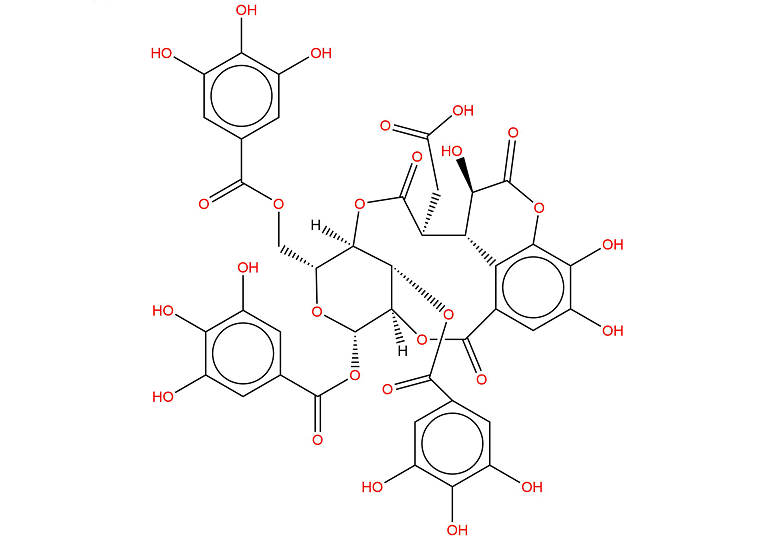
Chebulinic acid
CAS No. 18942-26-2
Chebulinic acid( —— )
Catalog No. M22792 CAS No. 18942-26-2
Chebulinic acid is a potent inhibitor of M. tuberculosis DNA gyrase. It also can inhibit SMAD-3 phosphorylation and H+ K+-ATPase activity.Chebulinic acid obviously inhibited HQ/Cu(II)- and H(2)O(2)/Cu(II)-mediated pBR322 DNA strand breaks. When MRC-5 cells were treated with HQ/Cu(II), the presence of Chebulinic acid inhibited HQ/Cu(II)-mediated double-strand breaks of genomic DNA.
Purity : >98% (HPLC)
 COA
Datasheet
HNMR
HPLC
MSDS
Handing Instructions
COA
Datasheet
HNMR
HPLC
MSDS
Handing Instructions
| Size | Price / USD | Stock | Quantity |
| 1 mL x 10 mM in DMSO | 226 | In Stock |


|
| 5MG | 148 | In Stock |
|
| 10MG | 215 | In Stock |
|
| 25MG | 432 | In Stock |
|
| 50MG | 616 | In Stock |
|
| 100MG | 861 | In Stock |
|
| 200MG | Get Quote | In Stock |
|
| 500MG | Get Quote | In Stock |
|
| 1G | Get Quote | In Stock |
|
Biological Information
-
Product NameChebulinic acid
-
NoteResearch use only, not for human use.
-
Brief DescriptionChebulinic acid is a potent inhibitor of M. tuberculosis DNA gyrase. It also can inhibit SMAD-3 phosphorylation and H+ K+-ATPase activity.Chebulinic acid obviously inhibited HQ/Cu(II)- and H(2)O(2)/Cu(II)-mediated pBR322 DNA strand breaks. When MRC-5 cells were treated with HQ/Cu(II), the presence of Chebulinic acid inhibited HQ/Cu(II)-mediated double-strand breaks of genomic DNA.
-
DescriptionChebulinic acid is a potent inhibitor of M. tuberculosis DNA gyrase. It also can inhibit SMAD-3 phosphorylation and H+ K+-ATPase activity.Chebulinic acid obviously inhibited HQ/Cu(II)- and H(2)O(2)/Cu(II)-mediated pBR322 DNA strand breaks. When MRC-5 cells were treated with HQ/Cu(II), the presence of Chebulinic acid inhibited HQ/Cu(II)-mediated double-strand breaks of genomic DNA [1].Chebulinic acid had no effect on KCl-induced aortic contraction, but irreversibly inhibited the contractile responses to phenylephrine in an apparently non-competitive manner. Chebulinic acid also inhibited contractile responses of rat aorta to 5-hydroxytryptamine and angiotensin II. 3. Chebulinic acid inhibited the binding of [3H]-prazosin to dog aortic microsomal membranes in a concentration-dependent manner with an IC50 value of 0.34 mmol/L.
-
In VitroIn vitro: binding of Chebulinic acid causes displacement of catalytic Tyr129 away from its target DNA-phosphate molecule. Chebulinic acid reduce the expression and activity of MMP-2at an ED50 value of 100 μM. EMT (Epithelial to Mesenchymal Transition) is found to be induced in ARPE-19 cells, through SMAD-3 phosphorylation and it is inhibited by CA. chebulinic acid significantly inhibited H+ K+-ATPase activity in vitrowith IC50 of 65.01 μg/ml.
-
In Vivo——
-
Synonyms——
-
PathwayGPCR/G Protein
-
TargetAntibacterial
-
Recptorbacterial DNA gyrase| Smad3| H+/K+-ATPase
-
Research Area——
-
Indication——
Chemical Information
-
CAS Number18942-26-2
-
Formula Weight956.68
-
Molecular FormulaC41H28O27
-
Purity>98% (HPLC)
-
SolubilityDMSO:Soluble
-
SMILESOC(C[C@H](C(O[C@@]([C@H](O[C@H]1OC(C2=CC(O)=C(O)C(O)=C2)=O)COC(C3=CC(O)=C(O)C(O)=C3)=O)([H])[C@@](OC(C4=CC(O)=C(O)C(O)=C4)=O)([H])[C@@]1([H])OC5=O)=O)[C@@]([C@H]6O)([H])C(C5=CC(O)=C7O)=C7OC6=O)=O
-
Chemical Name——
Shipping & Storage Information
-
Storage(-20℃)
-
ShippingWith Ice Pack
-
Stability≥ 2 years
Reference
1. Zong-Chun Yi, et al. Chebulinic Acid and Tellimagrandin I Inhibit DNA Strand Breaks by hydroquinone/Cu(II) and H(2)O(2)/Cu(II), but Potentiate DNA Strand Breaks by H(2)O(2)/Fe(II). Toxicol In Vitro. Jun 2009; 23 (4), 667-73
molnova catalog



related products
-
PA3552-IN-1
PA3552-IN-1 is an antibiotic adjuvant that can reduce the expression of PA3552 and restore the sensitivity of MDR Pseudomonas aeruginosa DK2 strain to Polymyxin B.
-
Rifamycin S
Rifamycin S is a potent DNA-dependent RNA polymerase inhibitoris a quinone and an antibiotic agnet against Gram-positive bacteria.
-
Difloxacin hydrochlo...
Difloxacin hydrochloride is a fluoroquinolone antibiotic?is a broad-spectrum antibacterial drug.
