


 Cart
Cart
 sales@molnova.com


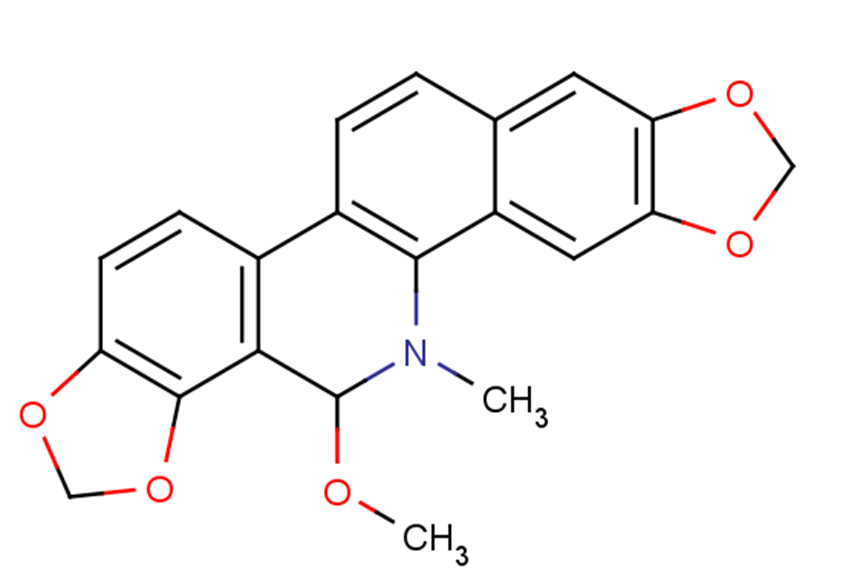
6-Methoxydihydrosanguinarine
CAS No. 72401-54-8
6-Methoxydihydrosanguinarine( —— )
Catalog No. M22599 CAS No. 72401-54-8
6-Methoxydihydrosanguinarine is a natural product. 6-Methoxydihydrosanguinarine shows strong cytotoxicity against MCF-7 and SF-268 cell lines with IC50 values of 0.61 μM and 0.54 μM, respectively.
Purity : >98% (HPLC)
 COA
Datasheet
HNMR
HPLC
MSDS
Handing Instructions
COA
Datasheet
HNMR
HPLC
MSDS
Handing Instructions
| Size | Price / USD | Stock | Quantity |
| 5MG | 235 | In Stock |


|
| 10MG | 353 | In Stock |
|
| 25MG | 582 | In Stock |
|
| 50MG | 808 | In Stock |
|
| 100MG | 1088 | In Stock |
|
| 200MG | Get Quote | In Stock |
|
| 500MG | Get Quote | In Stock |
|
| 1G | Get Quote | In Stock |
|
Biological Information
-
Product Name6-Methoxydihydrosanguinarine
-
NoteResearch use only, not for human use.
-
Brief Description6-Methoxydihydrosanguinarine is a natural product. 6-Methoxydihydrosanguinarine shows strong cytotoxicity against MCF-7 and SF-268 cell lines with IC50 values of 0.61 μM and 0.54 μM, respectively.
-
Description6-Methoxydihydrosanguinarine is a natural product. 6-Methoxydihydrosanguinarine shows strong cytotoxicity against MCF-7 and SF-268 cell lines with IC50 values of 0.61 μM and 0.54 μM, respectively.It has antibacterial activity against Methicillin-resistant Staphylococcus aureus (MRSA) strains with minimum inhibitory concentrations (MICs) ranging from1.9 to 3.9 microg/ml6-methoxydihydrosanguinarine (6ME), a benzophenanthridine alkaloid isolated from Hylomecon species, may have potential as a chemotherapeutic agent. 6ME inhibits the growth of HepG2 cells in a concentration- and time-dependent manner (IC50=3.8+/-0.2 microM following 6 h incubation). Treatment of HepG2 cells with 6ME resulted in the release of mitochondrial cytochrome c followed by the activation of caspase proteases, and subsequent proteolytic cleavage of poly(ADP-ribose) polymerase. 6ME increased the expression of p53 and bax and decreased the expression of bcl-2. The cytotoxic effect of 6ME is mediated by the time-dependent generation of reactive oxygen species. Preincubation of HepG2 cells with vitamin C decreased the expression of p53 and bax and inhibited the release of cytochrome c, activation of downstream caspase and the cleavage of poly(ADP-ribose) polymerase, thus inhibiting the apoptosis inducing effect of 6ME.
-
In Vitro——
-
In Vivo——
-
Synonyms——
-
PathwayOthers
-
TargetOther Targets
-
RecptorOthers
-
Research Area——
-
Indication——
Chemical Information
-
CAS Number72401-54-8
-
Formula Weight363.36
-
Molecular FormulaC21H17NO5
-
Purity>98% (HPLC)
-
SolubilityIn Vitro:?DMSO : 12.5 mg/mL (34.40 mM)
-
SMILESCOC1N(C)c2c(ccc3cc4OCOc4cc23)-c2ccc3OCOc3c12
-
Chemical Name——
Shipping & Storage Information
-
Storage(-20℃)
-
ShippingWith Ice Pack
-
Stability≥ 2 years
Reference
1. Yin H Q , Kim Y H , Moon C K , et al. Reactive oxygen species-mediated induction of apoptosis by a plant alkaloid 6-methoxydihydrosanguinarine in HepG2 cells[J]. Biochemical Pharmacology, 2005, 70(2):242-248.
molnova catalog



related products
-
Aplidine
Aplidine possesses antiviral activity against SARS-CoV-2(IC90 = 0.88 nM). Aplidine is a potent anti-cancer agent by targeting eukaryotic translation elongation factor 1 Alpha 2(EEF1A2, Kd = 80?nM).
-
AR420626
AR420626 is a selective fatty acid 3 receptor (FA3R) agonist and provides protective effects against salsolionl (SALS), which was totally blocked by beta-hydroxy butyrate (BHB), a selective FA3R antagonist.
-
Corazonin, American ...
Corazonin is a highly conserved neuropeptide hormone of wide-spread occurrence in insects, serves a central regulator of caste identity and behavior in social insects. Corazonin is also preferentially expressed in workers and/or foragers from other social insect species.
