


 Cart
Cart
 sales@molnova.com


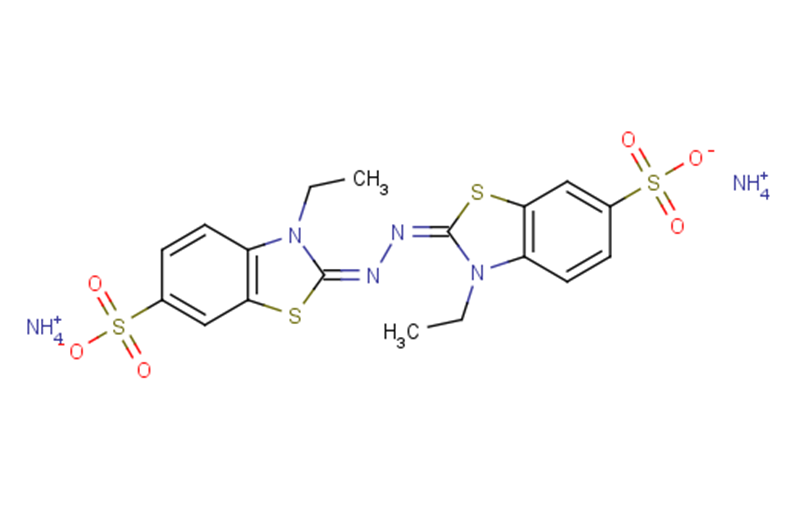
ABTS diammonium salt
CAS No. 30931-67-0
ABTS diammonium salt( AzBTS-(NH4)2 )
Catalog No. M22561 CAS No. 30931-67-0
ABTS diammonium salt is a substrate for horseradish peroxidase (HRP) conjugate.
Purity : >98% (HPLC)
 COA
Datasheet
HNMR
HPLC
MSDS
Handing Instructions
COA
Datasheet
HNMR
HPLC
MSDS
Handing Instructions
| Size | Price / USD | Stock | Quantity |
| 1 mL x 10 mM in DMSO | 43 | In Stock |


|
| 100MG | Get Quote | In Stock |
|
| 200MG | Get Quote | In Stock |
|
| 500MG | 33 | In Stock |
|
| 1G | 45 | In Stock |
|
Biological Information
-
Product NameABTS diammonium salt
-
NoteResearch use only, not for human use.
-
Brief DescriptionABTS diammonium salt is a substrate for horseradish peroxidase (HRP) conjugate.
-
DescriptionABTS diammonium salt is a substrate for horseradish peroxidase (HRP) conjugate.
-
In Vitro——
-
In Vivo——
-
SynonymsAzBTS-(NH4)2
-
PathwayOthers
-
TargetOther Targets
-
RecptorOthers
-
Research Area——
-
Indication——
Chemical Information
-
CAS Number30931-67-0
-
Formula Weight548.68
-
Molecular FormulaC18H24N6O6S4
-
Purity>98% (HPLC)
-
SolubilityH2O:47 mg/mL (85.66mM)
-
SMILES[NH4+].[NH4+].CCn1c2ccc(cc2s\c1=N\N=c1\sc2cc(ccc2n1CC)S([O-])(=O)=O)S([O-])(=O)=O
-
Chemical Name——
Shipping & Storage Information
-
Storage(-20℃)
-
ShippingWith Ice Pack
-
Stability≥ 2 years
Reference
1. Matsuda H, et al. Evaluation of ELISA with ABTS, 2-2'-azino-di-(3-ethylbenzthiazoline sulfonic acid), as the substrate of peroxidase and its application to the diagnosis of schistosomiasis. Jpn J Exp Med. 1984 Jun;54(3):131-8.
molnova catalog



related products
-
6,7-dimethoxy-2-[2-(...
6,7-dimethoxy-2-[2-(4'-hydroxyphenyl)ethenyl]chromone
-
Biotin-Intermedin (h...
Biotin-Intermedin (human)
-
pTH (44-68) (human)
pTH (44-68) (human) is apTH ((Human parathyroid hormone) fragment.
