


 Cart
Cart
 sales@molnova.com


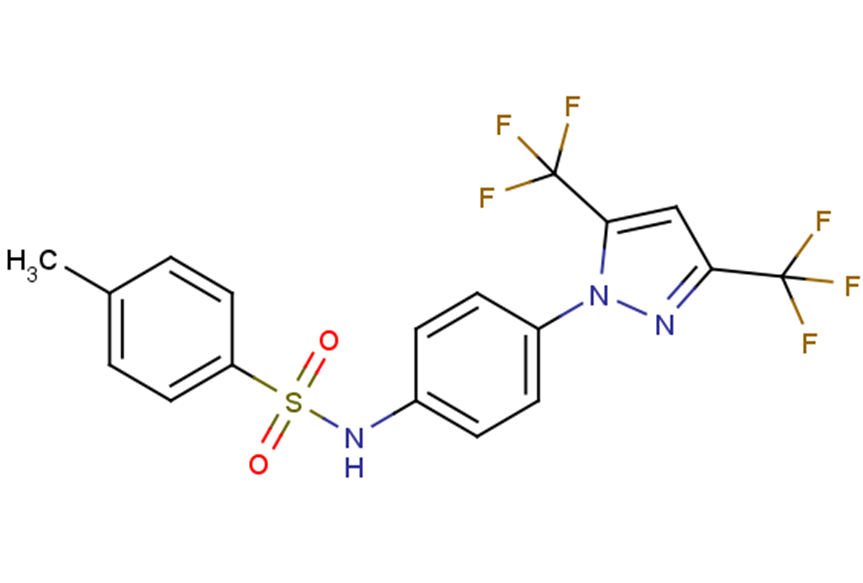
Pyr10
CAS No. 1315323-00-2
Pyr10( —— )
Catalog No. M22464 CAS No. 1315323-00-2
Pyr10 is a pyrazole derivative and a selective TRP cation 3 inhibitor. Pyr10 has the ability to distinguish between receptor-operated TRPC3 and native stromal interaction molecule 1 (STIM1)/Orai1 channels. Pyr10 inhibits Ca2+ influx in carbachol-stimulated TRPC3-transfected HEK293 cells (IC50: 0.72 μM) (IC50 of 13.08 μM for store-operated Ca2+ entry in BRL-2H3 cells) .
Purity : >98% (HPLC)
 COA
Datasheet
HNMR
HPLC
MSDS
Handing Instructions
COA
Datasheet
HNMR
HPLC
MSDS
Handing Instructions
| Size | Price / USD | Stock | Quantity |
| 1 mL x 10 mM in DMSO | 46 | In Stock |


|
| 2MG | 29 | In Stock |
|
| 5MG | 42 | In Stock |
|
| 10MG | 69 | In Stock |
|
| 25MG | 149 | In Stock |
|
| 50MG | 269 | In Stock |
|
| 100MG | 398 | In Stock |
|
| 200MG | Get Quote | In Stock |
|
| 500MG | Get Quote | In Stock |
|
| 1G | Get Quote | In Stock |
|
Biological Information
-
Product NamePyr10
-
NoteResearch use only, not for human use.
-
Brief DescriptionPyr10 is a pyrazole derivative and a selective TRP cation 3 inhibitor. Pyr10 has the ability to distinguish between receptor-operated TRPC3 and native stromal interaction molecule 1 (STIM1)/Orai1 channels. Pyr10 inhibits Ca2+ influx in carbachol-stimulated TRPC3-transfected HEK293 cells (IC50: 0.72 μM) (IC50 of 13.08 μM for store-operated Ca2+ entry in BRL-2H3 cells) .
-
DescriptionPyr10 is a pyrazole derivative and a selective TRP cation 3 inhibitor. Pyr10 has the ability to distinguish between receptor-operated TRPC3 and native stromal interaction molecule 1 (STIM1)/Orai1 channels. Pyr10 inhibits Ca2+ influx in carbachol-stimulated TRPC3-transfected HEK293 cells (IC50: 0.72 μM) (IC50 of 13.08 μM for store-operated Ca2+ entry in BRL-2H3 cells) . The novel pyrazole Pyr10 displayed substantial selectivity for TRPC3-mediated responses (18-fold) and the selective block of TRPC3 channels by Pyr10 barely affected mast cell activation.Pyr10 blunted ventricular CF activation and MF in l-NAME hypertensive mice. Finally, TRPC3 was present in human ventricular CFs and upregulated in MF, whereas pharmacological modulation of TRPC3-NFATc3 decreased proliferation and collagen secretion. TRPC3-NFATc3 signaling is modulated by P.E. and critically regulates ventricular CF phenotype and MF. These findings strongly argue for P.E., through TRPC3 targeting, as potential and interesting therapeutics for MF management.
-
In VitroPyr10 has the ability to discriminate between the classical Orai-mediated, highly Ca2+ selective signalling pathway and the phospholipase C-dependent Ca2+ entry-mediated by TRPC channels, specifically by TRPC3. Pyr10 (3 μM) completely eliminates TRPC3 currents as well as Ca2+ entry while exerting modest effects on Orai-mediated responses. The selective block of TRPC3 channels by Pyr10 barely affected mast cell activation.
-
In VivoGenetic deletion (TRPC3-/-) and pharmacological channel blockade with Pyr10 blunts ventricular cardiac fibroblast activation and myocardial fibrosis in N(ω)-nitro-l-arginine methyl ester (l-NAME) hypertensive mice.
-
Synonyms——
-
PathwayMembrane Transporter/Ion Channel
-
TargetTRP/TRPV Channel
-
RecptorTRPC3
-
Research Area——
-
Indication——
Chemical Information
-
CAS Number1315323-00-2
-
Formula Weight449.37
-
Molecular FormulaC18H13F6N3O2S
-
Purity>98% (HPLC)
-
SolubilityDMSO:95 mg/mL (211.4 mM; Need ultrasonic)
-
SMILESCc1ccc(cc1)S(=O)(=O)Nc1ccc(cc1)-n1nc(cc1C(F)(F)F)C(F)(F)F
-
Chemical Name——
Shipping & Storage Information
-
Storage(-20℃)
-
ShippingWith Ice Pack
-
Stability≥ 2 years
Reference
1. Schleifer H, et al. Novel pyrazole compounds for pharmacological discrimination between receptor-operated and store-operated Ca(2+) entry pathways. Br J Pharmacol. 2012 Dec;167(8):1712-1722.
molnova catalog



related products
-
Oleoyl Serotonin
Oleoyl Serotonin is an antagonist of hTRPV1 with an IC50 of 2.57 μM.
-
Olvanil
Olvanil is a vanilloid receptor agonist with EC50 of 0.7nM.
-
AM-0902
AM-0902 is a potent and specific TRPA1 antagonist (IC50s: 71/131 nM for rTRPA1 and hTRPA1).
