


 Cart
Cart
 sales@molnova.com


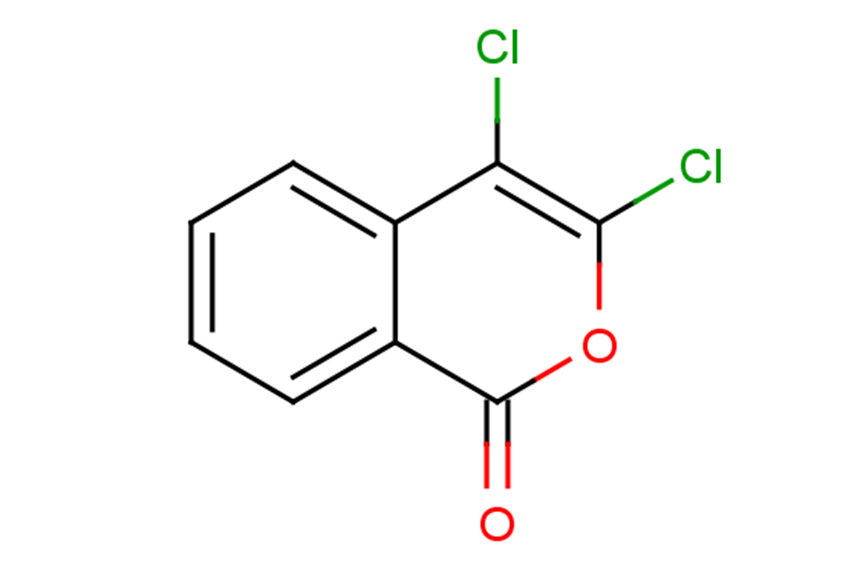
3,4 Dichloroisocoumarin
CAS No. 51050-59-0
3,4 Dichloroisocoumarin( —— )
Catalog No. M22401 CAS No. 51050-59-0
3,4 Dichloroisocoumarin is a granzyme, cathepsin G, and neutrolphil elastase inhibitor.
Purity : >98% (HPLC)
 COA
Datasheet
HNMR
HPLC
MSDS
Handing Instructions
COA
Datasheet
HNMR
HPLC
MSDS
Handing Instructions
| Size | Price / USD | Stock | Quantity |
| 1 mL x 10 mM in DMSO | 83 | In Stock |


|
| 5MG | 85 | In Stock |
|
| 10MG | 147 | In Stock |
|
| 25MG | 249 | In Stock |
|
| 50MG | 362 | In Stock |
|
| 100MG | 533 | In Stock |
|
| 200MG | Get Quote | In Stock |
|
| 500MG | Get Quote | In Stock |
|
| 1G | Get Quote | In Stock |
|
Biological Information
-
Product Name3,4 Dichloroisocoumarin
-
NoteResearch use only, not for human use.
-
Brief Description3,4 Dichloroisocoumarin is a granzyme, cathepsin G, and neutrolphil elastase inhibitor.
-
Description3,4 Dichloroisocoumarin is a granzyme, cathepsin G, and neutrolphil elastase inhibitor.
-
In Vitro——
-
In Vivo——
-
Synonyms——
-
PathwayOthers
-
TargetOther Targets
-
Recptorgranzyme|cathepsin G|neutrolphil elastase?
-
Research Area——
-
Indication——
Chemical Information
-
CAS Number51050-59-0
-
Formula Weight215.03
-
Molecular FormulaC9H4Cl2O2
-
Purity>98% (HPLC)
-
SolubilityIn Vitro:?DMSO : 100 mg/mL (465.05 mM)
-
SMILESClc1oc(=O)c2ccccc2c1Cl
-
Chemical Name——
Shipping & Storage Information
-
Storage(-20℃)
-
ShippingWith Ice Pack
-
Stability≥ 2 years
Reference
1. Rusbridge N M , Beynon R J . 3,4-Dichloroisocoumarin, a serine protease inhibitor, inactivates glycogen phosphorylase b[J]. Febs Letters, 1990, 268(1):133-136.
molnova catalog



related products
-
Jujuboside B
Jujuboside B has potent inhibitory effects on collagen-, thrombin-, AA-, and ADP-induced aggregation, and also exhibits superior protection on the thromboembolic model.
-
Tecovirimat
Tecovirimat (ST-246, Tpoxx) is a potent, orally bioavailable, first-in-class inhibitor of orthopoxvirus egress with EC50 of 0.01-0.6 uM against a panel of Orthopoxvirusesu.
-
Epiprogoitrin
The seeds of Eutrema yunnanense.
