


 Cart
Cart
 sales@molnova.com


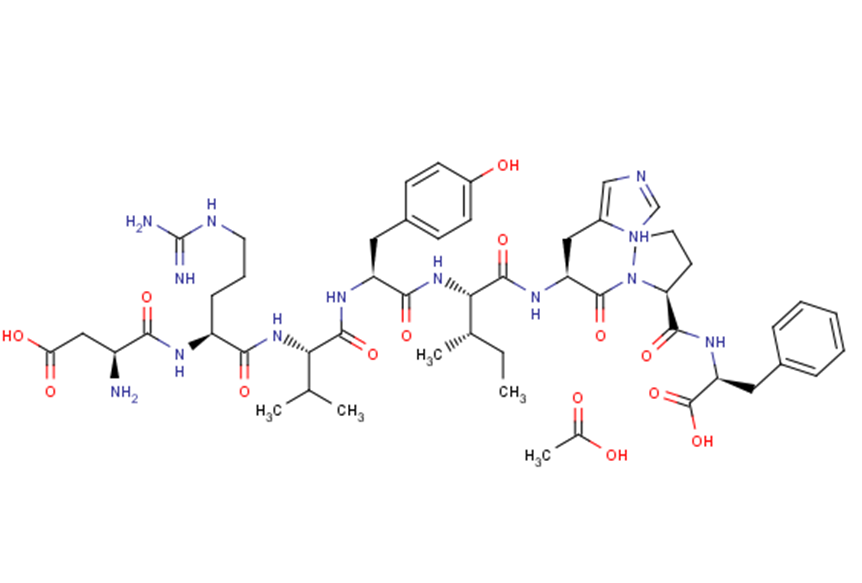
Angiotensin II acetate
CAS No. 68521-88-0
Angiotensin II acetate( Angiotensin II human acetate,Ang II acetate,DRVYIHPF acetate )
Catalog No. M22272 CAS No. 68521-88-0
Angiotensin II acetate is a vasoconstrictor that mainly acts on the AT1 receptor.
Purity : >98% (HPLC)
 COA
Datasheet
HNMR
HPLC
MSDS
Handing Instructions
COA
Datasheet
HNMR
HPLC
MSDS
Handing Instructions
| Size | Price / USD | Stock | Quantity |
| 5MG | 30 | In Stock |


|
| 10MG | 50 | In Stock |
|
| 25MG | 112 | In Stock |
|
| 50MG | 213 | In Stock |
|
| 100MG | 326 | In Stock |
|
| 200MG | Get Quote | In Stock |
|
| 500MG | 787 | In Stock |
|
| 1G | Get Quote | In Stock |
|
Biological Information
-
Product NameAngiotensin II acetate
-
NoteResearch use only, not for human use.
-
Brief DescriptionAngiotensin II acetate is a vasoconstrictor that mainly acts on the AT1 receptor.
-
DescriptionAngiotensin II acetate is a vasoconstrictor that mainly acts on the AT1 receptor.(In Vitro):Most of the known actions of Angiotensin II (Ang II) human acetate are mediated by AT1 receptors, the AT2 receptor contributes to the regulation of blood pressure and renal function.Angiotensin II human acetate raises blood pressure (BP) by a number of actions, the most important ones being vasoconstriction, sympathetic nervous stimulation, increased aldosterone biosynthesis and renal actions. Other Angiotensin II human acetate actions include induction of growth, cell migration, and mitosis of vascular smooth muscle cells, increased synthesis of collagen type I and III in fibroblasts, leading to thickening of the vascular wall and myocardium, and fibrosis. These actions are mediated by type 1 Ang II receptors (AT1).Angiotensin II (1 nM) induces the expression of LOX-1 and VEGF and enhances capillary formation from human coronary endothelial cells in Matrigel assay. Angiotensin II -mediated expression of LOX-1 and VEGF, capillary formation, intracellular reactive oxygen species generation, and phosphorylation of p38 as well as p44/42 mitogen-activated protein kinases, were suppressed by anti-LOX-1 antibody, nicotinamide-adenine dinucleotide phosphate oxidase inhibitor apocynin and the Ang II type 1 receptor blocker Losartan, but not by the Ang II type 2 receptor blocker PD123319.(In Vivo):Angiotensin II human (5 mL of 1 nM; intraperitoneal injection; 200-250 g Sprague-Dawley rats) acetate induces a significant neutrophil recruitment that was maximal at 4 hours and had resolved by 24 hours.To distinguish the AT1 receptor population that is critical for the pathogenesis of hypertension, osmotic minipumps are implanted s.c. into each animal to infuse Angiotensin II human (1000 ng/kg/min) acetate continuously for 4 weeks. Angiotensin II human acetate causes hypertension by activating AT1 receptors in the kidney promoting sodium reabsorption.
-
In VitroMost of the known actions of Angiotensin II (Ang II) human acetate are mediated by AT1 receptors, the AT2 receptor contributes to the regulation of blood pressure and renal function. Angiotensin II human acetate raises blood pressure (BP) by a number of actions, the most important ones being vasoconstriction, sympathetic nervous stimulation, increased aldosterone biosynthesis and renal actions. Other Angiotensin II human acetate actions include induction of growth, cell migration, and mitosis of vascular smooth muscle cells, increased synthesis of collagen type I and III in fibroblasts, leading to thickening of the vascular wall and myocardium, and fibrosis. These actions are mediated by type 1 Ang II receptors (AT1). Angiotensin II (1 nM) induces the expression of LOX-1 and VEGF and enhances capillary formation from human coronary endothelial cells in Matrigel assay. Angiotensin II -mediated expression of LOX-1 and VEGF, capillary formation, intracellular reactive oxygen species generation, and phosphorylation of p38 as well as p44/42 mitogen-activated protein kinases, were suppressed by anti-LOX-1 antibody, nicotinamide-adenine dinucleotide phosphate oxidase inhibitor apocynin and the Ang II type 1 receptor blocker Losartan, but not by the Ang II type 2 receptor blocker PD123319.
-
In VivoAngiotensin II human (5 mL of 1 nM; intraperitoneal injection; 200-250 g Sprague-Dawley rats) acetate induces a significant neutrophil recruitment that was maximal at 4 hours and had resolved by 24 hours.To distinguish the AT1 receptor population that is critical for the pathogenesis of hypertension, osmotic minipumps are implanted s.c. into each animal to infuse Angiotensin II human (1000 ng/kg/min) acetate continuously for 4 weeks. Angiotensin II human acetate causes hypertension by activating AT1 receptors in the kidney promoting sodium reabsorption.
-
SynonymsAngiotensin II human acetate,Ang II acetate,DRVYIHPF acetate
-
PathwayEndocrinology/Hormones
-
TargetRAAS
-
Recptorangiotensin AT1?receptor
-
Research Area——
-
Indication——
Chemical Information
-
CAS Number68521-88-0
-
Formula Weight1106.2
-
Molecular FormulaC52H75N13O14
-
Purity>98% (HPLC)
-
SolubilityIn Vitro:?H2O : 25 mg/mL (22.60 mM)
-
SMILESCC(O)=O.CC[C@H](C)[C@H](NC(=O)[C@H](Cc1ccc(O)cc1)NC(=O)[C@@H](NC(=O)[C@H](CCCNC(N)=N)NC(=O)[C@@H](N)CC(O)=O)C(C)C)C(=O)N[C@@H](Cc1cnc[nH]1)C(=O)N1CCC[C@H]1C(=O)N[C@@H](Cc1ccccc1)C(O)=O
-
Chemical Name——
Shipping & Storage Information
-
Storage(-20℃)
-
ShippingWith Ice Pack
-
Stability≥ 2 years
Reference
1. Fyhrquist F, et al. Role of angiotensin II in blood pressure regulation and in the pathophysiology of cardiovascular disorders. J Hum Hypertens. 1995 Nov;9 Suppl 5:S19-24.
molnova catalog



related products
-
Fosinopril sodium
Fosinopril Sodium is the ester prodrug of an angiotensin-converting enzyme (ACE) inhibitor.
-
ME-3221
ME-3221 is an angiotensin AT1 receptor antagonist that prevents hypertensive complications in aged stroke-prone hypertensive rats.
-
Leucylarginylproline
Leucylarginylproline is an?inhibitor of angiotensin-converting enzyme (ACE) (IC50 : 0.27μM).
