


 Cart
Cart
 sales@molnova.com


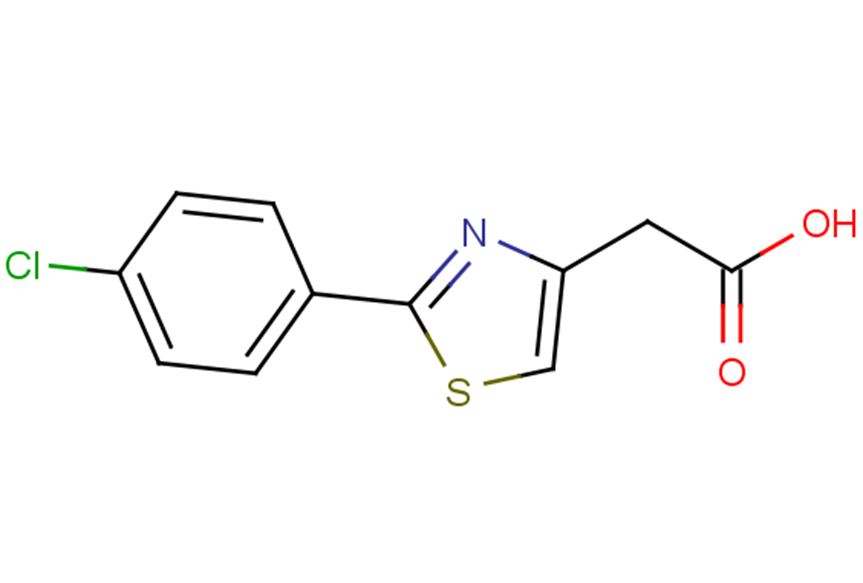
[2-(4-Chlorophenyl)-1,3-thiazol-4-yl]acetic acid
CAS No. 17969-20-9
[2-(4-Chlorophenyl)-1,3-thiazol-4-yl]acetic acid( 2-[2-(4-CHLOROPHENYL)-1,3-THIAZOL-4-YL]ACETIC ACID )
Catalog No. M22256 CAS No. 17969-20-9
[2-(4-Chlorophenyl)-1,3-thiazol-4-yl]acetic acid is an anti-inflammatory thiazole.
Purity : >98% (HPLC)
 COA
Datasheet
HNMR
HPLC
MSDS
Handing Instructions
COA
Datasheet
HNMR
HPLC
MSDS
Handing Instructions
| Size | Price / USD | Stock | Quantity |
| 1 mL x 10 mM in DMSO | 29 | In Stock |


|
| 10MG | 41 | In Stock |
|
| 25MG | 70 | In Stock |
|
| 50MG | 100 | In Stock |
|
| 100MG | 150 | In Stock |
|
| 200MG | 222 | In Stock |
|
| 500MG | Get Quote | In Stock |
|
| 1G | Get Quote | In Stock |
|
Biological Information
-
Product Name[2-(4-Chlorophenyl)-1,3-thiazol-4-yl]acetic acid
-
NoteResearch use only, not for human use.
-
Brief Description[2-(4-Chlorophenyl)-1,3-thiazol-4-yl]acetic acid is an anti-inflammatory thiazole.
-
Description[2-(4-Chlorophenyl)-1,3-thiazol-4-yl]acetic acid is an anti-inflammatory thiazole.
-
In Vitro——
-
In Vivo——
-
Synonyms2-[2-(4-CHLOROPHENYL)-1,3-THIAZOL-4-YL]ACETIC ACID
-
PathwayOthers
-
TargetOther Targets
-
Recptoranti-inflammatory
-
Research Area——
-
Indication——
Chemical Information
-
CAS Number17969-20-9
-
Formula Weight253.71
-
Molecular FormulaC11H8ClNO2S
-
Purity>98% (HPLC)
-
Solubility——
-
SMILESOC(=O)Cc1c[s]c(n1)c2ccc([Cl])cc2
-
Chemical Name——
Shipping & Storage Information
-
Storage(-20℃)
-
ShippingWith Ice Pack
-
Stability≥ 2 years
Reference
molnova catalog



related products
-
PRUNETIN-4-GLUCOSIDE
Prunetin 5-O-β-D-glucopyranoside is an isoflavone isolated from extracts of Potentilla astracanica. Prunetin 5-O-β-D-glucopyranoside is a potent and uncompetitive inhibitor of α-glucosidase, with an IC50 of 56.05 μg/mL. Prunetin 5-O-β-D-glucopyranoside can be used for the research of type-2 diabetes.
-
Hosenkoside L
Hosenkoside L is a baccharane-type glycoside.
-
Harmaline
Harmaline is a fluorescent psychoactive indole alkaloid from the group of harmala alkaloids and beta-carbolines. It is the reduced hydrogenated form of harmine.
