


 Cart
Cart
 sales@molnova.com


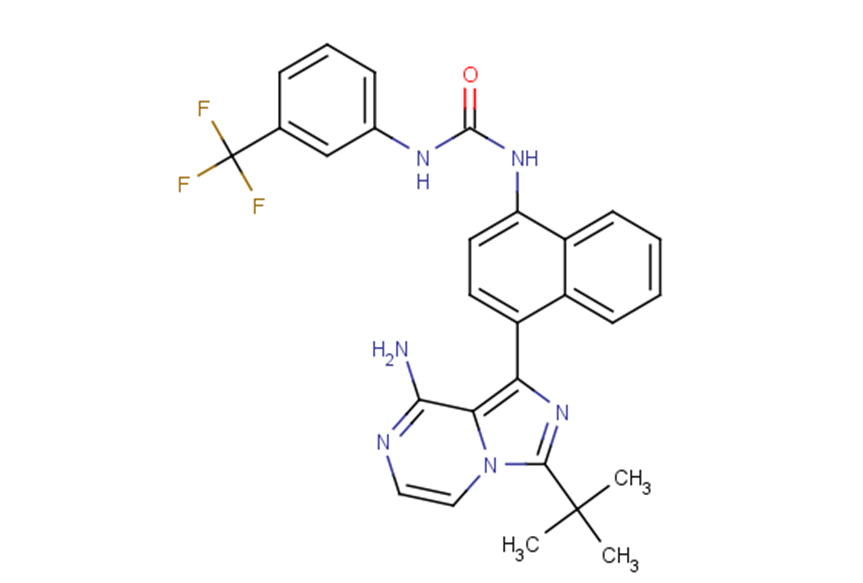
KIRA6
CAS No. 1589527-65-0
KIRA6( —— )
Catalog No. M22059 CAS No. 1589527-65-0
KIRA6 is an effective inhibitor of IRE1α RNase kinase (IC50: 0.6 μM). It can trigger an apoptotic response.KIRA6 (10-1000 nM, 72 hours) strongly compromises the viability of the KIT-dependent cell line HMC-1.1 at the low nM concentration, in a manner that coincided with KIT blockade.
Purity : >98% (HPLC)
 COA
Datasheet
HNMR
HPLC
MSDS
Handing Instructions
COA
Datasheet
HNMR
HPLC
MSDS
Handing Instructions
| Size | Price / USD | Stock | Quantity |
| 1 mL x 10 mM in DMSO | 93 | In Stock |


|
| 2MG | 51 | In Stock |
|
| 5MG | 86 | In Stock |
|
| 10MG | 133 | In Stock |
|
| 25MG | 272 | In Stock |
|
| 50MG | 384 | In Stock |
|
| 100MG | 572 | In Stock |
|
| 200MG | Get Quote | In Stock |
|
| 500MG | Get Quote | In Stock |
|
| 1G | Get Quote | In Stock |
|
Biological Information
-
Product NameKIRA6
-
NoteResearch use only, not for human use.
-
Brief DescriptionKIRA6 is an effective inhibitor of IRE1α RNase kinase (IC50: 0.6 μM). It can trigger an apoptotic response.KIRA6 (10-1000 nM, 72 hours) strongly compromises the viability of the KIT-dependent cell line HMC-1.1 at the low nM concentration, in a manner that coincided with KIT blockade.
-
DescriptionKIRA6 is an effective inhibitor of IRE1α RNase kinase (IC50: 0.6 μM). It can trigger an apoptotic response.KIRA6 (10-1000 nM, 72 hours) strongly compromises the viability of the KIT-dependent cell line HMC-1.1 at the low nM concentration, in a manner that coincided with KIT blockade. KIRA6 (1nM-100μM) bounds to the cytoplasmic domain of KIT with a Kd value of 10.8 μM. KIRA6 (10-1000 nM, 1 hour) reduces signaling output of KIT, including the phosphorylation of KIT as well as its downstream signaling modules, PSTAT5 and phosphorylated ERK1/2.KIRA6 (1 μM, 0-48 hours) inhibits Ins1 mRNA decay from IRE1α hyperactivation in a dose-dependent manner. KIRA6 (0.1-10μM, 72 hours) dose-dependently reduces 1NM-PP1 potentiation of Ins1 apoptosis during ER stress in a dose-dependent manner [2].KIRA6 (intraperitoneal injection; 5 mg/kg; 37 days) shows significant amelioration of random glucose levels over several weeks compared to the vehicle, both fed ad lib. KIRA6 (i.p, 5 mg/kg, 21 or 18 days post injections) increases both plasma insulin and C-peptide levels, remains insulin-positive islet areas at a high level after stopping injections in the Akita Mouse.
-
In VitroCell Viability Assay Cell Line:HMC-1.1 cellsConcentration:10 nM, 30 nM, 100 nM, 300 nM, 1000 nM Incubation Time:72 hours Result:Inhibited cell viability from 30 nM.Western Blot Analysis Cell Line:HMC-1.1 cells Concentration:10 nM, 30 nM, 100 nM, 300 nM, 1000 nM Incubation Time:1 hours Result:Reduced expression of phosphorylated KIT, STAT5 and ERK1/2.RT-PCRCell Line:INS-1 IRE1α (WT) cells Concentration:1 μM Incubation Time: 0 hour, 12 hours, 24 hours, 48 hours Result:Inhibited Ins1 mRNA expression.Apoptosis Analysis Cell Line:INS-1 IRE1α (WT) cells Concentration:1-10 μM Incubation Time:72 hours Result:Reduced 1NM-PP1 potentiation of Ins1 apoptosis during ER stress.
-
In VivoAnimal Model:Male Ins2+/Akita miceDosage:5 mg/kg Administration:Intraperitoneal injection; 5 mg/kg; 21 or 18 days postinjections Result:Attenuates b cell functional loss, increased insulin levels.
-
Synonyms——
-
PathwayOthers
-
TargetOther Targets
-
RecptorIRE1α
-
Research Area——
-
Indication——
Chemical Information
-
CAS Number1589527-65-0
-
Formula Weight518.53
-
Molecular FormulaC28H25F3N6O
-
Purity>98% (HPLC)
-
SolubilityDMSO:5 mg/mL (9.64 mM);Ethanol:2 mg/mL (3.86 mM; Need ultrasonic)
-
SMILESCC(C)(C)C1=NC(=C2N1C=CN=C2N)C1=CC=C(NC(=O)NC2=CC=CC(=C2)C(F)(F)F)C2=CC=CC=C12
-
Chemical Name——
Shipping & Storage Information
-
Storage(-20℃)
-
ShippingWith Ice Pack
-
Stability≥ 2 years
Reference
1. Mahameed M,et al. The unfolded protein response modulators GSK2606414 and KIRA6 are potent KIT inhibitors. Cell Death Dis. 2019 Apr 1;10(4):300.
molnova catalog



related products
-
Gelsemine
Gelsemine has marked antinociception in inflammatory, neuropathic and bone cancer pains without inducing antinociceptive tolerance.
-
Angiogenin (108-123)
Angiogenin Fragment (108-123) is a C-terminal segment 108-123 of Angiogenin that inhibits the enzymatic and biological activities of Angiogenin.
-
KF38789
KF 38789 is a selective inhibitor of P-selectin-mediated cell adhesion and P-selectin immunoglobulin G chimeric protein.
