


 Cart
Cart
 sales@molnova.com


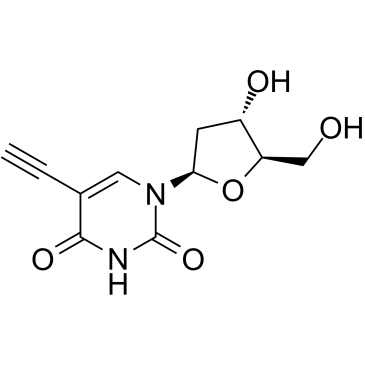
5-ETHYNYL-2'-DEOXYURIDINE
CAS No. 61135-33-9
5-ETHYNYL-2'-DEOXYURIDINE( —— )
Catalog No. M21893 CAS No. 61135-33-9
5-Ethynyl-2'-deoxyuridine (EdU) is a nucleoside analog of thymidine that is used to monitor de novo DNA synthesis through click chemistry.
Purity : >98% (HPLC)
 COA
Datasheet
HNMR
HPLC
MSDS
Handing Instructions
COA
Datasheet
HNMR
HPLC
MSDS
Handing Instructions
| Size | Price / USD | Stock | Quantity |
| 50MG | 35 | In Stock |


|
| 100MG | Get Quote | In Stock |
|
| 200MG | Get Quote | In Stock |
|
| 500MG | Get Quote | In Stock |
|
| 1G | Get Quote | In Stock |
|
Biological Information
-
Product Name5-ETHYNYL-2'-DEOXYURIDINE
-
NoteResearch use only, not for human use.
-
Brief Description5-Ethynyl-2'-deoxyuridine (EdU) is a nucleoside analog of thymidine that is used to monitor de novo DNA synthesis through click chemistry.
-
Description5-Ethynyl-2'-deoxyuridine (EdU) is a nucleoside analog of thymidine that is used to monitor de novo DNA synthesis through click chemistry.1,2 Like 5-bromo-2’-deoxyuridine (BrdU; Item No. 15580), EdU is incorporated into DNA during active DNA synthesis. It can then be detected using a fluorescent azide probe and copper catalysis using 1,3-dipolar cycloaddition.Modified nucleosides, including EdU, can be cytotoxic when added to cells for prolonged periods.(In Vitro):5-Ethynyl-2'-deoxyuridine (EdU) staining is a fast, sensitive and reproducible method to study cell proliferation in the central nervous system.PROTACs contain two different ligands connected by a linker; one is a ligand for an E3 ubiquitin ligase and the other is for the target protein. PROTACs exploit the intracellular ubiquitin-proteasome system to selectively degrade target proteins.(In Vivo):The number of 5-Ethynyl-2'-deoxyuridine (EdU; a single injection of EdU intraperitoneally at a dose of 10, 20, 50, 100 or 200 mg/kg body weight) positive cells in the dentate gyrus slightly increased in a dose-dependent manner in two month old female mice.
-
In Vitro——
-
In Vivo——
-
Synonyms——
-
PathwayPROTACs
-
TargetPROTAC
-
RecptorAlkyl-Chain
-
Research Area——
-
Indication——
Chemical Information
-
CAS Number61135-33-9
-
Formula Weight252.22
-
Molecular FormulaC??H??N?O?
-
Purity>98% (HPLC)
-
SolubilityDMSO : 50 mg/mL (198.24 mM; Need ultrasonic);H2O : 25 mg/mL (99.12 mM; Need ultrasonic)
-
SMILESO=C1NC(C(C#C)=CN1[C@H]2C[C@@H]([C@H](O2)CO)O)=O
-
Chemical Name——
Shipping & Storage Information
-
Storage(-20℃)
-
ShippingWith Ice Pack
-
Stability≥ 2 years
Reference
1. Chenbo Zeng, et al. Evaluation of 5-ethynyl-2'-deoxyuridine staining as a sensitive and reliable method for studying cell proliferation in the adult nervous system. Brain Res. 2010 Mar 10;1319:21-32.
2. An S, et al. Small-molecule PROTACs: An emerging and promising approach for the development of targeted therapy drugs. EBioMedicine. 2018 Oct;36:553-562
molnova catalog



related products
-
BI-3663
BI-3663 (BI 3663) is a cereblon-based degrader (PROTAC) of Focal adhesion tyrosine kinase (PTK2/FAK) with a median DC50 of 30 nM to >80% across a panel of eleven HCC cell lines.
-
Ac4ManNAz
Ac4ManNAz is a PEG-based PROTAC linker that can be used in the synthesis of PROTACs.
-
DBCO-S-S-PEG3-biotin
DBCO-S-S-PEG3-biotin is a cleavable reagent for introduction of a biotin moiety to azide-containing biomolecules using copper-free Click Chemistry.?The disulfide bond in this linker can be cleaved using reducing agents such as DTT, BME and TCEP to remove the biotin label.?PEG Linkers can be used in the synthesis of PROTACs.
