


 Cart
Cart
 sales@molnova.com


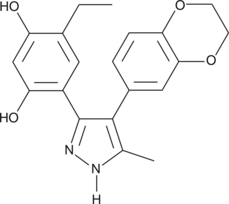
CCT018159
CAS No. 171009-07-7
CCT018159( —— )
Catalog No. M21862 CAS No. 171009-07-7
The heat shock protein 90 (Hsp90) is a molecular chaperone that activates and maintains the biological functioning of several client proteins, many of which are associated with oncogenic signaling pathways.
Purity : >98% (HPLC)
 COA
Datasheet
HNMR
HPLC
MSDS
Handing Instructions
COA
Datasheet
HNMR
HPLC
MSDS
Handing Instructions
| Size | Price / USD | Stock | Quantity |
| 5MG | 68 | In Stock |


|
| 10MG | 107 | In Stock |
|
| 25MG | 216 | In Stock |
|
| 50MG | 319 | In Stock |
|
| 100MG | 462 | In Stock |
|
| 200MG | Get Quote | In Stock |
|
| 500MG | Get Quote | In Stock |
|
| 1G | Get Quote | In Stock |
|
Biological Information
-
Product NameCCT018159
-
NoteResearch use only, not for human use.
-
Brief DescriptionThe heat shock protein 90 (Hsp90) is a molecular chaperone that activates and maintains the biological functioning of several client proteins, many of which are associated with oncogenic signaling pathways.
-
DescriptionThe heat shock protein 90 (Hsp90) is a molecular chaperone that activates and maintains the biological functioning of several client proteins, many of which are associated with oncogenic signaling pathways. Its activity is driven by ATP and regulated by co-chaperones such as Hsp72. CCT018159 is a 3,4-diaryl pyrazoloresorcinol compound that inhibits the ATPase activity of Hsp90 with IC50 values of 3.2 and 6.6 μM for human Hsp90β and yeast Hsp90, respectively.At concentrations up to 100 μM, CCT018159 does not inhibit human Hsp72 ATPase or topoisomerase II, yet at 50 μM CCT018159 inhibits 13 out of a panel of 20 commonly studied kinases.
-
In Vitro——
-
In Vivo——
-
Synonyms——
-
PathwayOthers
-
TargetOther Targets
-
Recptor——
-
Research Area——
-
Indication——
Chemical Information
-
CAS Number171009-07-7
-
Formula Weight352.4
-
Molecular FormulaC20H20N2O4
-
Purity>98% (HPLC)
-
SolubilityDMSO: 30 mg/ml
-
SMILESCCc1cc(c(O)cc1O)c1n[nH]c(C)c1c1ccc2OCCOc2c1
-
Chemical Name4-[4-(2,3-dihydo-1,4-benzodioxin-6-yl)-5-methyl-1H-pyrazol-3-yl]-6-ethyl-1,3-benzenediol
Shipping & Storage Information
-
Storage(-20℃)
-
ShippingWith Ice Pack
-
Stability≥ 2 years
Reference
molnova catalog



related products
-
Barium lithol red
Barium lithol red is a transparent blue-toned red pigment mainly used for ink coloring.
-
coreopsin
Coreopsin is one of the main components from Coreopsis tinctoria Nutt. Flower(CTF). CTF has been used traditionally in China for treating hypertension and diabetes as well as reducing body weight and blood fat.
-
Stigmasterol glucosi...
Stigmasterol glucoside, a constituent of Adenanthera pavonina seed and leaf, may be a plant anticancer agent.
