


 Cart
Cart
 sales@molnova.com


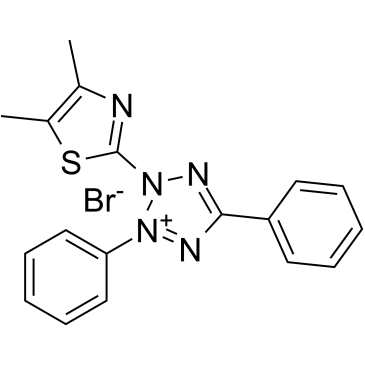
Thiazolyl Blue
CAS No. 298-93-1
Thiazolyl Blue( —— )
Catalog No. M21733 CAS No. 298-93-1
Thiazolyl Blue (MTT) is used in conjunction with rhodamine B to measure mitochondrial membrane potential.
Purity : >98% (HPLC)
 COA
Datasheet
HNMR
HPLC
MSDS
Handing Instructions
COA
Datasheet
HNMR
HPLC
MSDS
Handing Instructions
| Size | Price / USD | Stock | Quantity |
| 1 mL x 10 mM in DMSO | 29 | In Stock |


|
| 100MG | Get Quote | In Stock |
|
| 200MG | Get Quote | In Stock |
|
| 500MG | 28 | In Stock |
|
| 1G | 39 | In Stock |
|
Biological Information
-
Product NameThiazolyl Blue
-
NoteResearch use only, not for human use.
-
Brief DescriptionThiazolyl Blue (MTT) is used in conjunction with rhodamine B to measure mitochondrial membrane potential.
-
DescriptionThiazolyl Blue (MTT) is used in conjunction with rhodamine B to measure mitochondrial membrane potential. Thiazolyl Blue-formazan is generated in mitochondria acts as a fluorescence quencher for rhodamine that distributes across membranes of viable cells according to membrane potential. In the absence of mPMS, cellular reduction of Thiazolyl Blue is strong. Thiazolyl Blue is membrane-impermeable when incorporated into large unilamellar liposomes, and therefore it is taken up by cells via endocytosis.
-
In Vitro——
-
In Vivo——
-
Synonyms——
-
PathwayOthers
-
TargetOther Targets
-
Recptor——
-
Research Area——
-
Indication——
Chemical Information
-
CAS Number298-93-1
-
Formula Weight414.32
-
Molecular FormulaC??H??BrN?S
-
Purity>98% (HPLC)
-
SolubilityDMSO : 25 mg/mL (60.34 mM; Need ultrasonic);H2O : 0.88 mg/mL (2.12 mM; Need ultrasonic and warming)
-
SMILESCC1=C(C)N=C(N2N=C(C3=CC=CC=C3)N=[N+]2C4=CC=CC=C4)S1.[Br-]
-
Chemical Name——
Shipping & Storage Information
-
Storage(-20℃)
-
ShippingWith Ice Pack
-
Stability≥ 2 years
Reference
1. Berridge MV, et al. Tetrazolium dyes as tools in cell biology: new insights into their cellular reduction. Biotechnol Annu Rev. 2005;11:127-52.
molnova catalog



related products
-
4-[(E)-{[4,6-Di(4-mo...
4-[(E)-{[4,6-Di(4-morpholinyl)-1,3,5-triazin-2-yl]hydrazono}methy l]-2,6-dimethoxyphenol is a chemical compound.
-
PACAP-38 (31-38), hu...
PACAP-38 (31-38), human, mouse, rat (TFA) demonstrates potent, efficacious, and sustained stimulatory effects on sympathetic neuronal.
-
HET0016
HET0016 is a potent and selective 20-HETE synthase inhibitor (IC50s: 17.7 nM, 12.1 nM, and 20.6 nM for recombinant CYP4A1-, CYP4A2-, and CYP4A3-catalyzed 20-HETE synthesis) and a selective CYP450 inhibitor, shown to inhibit angiogenesis and tumor growth.
