


 Cart
Cart
 sales@molnova.com


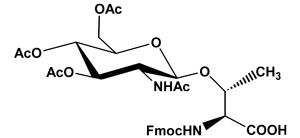
Fmoc-Thr(GlcNAc(Ac)3-b-D)-OH
CAS No. 160168-40-1
Fmoc-Thr(GlcNAc(Ac)3-b-D)-OH( —— )
Catalog No. M21715 CAS No. 160168-40-1
This amino acid is compatible with standard protocols in Fmoc solid phase peptide synthesis. Following chain assembly.
Purity : >98% (HPLC)
 COA
Datasheet
HNMR
HPLC
MSDS
Handing Instructions
COA
Datasheet
HNMR
HPLC
MSDS
Handing Instructions
| Size | Price / USD | Stock | Quantity |
| 25MG | 276 | In Stock |


|
| 100MG | Get Quote | In Stock |
|
| 200MG | Get Quote | In Stock |
|
| 500MG | Get Quote | In Stock |
|
| 1G | Get Quote | In Stock |
|
Biological Information
-
Product NameFmoc-Thr(GlcNAc(Ac)3-b-D)-OH
-
NoteResearch use only, not for human use.
-
Brief DescriptionThis amino acid is compatible with standard protocols in Fmoc solid phase peptide synthesis. Following chain assembly.
-
DescriptionThis amino acid is compatible with standard protocols in Fmoc solid phase peptide synthesis. Following chain assembly, removal of the acetyl protecting group can be carried out by treatment of the peptidyl resin with methanolic ammonia or sodium methoxide/DMF/methanol, or by treatment of the cleaved peptide with catalytic sodium methoxide in methanol.
-
In Vitro——
-
In Vivo——
-
Synonyms——
-
PathwayOthers
-
TargetOther Targets
-
Recptor——
-
Research Area——
-
Indication——
Chemical Information
-
CAS Number160168-40-1
-
Formula Weight670.66
-
Molecular FormulaC33H38N2O13
-
Purity>98% (HPLC)
-
Solubility——
-
SMILES——
-
Chemical Name——
Shipping & Storage Information
-
Storage(-20℃)
-
ShippingWith Ice Pack
-
Stability≥ 2 years
Reference
molnova catalog



related products
-
TPPU
TPPU is a potent inhibitor of both human and mouse sEH (IC50 of 3.7 and 2.8 nM respectively).
-
Neurotensin acetate ...
Neurotensin acetate salt
-
(D-Pro2,D-Phe7,D-Trp...
(D-Pro2,D-Phe7,D-Trp9)-Substance P
