


 Cart
Cart
 sales@molnova.com


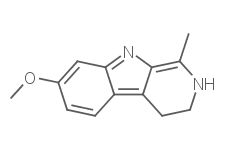
Harmaline
CAS No. 304-21-2
Harmaline( —— )
Catalog No. M21712 CAS No. 304-21-2
Harmaline is a fluorescent psychoactive indole alkaloid from the group of harmala alkaloids and beta-carbolines. It is the reduced hydrogenated form of harmine.
Purity : >98% (HPLC)
 COA
Datasheet
HNMR
HPLC
MSDS
Handing Instructions
COA
Datasheet
HNMR
HPLC
MSDS
Handing Instructions
| Size | Price / USD | Stock | Quantity |
| 1 mL x 10 mM in DMSO | 48 | In Stock |


|
| 100MG | Get Quote | In Stock |
|
| 200MG | Get Quote | In Stock |
|
| 500MG | Get Quote | In Stock |
|
| 1G | Get Quote | In Stock |
|
Biological Information
-
Product NameHarmaline
-
NoteResearch use only, not for human use.
-
Brief DescriptionHarmaline is a fluorescent psychoactive indole alkaloid from the group of harmala alkaloids and beta-carbolines. It is the reduced hydrogenated form of harmine.
-
DescriptionHarmaline is a fluorescent psychoactive indole alkaloid from the group of harmala alkaloids and beta-carbolines. It is the reduced hydrogenated form of harmine.
-
In Vitro——
-
In Vivo——
-
Synonyms——
-
PathwayOthers
-
TargetOther Targets
-
RecptorOthers
-
Research Area——
-
Indication——
Chemical Information
-
CAS Number304-21-2
-
Formula Weight214.27
-
Molecular FormulaC13H14N2O
-
Purity>98% (HPLC)
-
SolubilityDMSO:10 mM
-
SMILESCOC1=CC2=NC3=C(C)NCCC3=C2C=C1
-
Chemical Name3H-Pyrido(34-b)indole 49-dihydro-7-methoxy-1-methyl-
Shipping & Storage Information
-
Storage(-20℃)
-
ShippingWith Ice Pack
-
Stability≥ 2 years
Reference
1.Zheng XY et al. Archives of Pharmacological Research 32 (9): 1245–1251.
molnova catalog



related products
-
Malotilate
Malotilate, diisopropyl 1,3-dithiol-2-ylidenemalonate, is a drug used for the treatment of liver cirrhosis.
-
Vanilloid Receptor S...
Vanilloid Receptor Subtype 1 (VR1)
-
[D-Trp7,9,10]-Substa...
Substance P analog that inhibits activation of Gq/11 by M1 muscarinic ACh receptors. Does not inhibit Gi/o activation by M2 ACh receptors.
