


 Cart
Cart
 sales@molnova.com


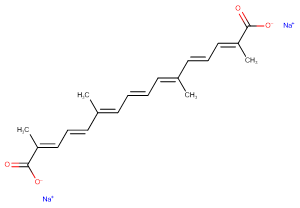
Transcrocetinate disodium
CAS No. 591230-99-8
Transcrocetinate disodium( Disodium trans-crocetinate )
Catalog No. M21664 CAS No. 591230-99-8
Transcrocetinate disodium extracted from saffron (Crocus sativus L.) is a high-affinity antagonist of NMDA receptor.
Purity : >98% (HPLC)
 COA
Datasheet
HNMR
HPLC
MSDS
Handing Instructions
COA
Datasheet
HNMR
HPLC
MSDS
Handing Instructions
| Size | Price / USD | Stock | Quantity |
| 1 mL x 10 mM in DMSO | 100 | In Stock |


|
| 5MG | 85 | In Stock |
|
| 10MG | 116 | In Stock |
|
| 25MG | 207 | In Stock |
|
| 50MG | 297 | In Stock |
|
| 100MG | 444 | In Stock |
|
| 200MG | Get Quote | In Stock |
|
| 500MG | Get Quote | In Stock |
|
| 1G | Get Quote | In Stock |
|
Biological Information
-
Product NameTranscrocetinate disodium
-
NoteResearch use only, not for human use.
-
Brief DescriptionTranscrocetinate disodium extracted from saffron (Crocus sativus L.) is a high-affinity antagonist of NMDA receptor.
-
DescriptionTranscrocetinate disodium extracted from saffron (Crocus sativus L.) is a high-affinity antagonist of NMDA receptor.(In Vitro):Crocetin (Transcrocetin, trans-Crocetin) disodium, a saffron metabolite originating from the crocin apocarotenoids, has been shown to exert strong NMDA receptor affinity and is thought to be responsible for the CNS activity of saffron.To ensure unchanged viability of Caco-2 cells throughout the transport experiments, cellular mitochondrial dehydrogenase activity of Caco-2 cells is measured by MTT assay after a 24 h incubation period with the test compounds.
-
In VitroCrocetin (Transcrocetin, trans-Crocetin) disodium, a saffron metabolite originating from the crocin apocarotenoids, has been shown to exert strong NMDA receptor affinity and is thought to be responsible for the CNS activity of saffron.To ensure unchanged viability of Caco-2 cells throughout the transport experiments, cellular mitochondrial dehydrogenase activity of Caco-2 cells is measured by MTT assay after a 24 h incubation period with the test compounds: Hydroalcoholic saffron extract saffron extract (SE, 0.5-1 mg/mL) and crocin-1 (250-1000 μM) reveal no negative significant changes in cellular viability. Crocetin disodium at 10 μM level does not change viability while higher concentrations (40-160 μM) reduces significantly cellular viability.
-
In Vivo——
-
SynonymsDisodium trans-crocetinate
-
PathwayMembrane Transporter/Ion Channel
-
TargetNMDAR
-
RecptorNMDA receptor
-
Research Area——
-
Indication——
Chemical Information
-
CAS Number591230-99-8
-
Formula Weight372.37
-
Molecular FormulaC20H22Na2O4
-
Purity>98% (HPLC)
-
SolubilityDMSO:Soluble
-
SMILESO=C([O-])/C(C)=C/C=C/C(C)=C/C=C/C=C(C)/C=C/C=C(C)/C([O-])=O.[Na+].[Na+]
-
Chemical Name——
Shipping & Storage Information
-
Storage(-20℃)
-
ShippingWith Ice Pack
-
Stability≥ 2 years
Reference
1.Lautenschl?ger M et al. Intestinal formation of trans-Crocetin from saffron extract (Crocus sativus L.) and in vitro permeation through intestinal and blood brain barrier. Phytomedicine. 2015 Jan 15;22(1):36-44.
molnova catalog



related products
-
Neboglamine hydrochl...
Neboglamine (CR-2249, XY-2401) hydrochloride, an orally active positive modulator of the NMDA receptor glycine site, can be used in schizophrenia research .
-
Ro 25-6981
Ro 25-6981 is a potent and selective activity-dependent NMDA receptors blocker containing the NR2B subunit with IC50s of 0.009 and 52 μM for cloned receptor subunit combinations NR1C/NR2B and NR1C/NR2A respectively. Ro 25-6981 can be used in studies about Parkinson's disease.
-
PF-3758309
PF-03758309 (IC50=1.3 nM), a pyrrolopyrazole inhibitor of PAK4, has effective ATP-competition.
