


 Cart
Cart
 sales@molnova.com


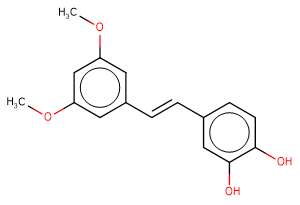
3'-Hydroxypterostilbene
CAS No. 475231-21-1
3'-Hydroxypterostilbene( 3'-HPT )
Catalog No. M21458 CAS No. 475231-21-1
3'-Hydroxypterostilbene a natural pterostilbene analogue effectively inhibits the growth of human colon cancer cells with IC50s of 9.0 40.2 and 70.9 μM for COLO 205 HCT-116 and HT-29 cells respectively by inducing apoptosis and autophagy.
Purity : >98% (HPLC)
 COA
Datasheet
HNMR
HPLC
MSDS
Handing Instructions
COA
Datasheet
HNMR
HPLC
MSDS
Handing Instructions
| Size | Price / USD | Stock | Quantity |
| 1 mL x 10 mM in DMSO | 57 | In Stock |


|
| 2MG | 31 | In Stock |
|
| 5MG | 48 | In Stock |
|
| 10MG | 67 | In Stock |
|
| 25MG | 107 | In Stock |
|
| 50MG | 152 | In Stock |
|
| 100MG | 222 | In Stock |
|
| 200MG | Get Quote | In Stock |
|
| 500MG | Get Quote | In Stock |
|
| 1G | Get Quote | In Stock |
|
Biological Information
-
Product Name3'-Hydroxypterostilbene
-
NoteResearch use only, not for human use.
-
Brief Description3'-Hydroxypterostilbene a natural pterostilbene analogue effectively inhibits the growth of human colon cancer cells with IC50s of 9.0 40.2 and 70.9 μM for COLO 205 HCT-116 and HT-29 cells respectively by inducing apoptosis and autophagy.
-
Description3'-Hydroxypterostilbene a natural pterostilbene analogue effectively inhibits the growth of human colon cancer cells with IC50s of 9.0 40.2 and 70.9 μM for COLO 205 HCT-116 and HT-29 cells respectively by inducing apoptosis and autophagy. 3'-Hydroxypterostilbene inhibits the p38MAPK and PI3K/Akt/mTOR/p70S6K pathways and activates the ERK1/2 JNK1/2 MAPK pathways.
-
In VitroCell Proliferation Assay Cell Line:COLO 205, HCT-116 and HT-29 cell lines Concentration:5, 10, 25 and 50 μM Incubation Time:24 hours Result:Inhibited cell proliferation of COLO 205, HCT-116 and HT-29 cells with IC50s of 9.0, 40.2 and 70.9 μM, respectively.Apoptosis Analysis Cell Line:COLO 205 cells Concentration:5-100 μM Incubation Time:24 hours Result:Induced apoptosis in human colorectal carcinoma cells.Western Blot Analysis Cell Line:COLO 205 cells Concentration:5-50 μM Incubation Time:24 hours Result:Degraded 116 kDa PARP into 85 kDa fragments and induced DFF-45 protein degradation and increased the amounts of LC3B I/II proteins than pterostilbene. Markedly decreased phosphorylation of mTOR, p70S6K (Thr389), PI3K, Akt and p38 MAPK in cells.Cell Autophagy Assay Cell Line:COLO 205 cells Concentration:25 and 50 μM Incubation Time:24 hours Result:Showed an inducing effect on autophagy than pterostilbene in COLO 205 cells.
-
In VivoAnimal Model:3-4 week old BALB/c nude mice with human colorectal carcinoma COLO 205 tumor xenografts Dosage:10 mg/kg Administration:Intraperitoneal injection; 10 mg/kg once per day for 15 days Result:Significantly inhibited tumor volume and tumor weight after 15 days treatment compared with the pterostilbene-treated mice, and decreased the protein levels of COX-2, MMP-9, VEGF, cyclin D1 and pro-caspase-3 in mice.
-
Synonyms3'-HPT
-
PathwayApoptosis
-
TargetApoptosis
-
RecptorApoptosis
-
Research Area——
-
Indication——
Chemical Information
-
CAS Number475231-21-1
-
Formula Weight272.29
-
Molecular FormulaC16H16O4
-
Purity>98% (HPLC)
-
SolubilityDMSO:26 mg/mL (954.83 mM)
-
SMILESCOc1cc(/C=C/c(cc2)cc(O)c2O)cc(OC)c1
-
Chemical Name——
Shipping & Storage Information
-
Storage(-20℃)
-
ShippingWith Ice Pack
-
Stability≥ 2 years
Reference
1.Cheng TC et al. Potent anti-cancer effect of 3'-hydroxypterostilbene in human colon xenograft tumors. PLoS One. 2014 Nov 12;9(11):e111814.
molnova catalog



related products
-
Curzerene
Curzerene is a sesquiterpene is isolated from the rhizome of Curculigo orchioides Gaertn with anti-cancer activity. Curzerene induces cell apoptosis[1].Curzerene inhibits glutathione S-transferase A1 (GSTA1) mRNA and protein expression.
-
MitoBloCK-6
MitoBloCK-6 is a potent Erv1/ALR inhibitor with IC50 values of 900 nM and 700 nM, respectively, and also inhibits Erv2 with an IC50 of 1.4 μM.
-
Hirsutine
Hirsutine induces apoptosis and is a potent Dengue virus inhibitor exhibiting low cytotoxicity.
