


 Cart
 sales@molnova.com


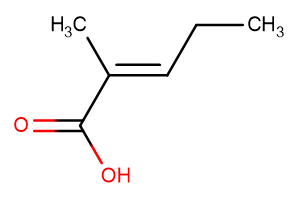
trans-2-Methyl-2-pentenoic Acid
CAS No. 16957-70-3
trans-2-Methyl-2-pentenoic Acid( (E)-2-Methyl-2-pentenoic acid )
Catalog No. M21395 CAS No. 16957-70-3
2-methyl-2-pentenoic acid also known as strawberry acid has a sweet berry-like aroma and flavor and is widely used in food flavor.
Purity : >98% (HPLC)
 COA
Datasheet
HNMR
HPLC
MSDS
Handing Instructions
| Size | Price / USD | Stock | Quantity |
| 1 mL x 10 mM in DMSO | 28 | Get Quote |


|
| 100MG | Get Quote | Get Quote |
|
| 200MG | Get Quote | Get Quote |
|
| 500MG | Get Quote | Get Quote |
|
| 1G | 27 | Get Quote |
|
Biological Information
-
Product Nametrans-2-Methyl-2-pentenoic Acid
-
NoteResearch use only, not for human use.
-
Brief Description2-methyl-2-pentenoic acid also known as strawberry acid has a sweet berry-like aroma and flavor and is widely used in food flavor.
-
Description2-methyl-2-pentenoic acid also known as strawberry acid has a sweet berry-like aroma and flavor and is widely used in food flavor.
-
In Vitro——
-
In Vivo——
-
Synonyms(E)-2-Methyl-2-pentenoic acid
-
PathwayOthers
-
TargetOther Targets
-
RecptorOthers
-
Research Area——
-
Indication——
Chemical Information
-
CAS Number16957-70-3
-
Formula Weight114.14
-
Molecular FormulaC6H10O2
-
Purity>98% (HPLC)
-
SolubilityIn Vitro:?DMSO : 100 mg/mL (876.12 mM)
-
SMILESCC/C=C(\C)/C(O)=O
-
Chemical Name——
Shipping & Storage Information
-
Storage(-20℃)
-
ShippingWith Ice Pack
-
Stability≥ 2 years
Reference
molnova catalog



related products
-
PAR-2 (1-6) (mouse, ...
PAR-2 (1-6) (mouse, rat)
-
Glycerol Tridecanoat...
Glycerol Tridecanoate is also known as triacylglycerols or triacylglycerides. The triglycerides are rebuilt in the blood from their fragments and become constituents of lipoproteins which deliver the fatty acids to and from fat cells among other functions. Various tissues can release free fatty acids and take them up as a source of energy.
-
Salvianolic acid F
The role of our hybrid molecules, an analogue of Salvianolic acid F, in compelling the glioma cells towards apoptosis by specifically perturbing the concentration of glutathione along with caspase 6.
