


 Cart
Cart
 sales@molnova.com


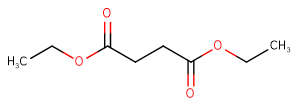
Diethyl succinate
CAS No. 123-25-1
Diethyl succinate( —— )
Catalog No. M21381 CAS No. 123-25-1
Diethyl succinate is the diethyl ester of succinate and acts as an irritant.
Purity : >98% (HPLC)
 COA
Datasheet
HNMR
HPLC
MSDS
Handing Instructions
COA
Datasheet
HNMR
HPLC
MSDS
Handing Instructions
| Size | Price / USD | Stock | Quantity |
| 1 mL x 10 mM in DMSO | 48 | In Stock |


|
| 50MG | 28 | In Stock |
|
| 100MG | Get Quote | In Stock |
|
| 200MG | Get Quote | In Stock |
|
| 500MG | Get Quote | In Stock |
|
| 1G | Get Quote | In Stock |
|
Biological Information
-
Product NameDiethyl succinate
-
NoteResearch use only, not for human use.
-
Brief DescriptionDiethyl succinate is the diethyl ester of succinate and acts as an irritant.
-
DescriptionDiethyl succinate is the diethyl ester of succinate and acts as an irritant.
-
In Vitro——
-
In Vivo——
-
Synonyms——
-
PathwayOthers
-
TargetOther Targets
-
RecptorOthers
-
Research Area——
-
Indication——
Chemical Information
-
CAS Number123-25-1
-
Formula Weight174.19
-
Molecular FormulaC8H14O4
-
Purity>98% (HPLC)
-
SolubilityDMSO:25 mg/mL (1435.21 mM)
-
SMILESCCOC(=O)CCC(=O)OCC
-
Chemical Name——
Shipping & Storage Information
-
Storage(-20℃)
-
ShippingWith Ice Pack
-
Stability≥ 2 years
Reference
1.Zacharias NM et al. Real-time molecular imaging of tricarboxylic acid cycle metabolism in vivo by hyperpolarized 1-(13)C diethyl succinate. J Am Chem Soc. 2012 Jan 18;134(2):934-43.
molnova catalog



related products
-
AG-10
AG-10 (Acoramidis) is an orally active and selective kinetic stabilizer of TTR (transthyretin). AG-10 exhibits activity for WT and V122I-TTR. AG-10 is used in the study of transthyretin amyloidosis.
-
naphthalene-1,3,6,8-...
The pentaketide 1,3,6,8-tetrahydroxynaphthalene (T4HN) is a key precursor of 1,8-dihydroxynaphthalene-melanin.
-
Dicyclo hexyl Phthal...
Dicyclo hexyl Phthalate
