


 Cart
Cart
 sales@molnova.com


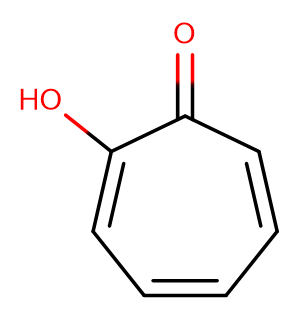
Tropolone
CAS No. 533-75-5
Tropolone( —— )
Catalog No. M21356 CAS No. 533-75-5
Tropolone a metal chelator possesses weak antioxidative and radical-scavenging properties and shows a strong affinity for ferric ion.
Purity : >98% (HPLC)
 COA
Datasheet
HNMR
HPLC
MSDS
Handing Instructions
COA
Datasheet
HNMR
HPLC
MSDS
Handing Instructions
| Size | Price / USD | Stock | Quantity |
| 1 mL x 10 mM in DMSO | 28 | Get Quote |


|
| 100MG | 27 | Get Quote |
|
| 200MG | Get Quote | Get Quote |
|
| 500MG | Get Quote | Get Quote |
|
| 1G | Get Quote | Get Quote |
|
Biological Information
-
Product NameTropolone
-
NoteResearch use only, not for human use.
-
Brief DescriptionTropolone a metal chelator possesses weak antioxidative and radical-scavenging properties and shows a strong affinity for ferric ion.
-
DescriptionTropolone a metal chelator possesses weak antioxidative and radical-scavenging properties and shows a strong affinity for ferric ion.
-
In Vitro——
-
In Vivo——
-
Synonyms——
-
PathwayProteasome/Ubiquitin
-
TargetTyrosinase
-
RecptorTyrosinase
-
Research Area——
-
Indication——
Chemical Information
-
CAS Number533-75-5
-
Formula Weight122.12
-
Molecular FormulaC7H6O2
-
Purity>98% (HPLC)
-
SolubilityDMSO:24 mg/mL (196.52 mM)
-
SMILESC1=CC=C(C(=O)C=C1)O
-
Chemical Name——
Shipping & Storage Information
-
Storage(-20℃)
-
ShippingWith Ice Pack
-
Stability≥ 2 years
Reference
1.Kahn V Andrawis A . Inhibition of mushroom tyrosinase by tropolone[J]. Phytochemistry 1985 24(5):905-908.
molnova catalog



related products
-
D-Tyrosine
D-Tyrosine negatively regulates melanin synthesis by inhibiting tyrosinase activity. D-Tyrosine is the D-isomer of tyrosine. D-Tyrosine inhibits biofilm formation and trigger the self-dispersal of biofilms without suppressing bacterial growth.
-
Methyl rosmarinate
Methyl rosmarinate is a noncompetitive tyrosinase inhibitor which is isolated from Rabdosia serra, with an IC50 of 0.28 mM for mushroom tyrosinase.Methyl rosmarinate shows antioxidative, and antifungal activities.?It has inhibitory activities against tyrosinase, α±-glucosidase, and matrix metalloproteinase-1 (MMP-1).
-
RO495
RO495, a potent inhibitor of TYK2, inhibits TYK2 with IC50 of 1.5nM as tested in cell-based pharmacological assays.
