


 Cart
Cart
 sales@molnova.com


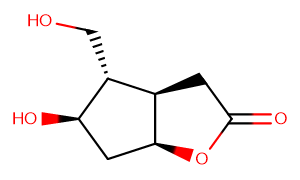
Corey Lactone Diol
CAS No. 32233-40-2
Corey Lactone Diol( (-)-Corey lactone diol )
Catalog No. M21346 CAS No. 32233-40-2
Corey Lactone Diol is a pharmaceutical intermediate.
Purity : >98% (HPLC)
 COA
Datasheet
HNMR
HPLC
MSDS
Handing Instructions
COA
Datasheet
HNMR
HPLC
MSDS
Handing Instructions
| Size | Price / USD | Stock | Quantity |
| 100MG | Get Quote | In Stock |


|
| 200MG | 27 | In Stock |
|
| 500MG | Get Quote | In Stock |
|
| 1G | Get Quote | In Stock |
|
Biological Information
-
Product NameCorey Lactone Diol
-
NoteResearch use only, not for human use.
-
Brief DescriptionCorey Lactone Diol is a pharmaceutical intermediate.
-
DescriptionCorey Lactone Diol is a pharmaceutical intermediate.
-
In Vitro——
-
In Vivo——
-
Synonyms(-)-Corey lactone diol
-
PathwayOthers
-
TargetOther Targets
-
RecptorOthers
-
Research Area——
-
Indication——
Chemical Information
-
CAS Number32233-40-2
-
Formula Weight172.18
-
Molecular FormulaC8H12O4
-
Purity>98% (HPLC)
-
SolubilityDMSO:34 mg/mL (197.46 mM)
-
SMILESOC[C@H]([C@@H](C1)[C@H](C2)OC1=O)[C@@H]2O
-
Chemical Name——
Shipping & Storage Information
-
Storage(-20℃)
-
ShippingWith Ice Pack
-
Stability≥ 2 years
Reference
1.Achmatowicz B Baranowska E Daniewski A R et al. A novel approach to prostaglandins from the corey lactone involving BF3-mediated reactions of a sulphone and aldehydes[J]. Tetrahedron Letters 1985 26(45):5597–5600.
molnova catalog



related products
-
2-Ethyl-5-methylphen...
2-Ethyl-5-methylphenol is an alkylphenol that can be isolated or identified from Penicillium aurantiogriseum, P. verrucosum and P. viridicatum.
-
Sarmazenil
Sarmazenil (Ro 15-3505) is a partial inverse agonist at the benzodiazepine receptor with pro-convulsant properties and is used in the study of chronic hepatic encephalopathy (HE).
-
TES
TES is used to make buffer solutions in the pH range 6.8-8.2. TES has a pKa value of 7.550 (at 25°C).
