


 Cart
Cart
 sales@molnova.com


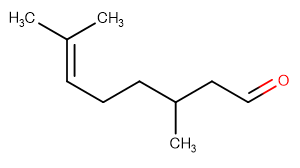
Citronellal
CAS No. 106-23-0
Citronellal( (±)-Citronellal )
Catalog No. M21327 CAS No. 106-23-0
Citronellal is a monoterpene predominantly formed by the secondary metabolism of plants producing antithrombotic antiplatelet and antihypertensive activities.
Purity : >98% (HPLC)
 COA
Datasheet
HNMR
HPLC
MSDS
Handing Instructions
COA
Datasheet
HNMR
HPLC
MSDS
Handing Instructions
| Size | Price / USD | Stock | Quantity |
| 1 mL x 10 mM in DMSO | 29 | In Stock |


|
| 100MG | Get Quote | In Stock |
|
| 200MG | Get Quote | In Stock |
|
| 500MG | Get Quote | In Stock |
|
| 1G | 28 | In Stock |
|
Biological Information
-
Product NameCitronellal
-
NoteResearch use only, not for human use.
-
Brief DescriptionCitronellal is a monoterpene predominantly formed by the secondary metabolism of plants producing antithrombotic antiplatelet and antihypertensive activities.
-
DescriptionCitronellal is a monoterpene predominantly formed by the secondary metabolism of plants producing antithrombotic antiplatelet and antihypertensive activities.
-
In Vitro——
-
In Vivo——
-
Synonyms(±)-Citronellal
-
PathwayOthers
-
TargetOther Targets
-
RecptorOthers
-
Research Area——
-
Indication——
Chemical Information
-
CAS Number106-23-0
-
Formula Weight154.25
-
Molecular FormulaC10H18O
-
Purity>98% (HPLC)
-
SolubilityIn Vitro:?DMSO : 100 mg/mL (648.30 mM)
-
SMILESCC(CCC=C(C)C)CC=O
-
Chemical Name6-Octenal 37-dimethyl-
Shipping & Storage Information
-
Storage(-20℃)
-
ShippingWith Ice Pack
-
Stability≥ 2 years
Reference
1.Lu J X Guo C Ou W S et al. Citronellal prevents endothelial dysfunction and atherosclerosis in rats[J]. Journal of Cellular Biochemistry 2018.
molnova catalog



related products
-
Sodium Hyaluronate
Hyaluronic acid (HA) is an anionic nonsulfated glycosaminoglycan distributed widely throughout connective epithelial and neural tissues. It is unique among glycosaminoglycans in that it is nonsulfated forms in the plasma membrane instead of the Golgi and can be very large with its molecular weight often reaching the millions.
-
NCGC00229600
NCGC00229600 is an allosteric inverse thyrotropin receptor (TSHR) agonist.
-
H-Gly-Arg-Ala-Asp-Se...
H-Gly-Arg-Ala-Asp-Ser-Pro-Lys-OH
